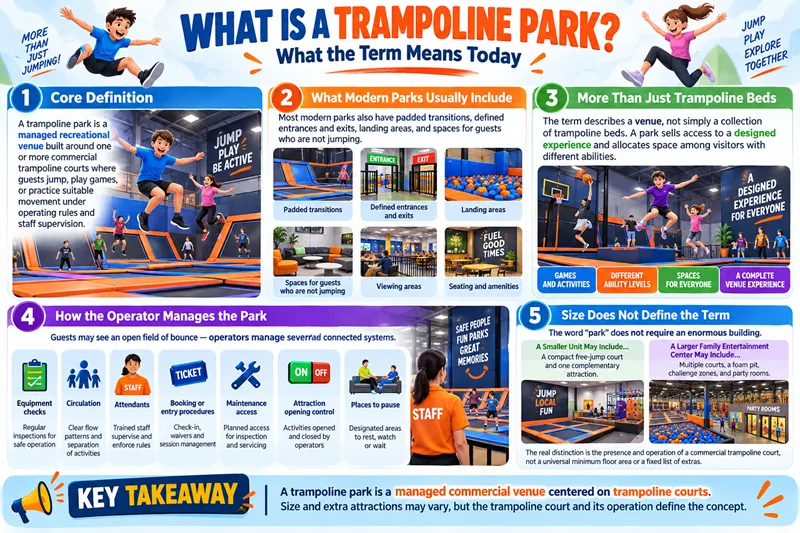
What the Term Means Today
What is a trampoline park? It is a managed recreational venue built around one or more commercial trampoline courts where guests jump, play games, or practice suitable movement under operating rules and staff supervision. Most modern parks also have padded transitions, defined entrances and exits, landing areas, and spaces for guests who are not jumping. Some add climbing, obstacle courses, slides, parties, or food service. Those additions can change the business mix, but the trampoline court remains the defining attraction.
That definition describes a venue, not simply a collection of beds. A park sells access to a designed experience, allocates space among visitors with different abilities, checks its equipment, and controls when an attraction can open. It needs circulation, attendants, booking or entry procedures, maintenance access, and places to pause. The customer may see an open field of bounce; the operator manages several connected systems.
The word “park” does not require an enormous building. A smaller unit may have a compact free-jump court and one complementary attraction. A large family entertainment center can contain multiple courts, a foam pit, challenge zones, and party rooms. The relevant distinction is the presence and operation of a commercial trampoline court, not a universal minimum floor area or a fixed list of extras.
Where the Trampoline Court Begins and Ends
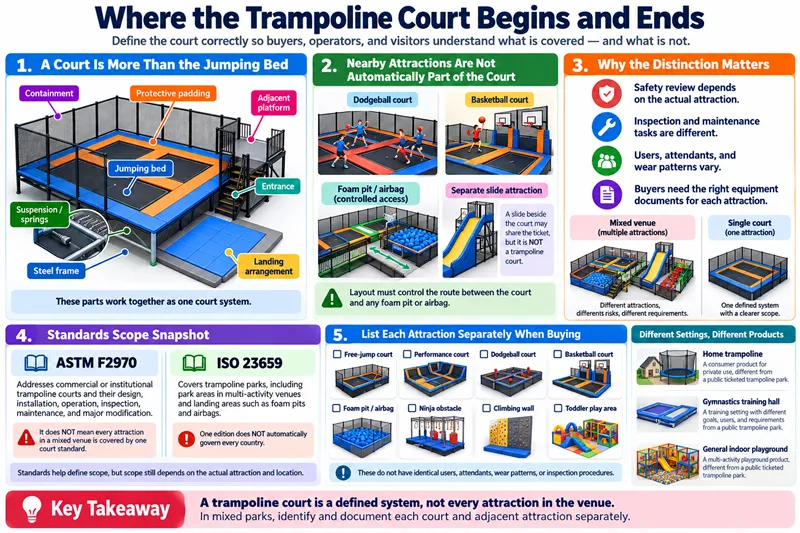
A court includes more than its jumping surface. The bed, suspension, frame, padding, containment, entrances, adjacent platforms, and landing arrangement work together. Games such as trampoline dodgeball or basketball use that system differently from ordinary free jumping. The layout must also control the path between the bed and any foam pit or airbag. A slide beside the court may be part of the venue, but it does not become a trampoline court merely by sharing a ticket.
This distinction matters when discussing safety requirements. ASTM's F2970 scope addresses commercial or institutional trampoline courts and their design, installation, operation, inspection, maintenance, and major modification. It explicitly excludes several other devices and attractions. ISO 23659's abstract describes requirements for trampoline parks, including park areas within multi-activity venues and landing areas such as foam pits and airbags. Neither reference means that every attraction in a mixed venue is covered by one court standard, or that one edition automatically governs every country.
A home trampoline is a different product and use setting. A gymnastics training hall may contain trampolines without operating as a ticketed public park. A general indoor playground may include soft play with no rebound court at all. These differences help visitors understand the experience and help buyers request the right equipment documentation for the location.
When selecting trampoline park equipment, list each court and adjacent attraction separately. A free-jump bed, performance court, ninja obstacle, climbing wall, and toddler play area do not have identical users, attendants, wear patterns, or inspection procedures.
Before Parks: A Rebound Device Becomes a Sport
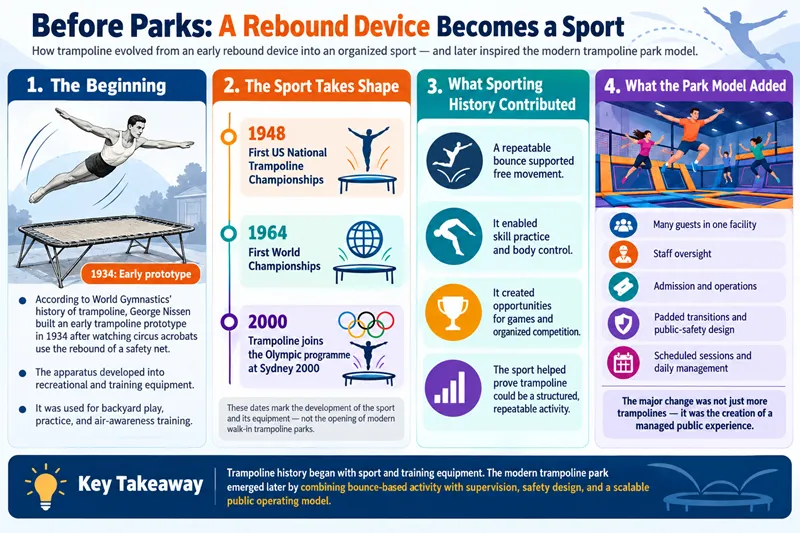
The story begins decades before commercial indoor parks. According to World Gymnastics' history of trampoline, George Nissen built an early trampoline prototype in 1934 after watching circus acrobats use a safety net's rebound. The apparatus developed into recreational and training equipment. It was used for activities ranging from backyard play to air-awareness training, while organized competition followed its own path.
The first US national trampoline championships were held in 1948, and the first world championships in 1964. Trampoline became part of the Olympic programme at Sydney 2000. These dates describe the development of the sport and its equipment. They do not mark the opening of a modern walk-in trampoline park.
The sporting history still shaped the commercial idea. A repeatable bounce could support free movement, skill practice, and games. What the later park model added was a facility designed for many guests, staff oversight, admission, padded transitions, and an operating schedule. The change was as much about managing a public experience as about installing more trampolines.
The 2004 Commercial Park Milestone
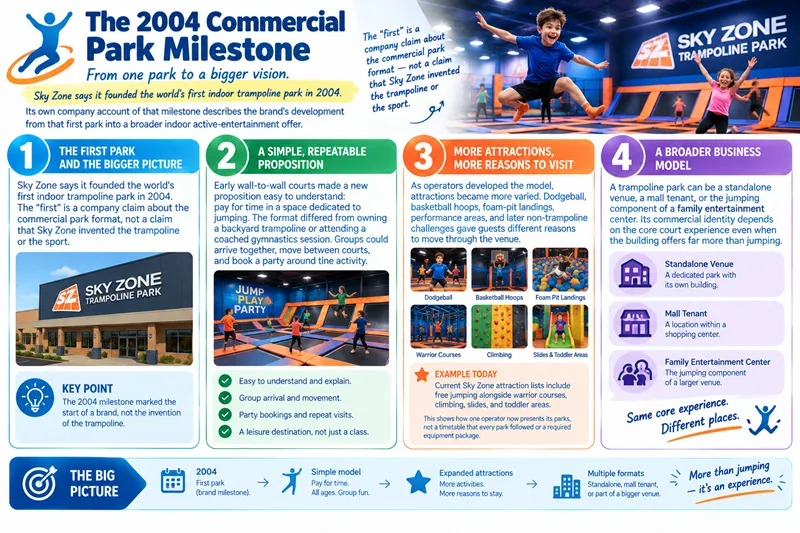
Sky Zone says it founded the world's first indoor trampoline park in 2004. Its own company account of that milestone describes the brand's development from that first park into a broader indoor active-entertainment offer. The “first” is a company claim about the commercial park format; it is not a claim that Sky Zone invented the trampoline or the sport.
Early wall-to-wall courts made a new proposition easy to understand: pay for time in a space dedicated to jumping. The format differed from owning a backyard trampoline or attending a coached gymnastics session. Groups could arrive together, move between courts, and book a party around the activity. That made the facility a repeatable leisure destination as well as a place to bounce.
As operators developed the model, attractions became more varied. Dodgeball, basketball hoops, foam-pit landings, performance areas, and later non-trampoline challenges gave guests different reasons to move through the venue. Current Sky Zone attraction lists, for example, include free jumping alongside warrior courses, climbing, slides, and toddler areas. This is evidence of how one operator now presents its parks, not a timetable that every park followed or a required equipment package.
The business vocabulary broadened too. A trampoline park can be a standalone venue, a mall tenant, or the jumping component of a family entertainment center. Its commercial identity depends on the core court experience even when the building offers far more than jumping.
Why Today's Parks Often Look Like Mixed Activity Centers
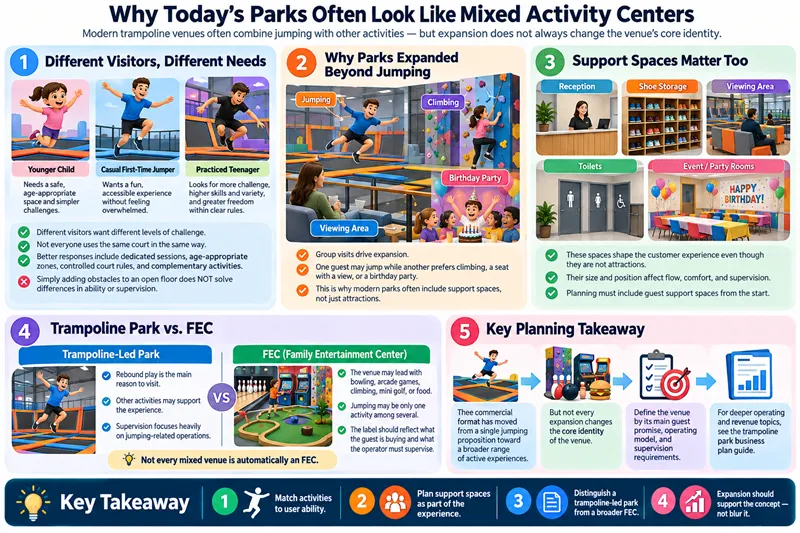
Different visitors want different levels of challenge. A younger child, a casual first-time jumper, and a practiced teenager may not use the same court in the same way. A park can respond with dedicated sessions, age-appropriate zones, controlled court rules, and complementary activities. Simply adding obstacles to an open floor does not solve differences in ability or supervision.
The expansion also reflects group visits. One member may jump while another prefers a climbing challenge, a seat with a view, or a birthday party. This is why a contemporary park often includes reception, shoe storage, viewing areas, toilets, and event rooms in its planning. Their sizes and positions affect the experience even though they are not attractions.
Calling every mixed venue an FEC can hide an important difference. A trampoline-led park makes rebound play the main reason to visit. An FEC may instead lead with bowling, arcade games, climbing, mini golf, or food and include jumping as one of several activities. The label should reflect what the guest is buying and what the operator must supervise, rather than the number of logos on an equipment proposal.
The trampoline park business plan guide deals with the operating and revenue questions in more detail. For this article, the point is definitional: the commercial format has moved from a single jumping proposition toward a range of active experiences, but not every expansion changes the core identity of the venue.
Future Direction One: Mix Activities With a Clear Purpose
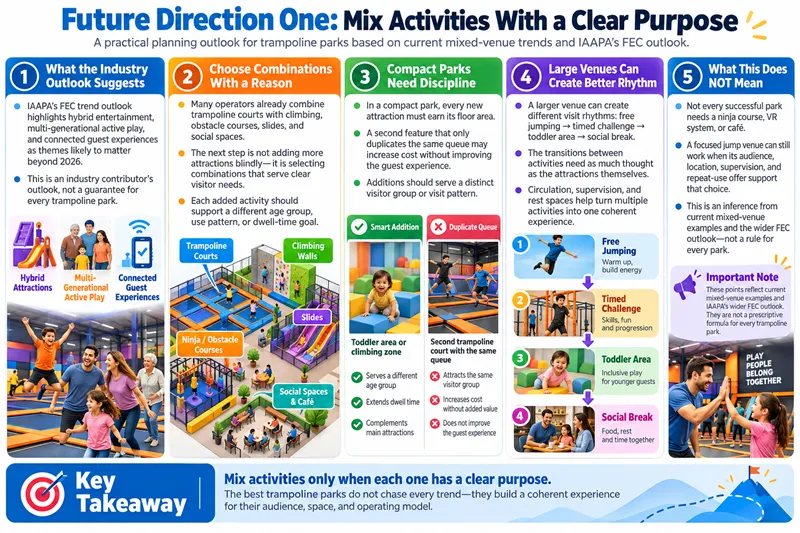
An IAAPA article on emerging FEC trends argues that hybrid entertainment, multi-generational active play, and connected guest experiences are likely to matter beyond 2026. It is an industry contributor's outlook, not a guarantee for every trampoline park. Existing operators already combine courts with climbing, obstacle courses, slides, and social spaces. The plausible next step is more deliberate selection of those combinations.
For a compact park, another attraction should earn its floor area by serving a distinct visitor group or visit pattern. A second feature that only duplicates the same queue may add cost without improving the experience. A larger venue can create different rhythms: free jumping, a timed challenge, a toddler area, then a break. The transitions between those activities need as much thought as their individual structures.
This is an inference from current mixed-venue examples and the wider FEC outlook. It does not mean that every successful park must install a ninja course, virtual reality system, or café. A focused jump venue can remain coherent if its audience, location, supervision, and repeat-use offer support that choice.
Future Direction Two: Connect the Visit, Not Just the Game
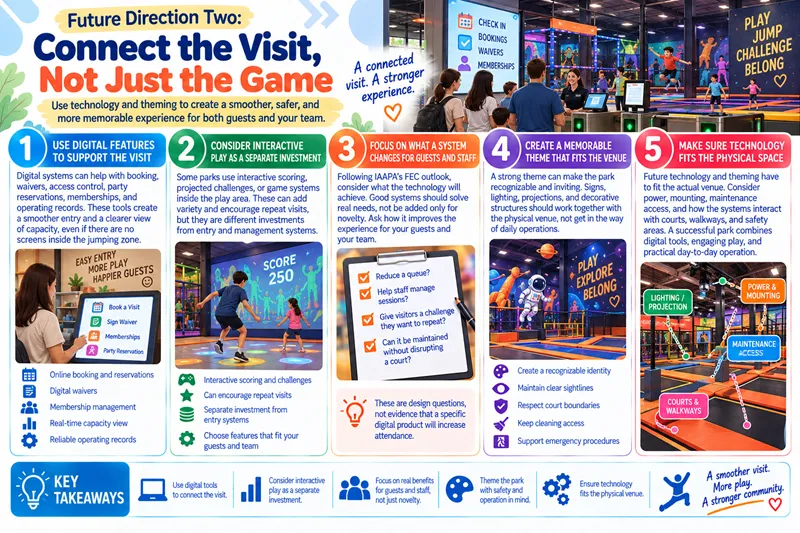
Digital features can support booking, waivers, access control, party reservations, memberships, and operating records. Some parks may also use interactive scoring or projected challenges. Those are different investments. A smoother entry and a reliable capacity view can help a busy venue even if no screen appears inside the jumping zone.
IAAPA's FEC outlook describes connected operations and cautions against technology added only for its novelty. For trampoline parks, this suggests asking what a system changes for the guest and the team: Does it reduce a queue? Help staff manage sessions? Give visitors a challenge they want to repeat? Can it be maintained without disrupting a court? These are design questions, not evidence that a specific digital product will increase attendance.
The same discipline applies to theming. A memorable identity can make the park recognizable, but signs, lighting, projections, or decorative structures must coexist with sightlines, court boundaries, cleaning access, and emergency procedures. Future technology has to fit the physical venue.
Future Direction Three: Design for More Users and Longer Service
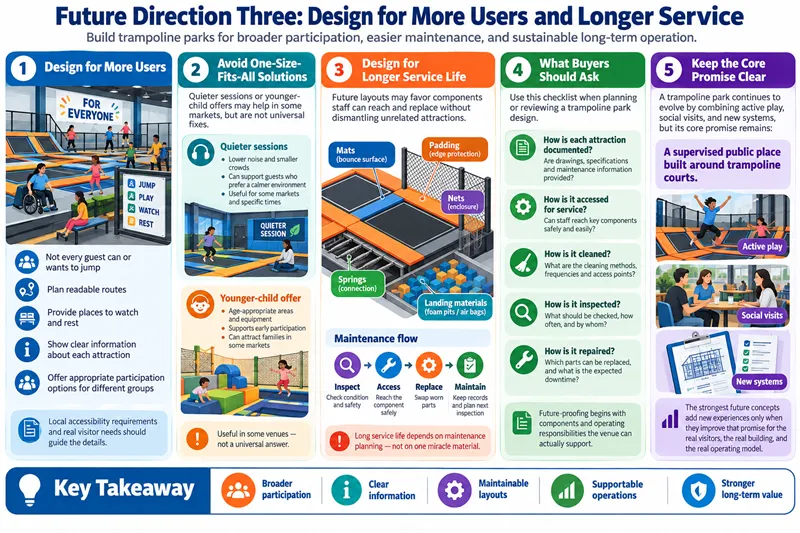
Accessibility and varied participation deserve more than a single attraction labeled “for everyone.” Not every guest can or wants to jump. Operators can plan readable routes, places to watch and rest, clear information about each attraction, and appropriate ways for different groups to participate. Local accessibility requirements and the needs of the intended visitors guide the details. A quieter session or a distinct younger-child offer may be useful in some markets, but neither should be presented as a universal fix.
The physical park also needs a service life. Mats, padding, nets, springs, and landing materials have different inspection and replacement needs. Future designs may favor layouts where staff can reach and replace those components without dismantling unrelated attractions. That is a planning inference grounded in how commercial courts must be inspected and maintained; it is not a prediction of one new material that will make wear disappear.
Buyers comparing commercial playground equipment companies should ask how each proposed attraction is documented, accessed, cleaned, inspected, and repaired. A trampoline equipment park project needs a plan for courts and non-jump areas alike. Future-proofing begins with components and operating responsibilities that the venue can actually support.
The meaning of a trampoline park will keep evolving as operators combine active play, social visits, and new systems. Its defining promise remains clear: a supervised public place built around trampoline courts. The strongest future concepts will show how every added experience improves that promise for the particular visitors and building, with the necessary operations to sustain it.
FAQ
What is a trampoline park in simple terms?
A trampoline park is a staffed recreational venue where commercial trampoline courts form the main activity. Guests may free-jump, play a court game, or use a suitable landing feature under the park's rules. The venue usually includes padding, controlled access, attendants, and support spaces such as reception and seating. Many parks now add climbing, slides, obstacle courses, or parties, but those extras are not required for the basic definition. The important distinction is that the operator runs a public court experience; owning several individual trampolines does not by itself create a managed park.
When were trampoline parks invented?
The trampoline and the commercial park have different histories. World Gymnastics dates George Nissen's early trampoline prototype to 1934. Organized championships followed, and trampoline became an Olympic discipline in 2000. Sky Zone says it founded the first indoor trampoline park in 2004. That last date refers to the commercial, multi-user park model, not the invention of the apparatus or the beginning of competitive trampolining. Other businesses subsequently developed different formats. When recounting the history, it is more accurate to identify which milestone is being discussed than to give one date for everything.
What activities can a trampoline park include?
Free-jump courts are the common starting point. A park may also include trampoline dodgeball, basketball-style games, performance courts, foam pits or airbags designed as landing areas, and adjoining attractions such as ninja courses, climbing, slides, or toddler play. The actual mix depends on the building, intended ages, staffing, and applicable requirements. Activities without a trampoline bed may be part of the same venue while following different equipment guidance. Adding every available attraction is not necessary; the operator should be able to explain the purpose, supervision, capacity, and maintenance plan for each zone.
Is a trampoline park the same as a family entertainment center?
They can overlap, but the terms describe different emphases. A trampoline park leads with commercial rebound courts, even if it offers parties, climbing, or food. A family entertainment center can combine many attractions and may or may not include trampolines. A large venue can reasonably be both if jumping is a prominent part of a wider entertainment offer. The distinction helps visitors understand what they will do and helps operators plan staffing and equipment documentation. It does not create one worldwide licensing category; the local authority and the actual attractions determine applicable requirements.
What is the future of trampoline parks?
The likely direction is a more intentional mix of active experiences, visitor services, and connected operations. Existing parks already pair jumping with obstacle courses, climbing, slides, and group events. Industry commentary also points toward accessible, multi-generational play and technology that simplifies booking and operations. These are trends and planning opportunities, not promises that a particular attraction or app will bring more customers. A park should choose additions that fit its audience and space, preserve supervision and maintenance access, and measure whether visitors actually use and return for the experience.