
Stop treating a trampoline park like a giant playroom. It is not. This is a heavy-asset, high-risk, structural engineering game. Most investors fail before they even open their doors because their trampoline park business plan is built on naive assumptions. They count ticket sales in their heads, buy cheap equipment, and completely ignore the brutal reality of personal injury lawsuits, structural physics, and cash flow starvation. I've been in the trampoline park industry for ten years. I've built trampoline parks all over the world. I've witnessed investors create money-making machines, and I've seen investors go bankrupt trying to cut corners on safety mats. I don't work on theoretical business models; I only do real business, with steel frames, galvanised springs, rigorous safety certifications, and real money.
If you want to survive in this industry, you must understand one fundamental truth: A trampoline park is not an equipment business. It is a safety, operations, and cash flow management business. Your biggest risk is not a lack of customers. Your biggest risk is a single, catastrophic accident. Here is the unfiltered blueprint. I am giving you the exact metrics, the exact ratios, and the exact warnings you must write into your business plan.
The Budget Black Hole: Three Hidden Costs That Will Destroy You
Newcomers often see a huge warehouse, get equipment quotes, and think they've got the whole investment figured out. They're wrong. In this industry, it's not just about the equipment quotes; there are three hidden costs that, if ignored, mean all your effort is wasted.
•First: The Insurance Nightmare. You must factor in Employer Liability Insurance and Commercial Public Liability Insurance. In the US and European markets, insurance underwriters are ruthless. If your equipment does not have strict ASTM (US) or EN (Europe) certificates from a top-tier factory, insurance companies will directly reject your application. If you somehow get coverage, your premiums will skyrocket. Without coverage, when an accident happens, you pay out of your own pocket and go bankrupt. A normal, healthy insurance cost should consume exactly 3%–5% of your total investment annually. It is a continuous, non-negotiable cost.
•Second: The Safety and Training System. Accidents rarely happen because a high-quality spring snaps. They happen because your minimum-wage teenager staff failed to stop a customer from doing a dangerous double backflip into a crowded foam pit. Your budget must include high salaries for trained safety officers, a rigorous internal training system, and an ironclad legal waiver system.
•Third: The 6-Month Cash Flow Reserve. You must reserve 3 to 6 months of fixed-cost cash flow to prevent a broken capital chain in your early stages. If you open in a slow month, you still have to pay rent, electricity, and payroll.
Here is the only standard budget ratio you should follow:
Equipment Procurement: 30%–50%
Venue Rent (Deposit + First Term): 10%–15%
Renovation & Fire Safety: 20%–30%
Insurance: 3%–5%
Operating Cash Flow (6 Months): 10%–25%
The Ceiling Death Line: Master the Vertical Space Business
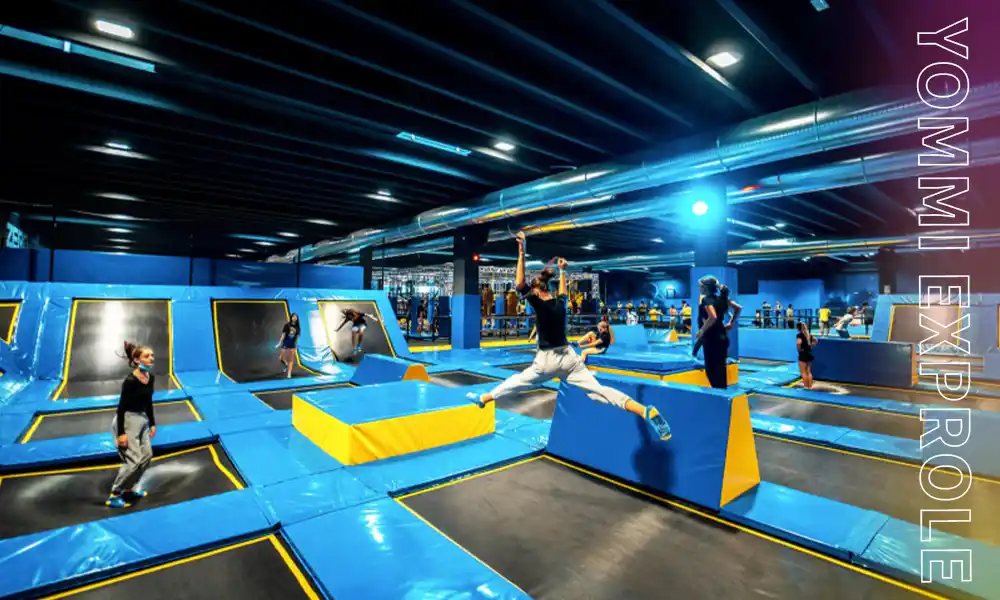
Trampoline parks are not ground sports. They are a vertical space business. Your ceiling height is a hard, physical requirement. There is absolutely zero room for optimisation or negotiation here.
If you want to build a safe trampoline park, follow these exact numbers:
Free Jump Zone Minimum Clear Height: > 4.0 meters
High-Performance Zone Minimum Clear Height: > 6.0 meters
Do not rent a cheap 5-meter warehouse and ask me to install professional Olympic trampolines. If you ignore this hard requirement, the consequences are horrific. A player will bounce off the high-performance bed and smash their head into your concrete ceiling or steel beams. A standard flip instantly becomes a "cervical spine risk action." You will never pass your insurance safety audit, and high-end, serious jumpers will immediately abandon your park. Height is survival.
Materials and Lawsuits: The 20% Trap That Bankrupts Parks
You think you are a genius for finding cheap trampoline park trampolines for sale from a local middleman? Let me expose the truth about manufacturing costs.
The cost difference between cheap trash and safe material is painfully obvious in the safety pads. Low-end pads use a thin PVC skin wrapping cheap, low-density foam. High-standard, professional pads use high-density EPE core wrapped in ultra-thick, tear-resistant PVC. The core difference is whether the material can pass the rigorous ASTM or EN impact tests. The overall price difference between the two is only about 20%.
Is saving 20% worth losing everything? Listen to this real case from my factory. I had a client in Guatemala who ignored my warnings. To save money, he bought low-end, thin soft pads from a cheap supplier. Three months after opening, a heavy adult jumped near the edge, bottomed out through the thin pad, and smashed directly into the hard steel frame beneath. The client faced massive medical compensation payouts that instantly wiped out his operating capital. Buy certified materials. It is your only shield against lawsuits.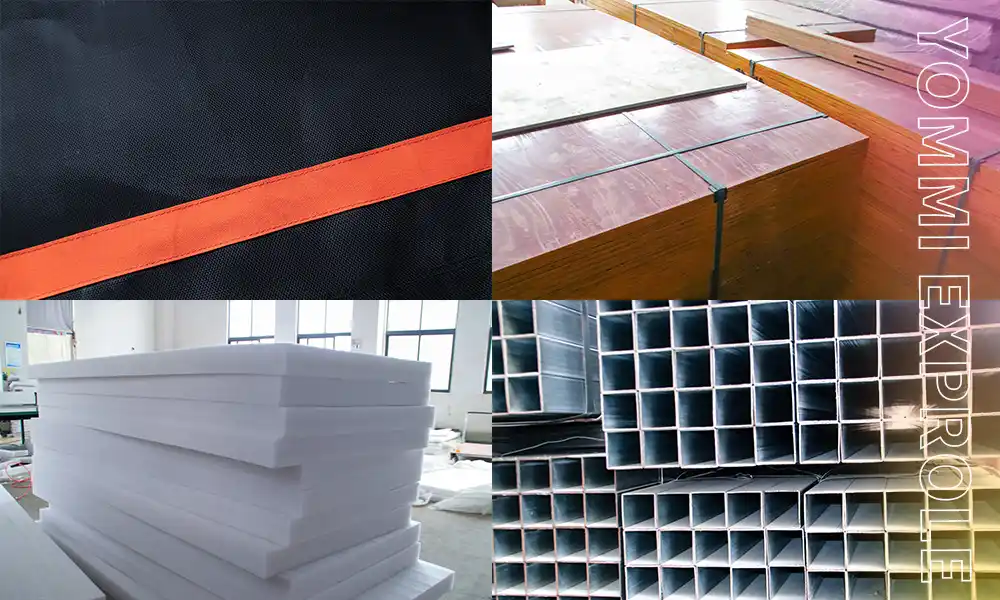
Scientific Capacity and the ROI Reality Check
Stop lying to your investors about a 6-month payback period. Let’s look at the math for a standard 1,000 square meter (approx. 10,700 sq.ft) venue.
The international safety standard dictates 3 to 5 square meters per person. Therefore, the absolute maximum safe capacity for a 1,000-seat㎡ venue is 200 to 350 people. However, I strongly advise my clients to deliberately control their operations at 70% capacity. By doing this, you drastically reduce the chaos on the jumping courts, and your accident rate drops exponentially. Insurance companies love parks with controlled capacity.
Here is the brutally honest Return on Investment (ROI) timeline you must put in your trampoline park business plan:
Excellent Performance: 12–18 months
Normal Performance: 18–30 months
Poor Operations: You will never break even.
Zoning for Profit: Why Pure Jumping is a Dead End
If you cover your entire floor with basic free jump trampolines, you will fail. Pure trampoline jumping is actually very boring. Customers will jump for 20 minutes, get exhausted, leave, and never come back. Your true profit does not come from the trampoline itself. It comes from "crowds + social scenes."
Here is the exact zoning ratio you need to maximise your revenue per square meter:
Trampoline Zones (Free Jump, Pro Zone): 40%
Indoor play / Soft Play (For younger siblings): 20%
Extra Interactive Sports (Basketball, Bubble Football, Ninja): 20%
High-End Party Rooms: 10%
Rest & Observation Areas: 10%
Pay close attention to that 10% allocated to Party Rooms. Why? Because party rooms are the ultimate profit engine. They command a massive single-session price ticket. They offer high social sharing (parents posting photos online). Most importantly, they guarantee a high repurchase rate. You sell an experience, not a piece of canvas.
The Invisible Goldmine: Grip Socks and Secondary Consumption
Do not rely purely on admission tickets to pay your rent. If you do, your margins will be razor-thin. The hidden wealth in this industry lies in secondary consumption.
You must mandate the purchase of custom-branded grip socks for safety reasons. The markup on a pair of grip socks is staggering. Combine that with a well-designed food and beverage (F&B) station. Parents will sit in the rest area for hours while their kids jump, drinking expensive coffee and eating snacks. In a healthy trampoline park project, this secondary consumption must account for more than 20% of your total gross revenue. Build it into your financial model from day one.
The Installation Nightmare: It Is Not Assembly, It Is Engineering
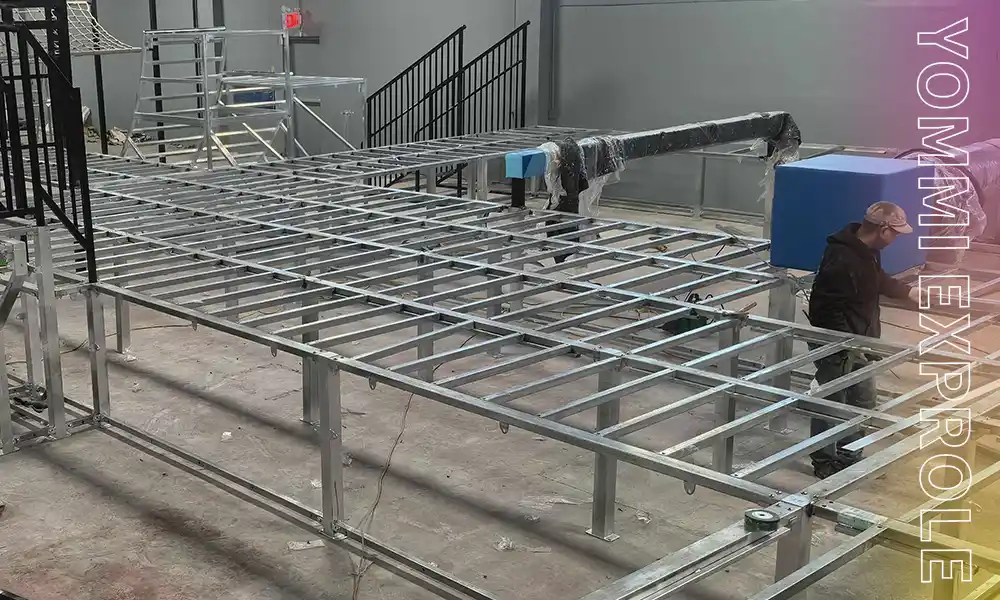
You want to hire cheap, inexperienced local contractors to put your park together? Stop. Trampoline installation is not "furniture assembly." It is heavy structural engineering. When workers with no trampoline experience touch your park, they make fatal errors. I have seen it a hundred times. Here are the three most common disasters:
1. Uneven Spring Tension: They pull the springs in the wrong order. This leads directly to localised mat collapse when a heavy person jumps on it.
2. Uncalibrated Steel Frames: They bolt the frames together without proper levelling. This leads to long-term structural deformation under the massive kinetic stress of daily jumping.
3. Weak Ground Anchoring: They use cheap concrete anchors. After two months of teenagers bouncing, the entire steel structure shifts across your floor.
As a premium indoor playground supplier, we refuse to let local amateurs ruin our equipment. We send our factory veterans. We torque every bolt and tension every spring to exact engineering specifications.
.
Depreciation, Warranties, and the 5%-10% Rule
Don't believe salespeople promising "lifetime warranties" on trampolines. That's a lie. Under the intense demands of commercial operation, the trampoline, galvanised springs, and PVC padding will all suffer significant physical fatigue.
Typically, reputable manufacturers offer reliable warranties on equipment components. When choosing a manufacturer, make sure they offer this warranty, as it can save you a considerable amount of money in the first two years.
However, in your long-term financial planning, you must allocate a substantial maintenance budget. You must conduct weekly safety checks. If a spring is stretched or deformed, replace it; if the seams of the pad are worn, replace it. Therefore, you must allocate approximately 5% of your budget for maintenance. If you try to cut corners on this 5%, a customer might step on a broken pad, break their leg, and your business will be over.
Slaughtering Franchise Giants in Your Territory
What happens if you secure the perfect location, but there is a massive Sky Zone or another corporate franchise park just a few miles away? Do not panic, and do not fight them on ticket prices. You will fail. Large franchise brands have one fatal weakness: extreme standardisation. They offer the exact same layout everywhere. They lack freshness. Here is how your business plan will outline a strategy to steal their traffic:
•First, build a Differentiated Experience. Commit to innovative gameplay. Install extreme Ninja Warrior challenge courses, integrate interactive e-sports projection games with physical sports, and build things the chains are too slow to adopt.
•Second, highlight Strong Social Attributes. Shift your marketing focus heavily toward corporate team-building events and massive school physical education partnerships. Sell out your park on Tuesday mornings to local schools.
•Third, execute Localised Operations. Corporate chains are rigid. You are flexible. Set up an aggressive, highly discounted community membership system. Use local short-video marketing to target parents within a 10-mile radius. Infiltrate campus channels directly. Your advantage is your operational flexibility.
I will say it one last time to hammer it into your head: A trampoline park is not about buying equipment. It is entirely about mastering safety, operations, and cash flow. Get these right, and you will dominate your market.
Hardcore B2B FAQ
Q: Can I negotiate or optimise the ceiling height to fit an Olympic trampoline zone into a cheaper 5-meter building?
No. Ceiling height is a hard, physical requirement in a vertical space business, and there is absolutely zero room for optimisation.
My Experience: I constantly see investors trying to squeeze professional trampolines into low warehouses. The rule is simple: a free jump requires over 4 meters, and a professional jump requires over 6 meters. If you put an Olympic trampoline in a 5-meter room, players will hit the ceiling. Flips directly become a "cervical spine risk action." You will instantly fail your insurance audit, and high-end players will simply go to your competitor. Height is non-negotiable.
Q: Is it really worth paying a 20% premium for ASTM-certified safety pads instead of buying cheap local foam?
No. Buying cheap, non-certified materials leads directly to devastating injuries and massive compensation payouts.
My Experience: The cost gap between low-end thin PVC with low-density foam and high-standard thick PVC with high-density EPE is only about 20%. I had a client in Guatemala who bought thin pads to save money. A jumper bottomed out through the pad, hit the steel frame, and the client faced a crippling lawsuit. You must buy materials with strict ASTM or EN certification. It is the only way to protect your business and keep your insurance premiums low.
Q: Can I hit my ROI targets by dedicating my entire floor space purely to trampolines?
No. Pure trampoline areas are boring, and the true profit comes from a mixed social scene, not the jumping itself.
My Experience: If you build a 100% trampoline park, customers leave after 20 minutes and don't come back. You must mix it up. Limit trampolines to 40%. Dedicate 20% to a naughty castle for toddlers, 20% to interactive sports like basketball, and critically, 10% to high-end party rooms. Party rooms command high single-session prices, drive social sharing, and guarantee repeat business. Profit is generated by keeping diverse age groups in the building for hours.


