I have been manufacturing and exporting commercial indoor playground and trampoline equipment for over 10 years. In my dealings with hundreds of Western clients, I see the same brutal reality play out: when investors start searching for trampoline park equipment for sale, they spend months negotiating prices and looking at pretty 3D renders, but they know absolutely nothing about local compliance.
No matter how beautiful your equipment is, if you cannot get your Certificate of Occupancy (CO), that equipment is just a pile of scrap metal sitting in a warehouse. In North America and Europe, local building departments, fire marshals, and safety inspectors are incredibly strict. Today, I am going to break down the core requirements for trampoline park compliance from the perspective of a source manufacturer. This guide will help you navigate the permitting death traps.
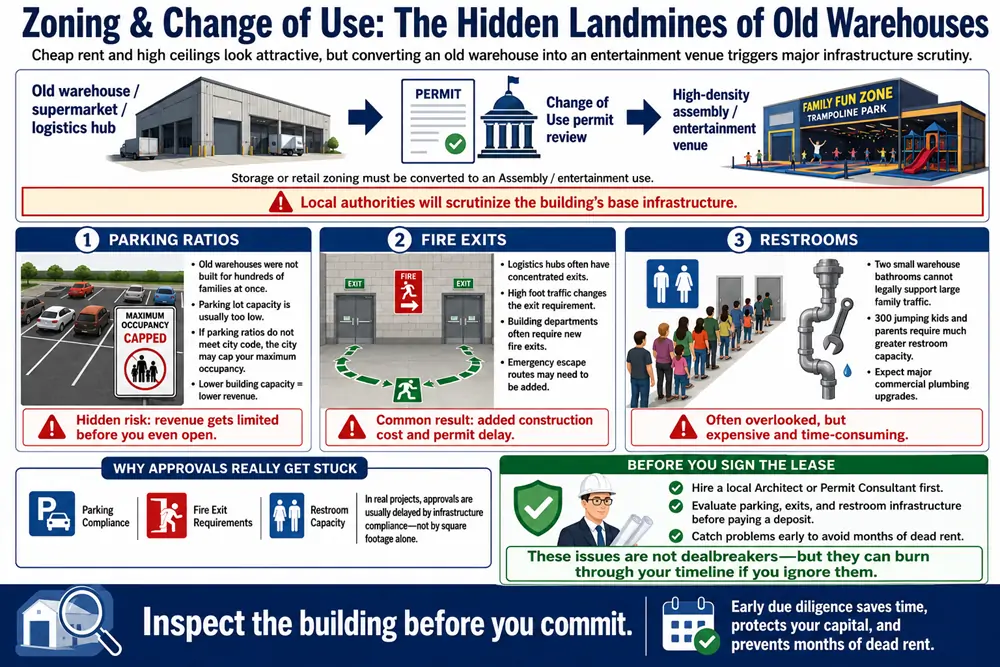
1. Zoning & Change of Use: The Hidden Landmines of Old Warehouses
Renting an old industrial warehouse, an abandoned supermarket, or a former logistics hub is a very common strategy. These spaces offer massive square footage, high ceilings, and relatively cheap rent. However, you must face a critical hurdle: Change of Use. The building was originally zoned for storage or retail. You are now converting it into a high-density "Assembly" or entertainment venue. When you apply for this permit, the local government will heavily scrutinise the building's base infrastructure.
Based on my experience across countless projects, the approval usually gets stuck on these three factors rather than the actual square footage:
• Parking Ratios: Old warehouses were not built to host hundreds of families at once. Their parking lot capacity is usually very low. If your parking ratio does not meet the city code for an entertainment venue, the city will cap your maximum building capacity, severely limiting your revenue.
• Fire Exits: Logistics hubs usually have concentrated exits. When calculating the high foot traffic of a trampoline park, the building department will almost always require you to cut new fire exits and add emergency escape routes.
• Restrooms: The two small bathrooms in a warehouse cannot legally support 300 jumping kids and parents. You will have to build out massive commercial plumbing.
These are not dealbreakers, but they will burn through your timeline. My strict advice: Before you sign a lease or pay a deposit, hire a local Architect or Permit Consultant to evaluate the building's infrastructure. Catching these issues early saves you months of dead rent.
2. Fire Safety & Sprinklers: The "2-Foot" Clearance Deadline
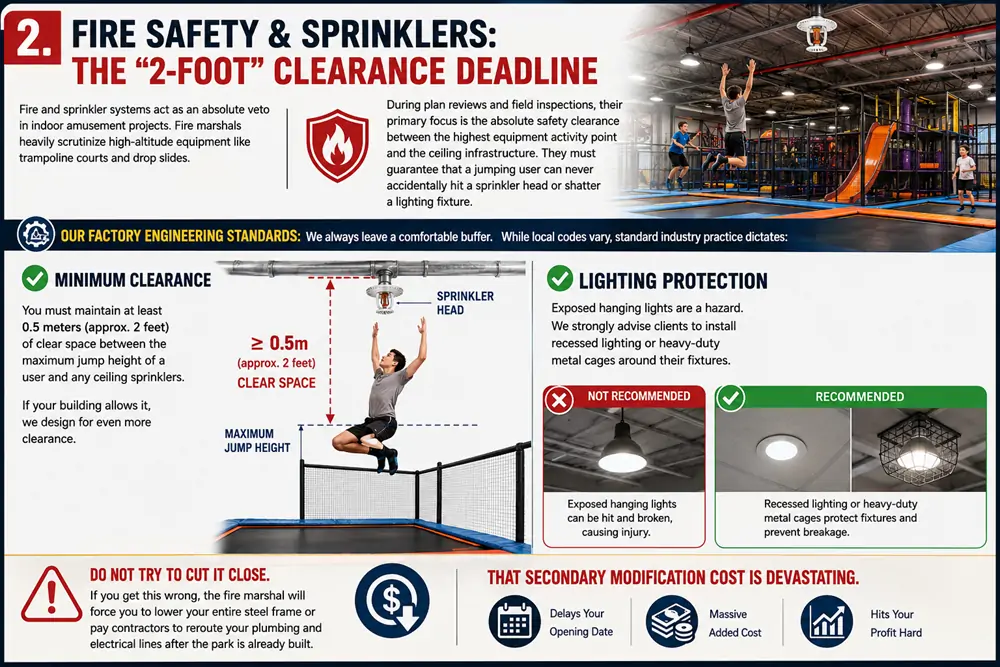
Fire and sprinkler systems act as an absolute veto in indoor amusement projects. Fire marshals heavily scrutinise high-altitude equipment like trampoline courts and drop slides. During plan reviews and field inspections, their primary focus is the absolute safety clearance between the highest equipment activity point and the ceiling infrastructure. They must guarantee that a jumping user can never accidentally hit a sprinkler head or shatter a lighting fixture.
In our factory engineering standards, we always leave a comfortable buffer. While local codes vary, standard industry practice dictates:
• Minimum Clearance: You must maintain at least 0.5 meters (approx. 2 feet) of clear space between the maximum jump height of a user and any ceiling sprinklers. If your building allows it, we design for even more clearance.
• Lighting Protection: Exposed hanging lights are a hazard. We strongly advise clients to install recessed lighting or heavy-duty metal cages around their fixtures.
Do not try to cut it close. If you get this wrong, the fire marshal will force you to lower your entire steel frame or pay contractors to reroute your plumbing and electrical lines after the park is already built. That secondary modification cost is devastating.
3. From 3D Renders to Real Engineering: The Factory Breakdown Standard
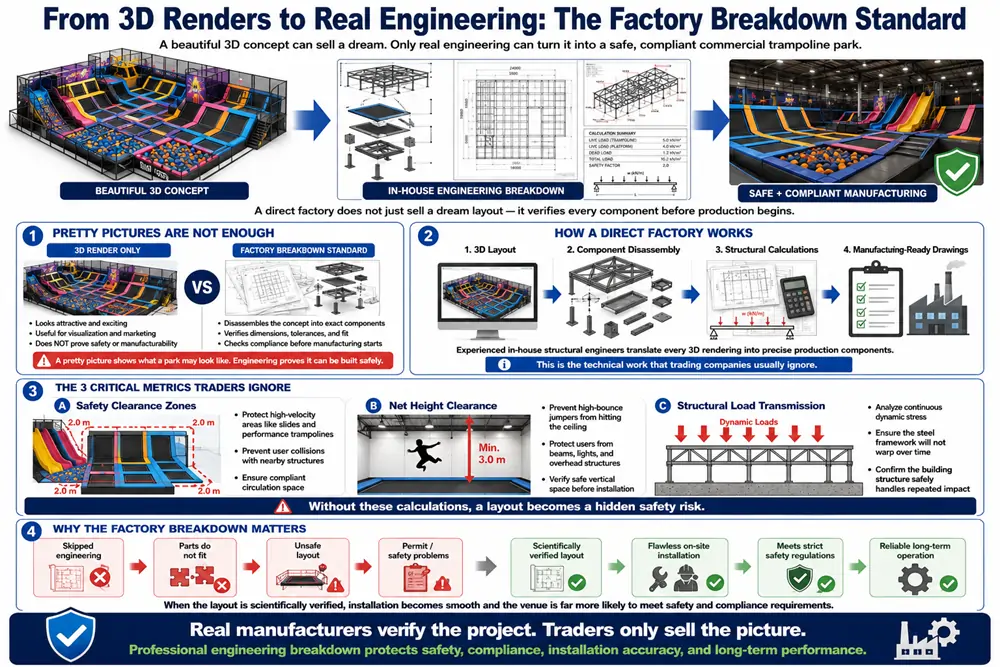
Anyone can hire a freelance graphic designer to draw a beautiful, colourful 3D concept of a trampoline park. But you cannot build a safe, compliant commercial playground from a pretty picture alone.A professional, direct factory does not just sell you a dream layout. We employ an experienced, in-house team of structural engineers to subject every single 3D rendering and piece of equipment to a rigorous engineering breakdown. This precise disassembly ensures that every component strictly aligns with global manufacturing standards before production ever begins.Our engineering breakdown focuses on the critical metrics that trading companies completely ignore:
• Enforcing exact safety clearance zones around high-velocity areas like slides and high-performance trampolines to avoid user collisions.
• Calculating net height clearances to ensure high-bounce jumpers never impact the ceiling or lighting infrastructure.
• Analysing structural load transmission to make sure the steel framework handles continuous dynamic stress safely without warping over time.
When you work with a legitimate manufacturer, your project layout is scientifically verified. This professional engineering breakdown guarantees a flawless installation process on-site and ensures your venue seamlessly meets all strict safety regulations.
4. Field Inspection: The Details Make or Break You
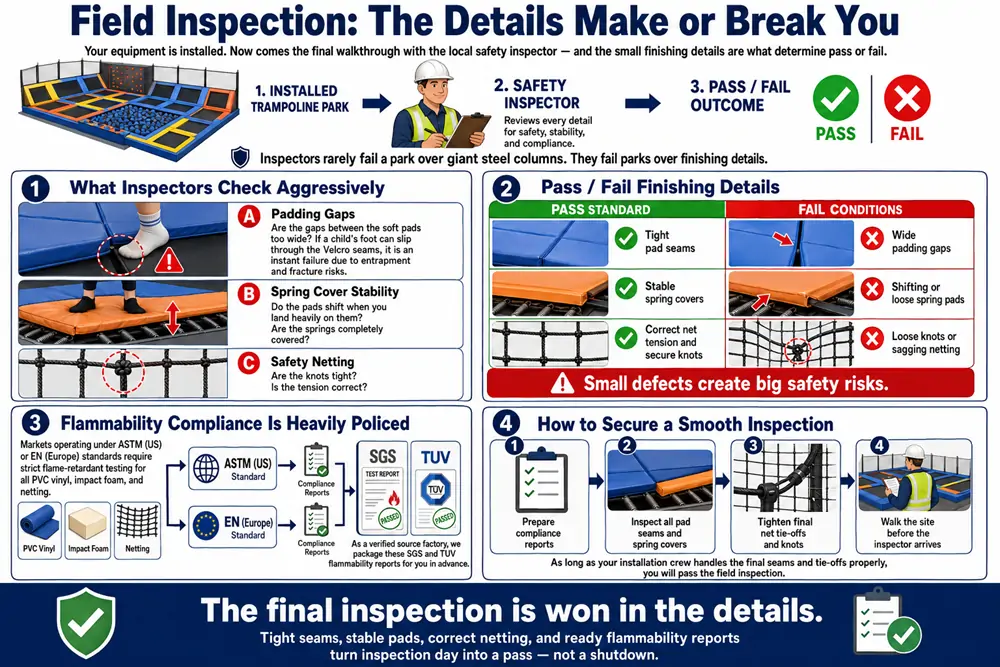
Your equipment has arrived. It is fully installed. Now comes the final walkthrough with the local safety inspector. Believe me, inspectors rarely fail a park over the giant steel support columns. They fail parks over the finishing details.
When the inspector steps onto your trampolines, they will aggressively check:
• Padding Gaps: Are the gaps between the soft pads too wide? If a child’s foot can slip through the Velcro seams, it is an instant failure due to entrapment and fracture risks.
• Spring Cover Stability: Do the pads shift when you land heavily on them? Are the springs completely covered?
• Safety Netting: Are the knots tight? Is the tension correct?
Aside from physical structure, material flammability is heavily policed. Markets operating under ASTM (US) or EN (Europe) standards require strict flame-retardant testing for all PVC vinyl, impact foam, and netting. As a verified source factory, we package these SGS and TUV flammability reports for you in advance. As long as your installation crew handles the final seams and tie-offs properly, you will pass the field inspection.
5. Liability Insurance: The Strict Depth Requirements for Foam Pits
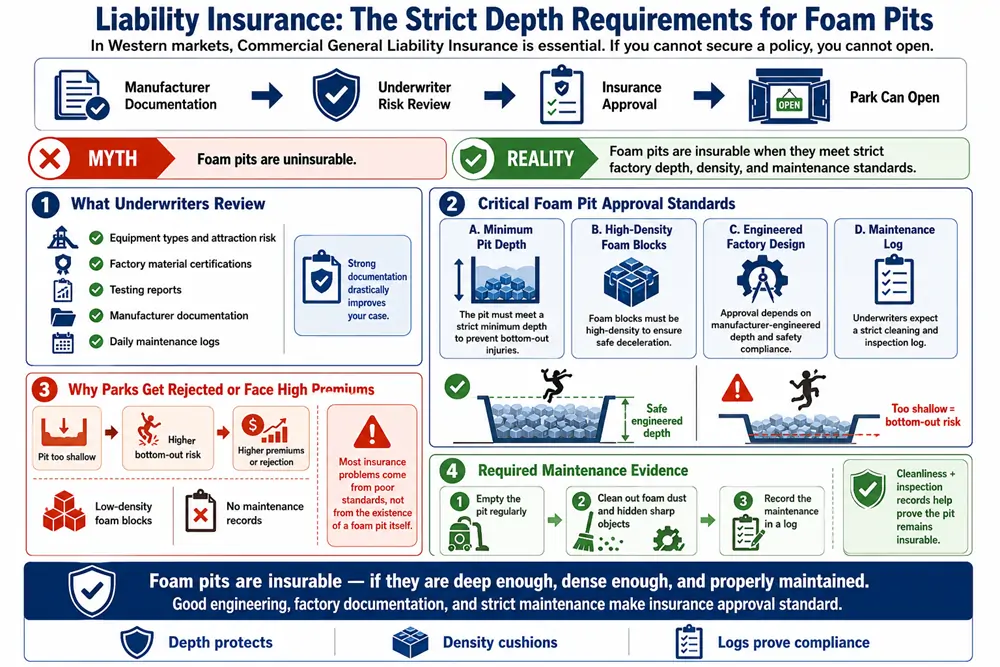
In Western markets, Commercial General Liability Insurance is a prerequisite for opening. If you cannot get an insurance policy, you cannot open your doors.
Underwriters assess your risk based on your equipment types and your manufacturer's documentation. Providing factory material certifications, testing reports, and daily maintenance logs drastically helps your case.
However, there is a major misconception about foam pits right now. Many investors think insurance companies will completely refuse to cover traditional loose foam pits. That is not true. Foam pits are insurable, but approval depends entirely on strict factory standards. Insurance companies will only cover your foam pit if it meets exact depth and density requirements. Why do some parks face astronomical premiums or rejections? Because their pits are too shallow. To get approved, your foam pit must hit a strict minimum depth to prevent "bottom-out" injuries. The foam blocks must be high-density to guarantee safe deceleration. Furthermore, underwriters will demand a strict maintenance log showing that you regularly empty the pit to clean out foam dust and hidden sharp objects. If your manufacturer engineers the pit to these exact depth and safety codes, securing a solid insurance policy is completely standard.
6. HVAC & Air Exchange: Do Not Destroy Your Park with Humidity
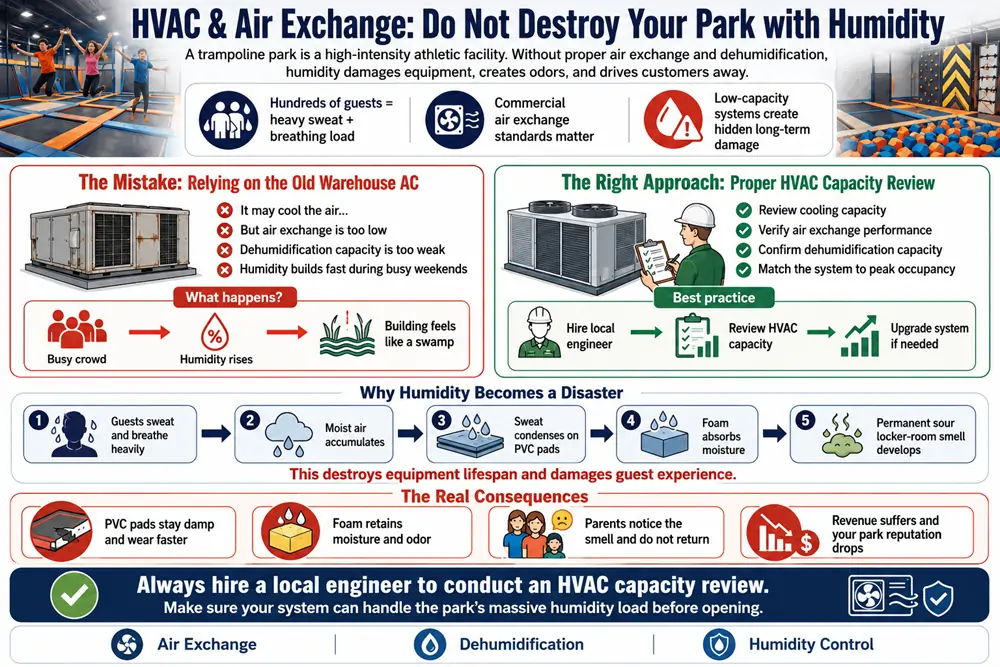
HVAC (Heating, Ventilation, and Air Conditioning) is the most frequently ignored budget item for new investors because it isn't a fun, colourful attraction. A trampoline park is a high-intensity athletic facility. Hundreds of people are sweating and breathing heavily. Building and health departments use strict commercial air exchange standards to ensure the air does not become stale and hazardous.
If you try to save money by using the old warehouse's existing AC unit, you will face a disaster. The old unit might cool the air, but its air exchange and dehumidification capacity will be far too low. During a busy weekend, the building will feel like a swamp. Sweat will condense on your PVC pads, the foam will absorb the moisture, and your entire park will develop a permanent, sour locker-room smell. This destroys your equipment's lifespan and guarantees parents will never return. Always hire a local engineer to conduct an HVAC capacity review to ensure your system can handle the massive humidity load.
7. Approval Timelines & The 20% Survival Buffer
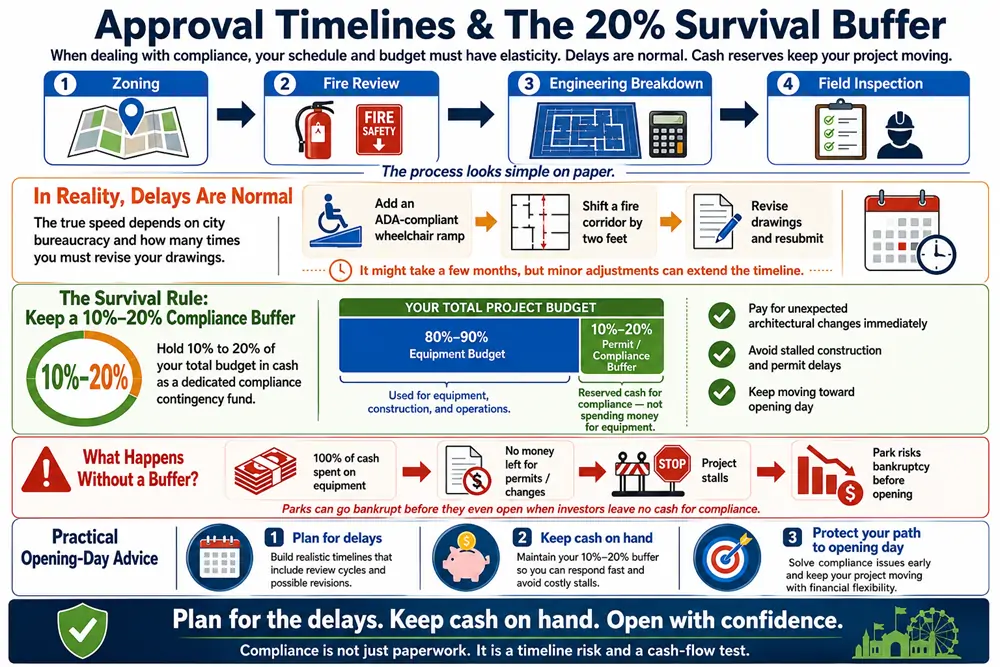
Let’s talk about time and money. When dealing with compliance, your schedule and budget must have elasticity.
The process is straightforward on paper: Zoning -> Fire Review -> Engineering Breakdown -> Field Inspection. In reality, the speed depends entirely on your city's bureaucracy and how many times you have to revise your drawings. It might take a few months, but it is completely normal to be delayed by minor adjustments—like being forced to add an ADA-compliant wheelchair ramp or shifting a fire corridor by two feet.
My ultimate survival advice: You must hold 10% to 20% of your total budget in cash as a dedicated compliance contingency fund. You might not spend it all. But having this financial buffer means that when the city demands an unexpected architectural change, you can write the check and keep moving. Parks go bankrupt before they even open because investors spend 100% of their cash on equipment and have nothing left to pay for the permits required to turn the lights on. Plan for the delays, keep cash on hand, and your path to opening day will be secure.
Sales-Expert FAQ: Handling Your Compliance Doubts
Q: I found some incredibly cheap trampoline park equipment for sale from a small workshop online. Can I just buy that and use their basic blueprints to get my local permits?
Absolutely not. Small workshops cannot produce the rigorous engineering breakdown required by Western safety inspectors, which will instantly kill your project. My Experience: Safety inspectors in the US and Europe demand to see precise manufacturing data on platform load capacities and dynamic impact forces. Cheap workshops offering heavily discounted trampoline park equipment for sale do not employ structural engineers; they just copy visual designs. If you buy from them, your local layout will fail the engineering breakdown check. You will be stuck with mismatched equipment that fails local code and is legally forbidden to operate.
Q: Since you are top-tier trampoline park equipment manufacturers, can your factory directly apply for my local fire and building permits?
No foreign manufacturer can legally pull permits in your city, but we provide the legally bulletproof technical documents your local team needs to win approval. My Experience: Permits must be filed by an Architect or General Contractor licensed in your specific state or province. However, they cannot do their job without our math. We arm your local consultants with ASTM/EN flame-retardant certificates, exact safety clearance CADs, and dynamic stress models from our engineering breakdown. With our factory's data backing them up, your local team can confidently pass the city's scrutiny.
Q: Change of Use permits take too long. Can I just open the park quietly under the warehouse's existing retail zoning?
Operating without the correct zoning is illegal and will instantly void your liability insurance, leaving you personally exposed to millions in lawsuits. My Experience: Western cities heavily monitor high-capacity assembly spaces. If you open a trampoline park without a Change of Use permit, it takes exactly one minor twisted ankle or one noise complaint for the fire marshal to investigate. They will chain your doors shut, hit you with massive fines, and your insurance company will tear up your policy for illegal operation. Never skip zoning.
Q: Why is my insurance broker questioning my traditional foam pit? Do I have to replace it?
You do not have to replace it, but you must prove to the broker that your foam pit meets strict minimum depth and foam density standards. My Experience: Insurance underwriters do not automatically hate foam pits; they hate shallow foam pits that cause bottom-out injuries. To get insured at a reasonable rate, you must provide factory documentation proving your pit exceeds the required minimum depth (calculated based on the highest jump point). You also need certificates showing the foam blocks are high-density and fire-retardant. If your direct manufacturer engineers the pit correctly and maintains a strict cleaning log to remove hidden debris, securing coverage is entirely possible and straightforward.