I have been handling commercial indoor park projects for 10 years. Every month, I see new investors make the same mistake. They spend months analysing rent, looking at floor plans, and negotiating leases. Then, they throw away their entire budget by buying their equipment from a trading company instead of a direct trampoline manufacturer. Middlemen have polished websites. They speak smooth English. They promise you the world. But they do not own a single welding machine. They do not buy steel. They do not employ engineers.
When you buy from a trader, you are gambling with your capital and your project's safety. I am going to show you the hard math, the structural risks, and the logistical realities from the factory floor. Here is why dealing directly with the factory is the only way to protect your return on investment (ROI).
1. The Real Cost of Price Arbitrage
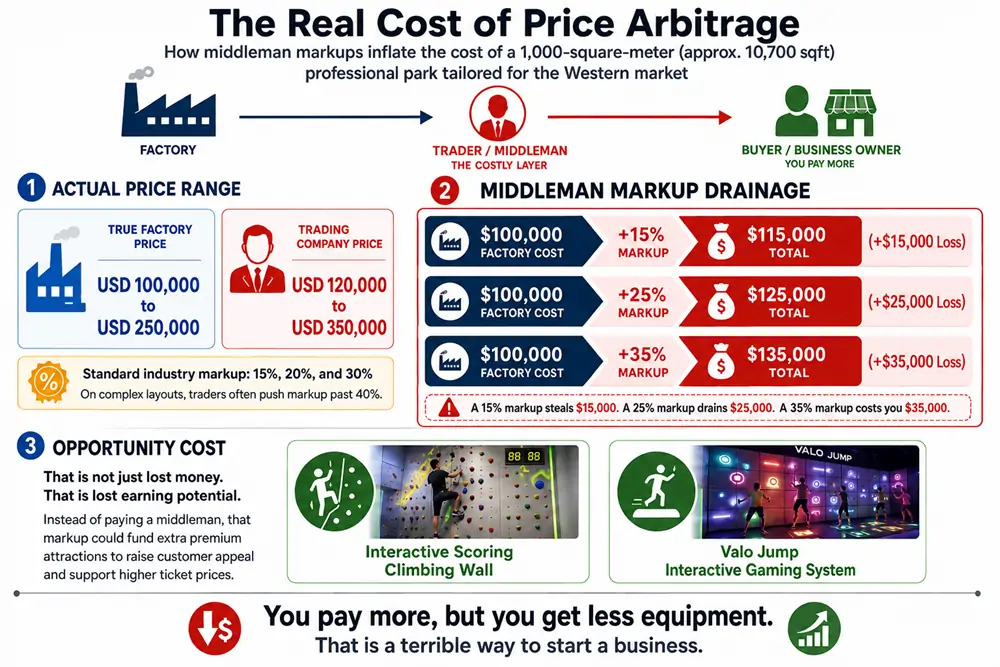
Traders survive on price markups. They buy from factories like mine, add their margin, and pass the bill to you.
Let’s look at the actual numbers for a standard 1,000-square-meter (approx. 10,700 sqft) professional park tailored for the Western market:
True Factory Price: USD 100,000 to USD 250,000
Trading Company Price: USD 120,000 to USD 350,000
The standard industry markup ranges between 15%, 20%, and 30%. On complex layouts, traders easily push that markup past 40%.
Look at a base project value of just $100,000. A 15% markup steals $15,000 from your pocket. A 25% markup drains $25,000. A 35% markup costs you $35,000.
[Middleman Markup Drainage]
$100,000 Factory Cost ──► +15% Markup ──► $115,000 Total (+$15,000 Loss)
$100,000 Factory Cost ──► +25% Markup ──► $125,000 Total (+$25,000 Loss)
$100,000 Factory Cost ──► +35% Markup ──► $135,000 Total (+$35,000 Loss)
That is not just lost money. That is lost earning potential. That pocketed markup could have purchased extra premium attractions to drive up your ticket prices. Instead of giving that cash to a middleman, you could have added a full interactive scoring climbing wall or an advanced Valo Jump interactive gaming system to your floor plan. You pay more, but you get less equipment. That is a terrible way to start a business.
2. Steel and Springs: The Invisible Material Deception
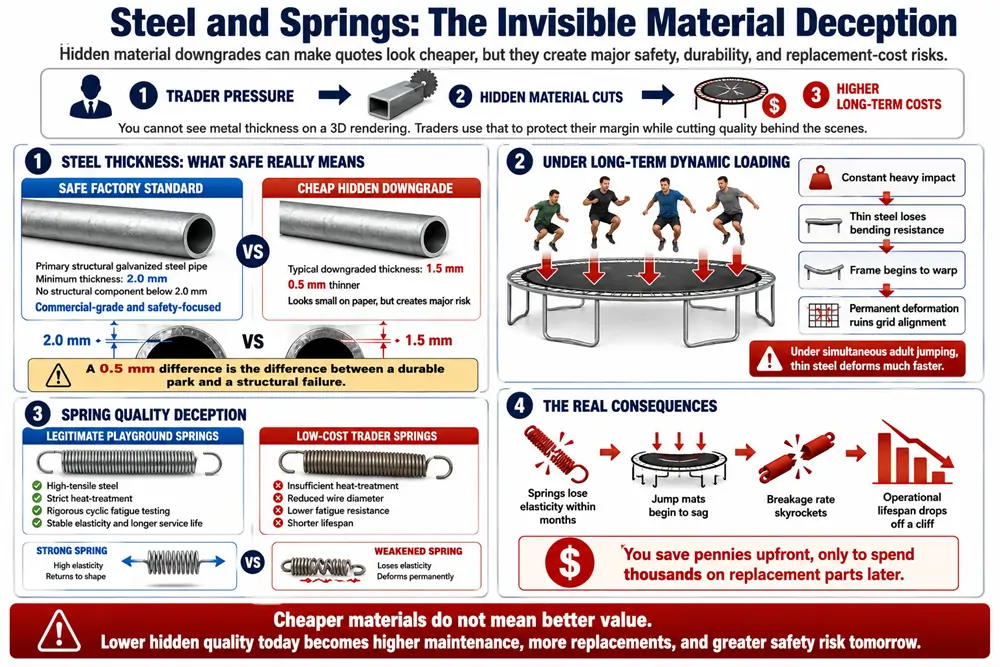
You cannot see metal thickness on a 3D rendering. Traders know this, and they use it to maximise their margins. They pressure suppliers to cut material quality so they can keep their retail prices attractive while pocketing a heavy profit.
In our factory, the standard configuration for safe, commercial-grade trampoline framework requires primary structural galvanised steel pipes to be exactly 2.0 mm thick. We never allow any structural component to drop below 2.0 mm. A difference of 0.5mm seems minor on paper. In reality, it is the difference between a durable park and a structural failure. Under long-term dynamic loading—the constant, violent impact of heavy adults jumping simultaneously—thin steel loses its bending resistance rapidly. The entire frame begins to warp, creating permanent deformation that ruins the alignment of your grid.
The same deception happens with springs. A legitimate playground manufacturer uses high-tensile steel springs that undergo strict heat-treatment and rigorous cyclic fatigue testing. Low-cost solutions provided by traders use insufficient heat-treatment and shrunk wire diameters.
The consequence? Your springs lose their elasticity within months. The jump mats sag, the breakage rate skyrockets, and your operational lifespan drops off a cliff. You save pennies upfront, only to spend thousands on replacement parts later.
3. The Multi-Factory Sourcing Nightmare
Traders do not have production lines. To drive their costs down to the absolute minimum, many middlemen split a single order among completely separate workshops. They will order the raw galvanised steel frames from Workshop A because they are cheap to weld. They will order the foam safety padding and PVC vinyl covers from Workshop B because they are a cheap sewing shop.
When this "Frankenstein" kit arrives at your job site, your installation team faces a total disaster. The bolt holes on the steel tubes do not line up with the brackets. The soft padding dimensions deviate from the metal frames, leaving dangerous gaps or overlapping pieces. Your installation grinds to a halt. Your crew has to cut, weld, and modify the equipment on-site. This destroys the structural coating and multiplies your local installation labour costs. What seemed like a cheap deal from a trader becomes a massive money pit during assembly.
4. 3D Renderings vs. Real Engineering Breakdown
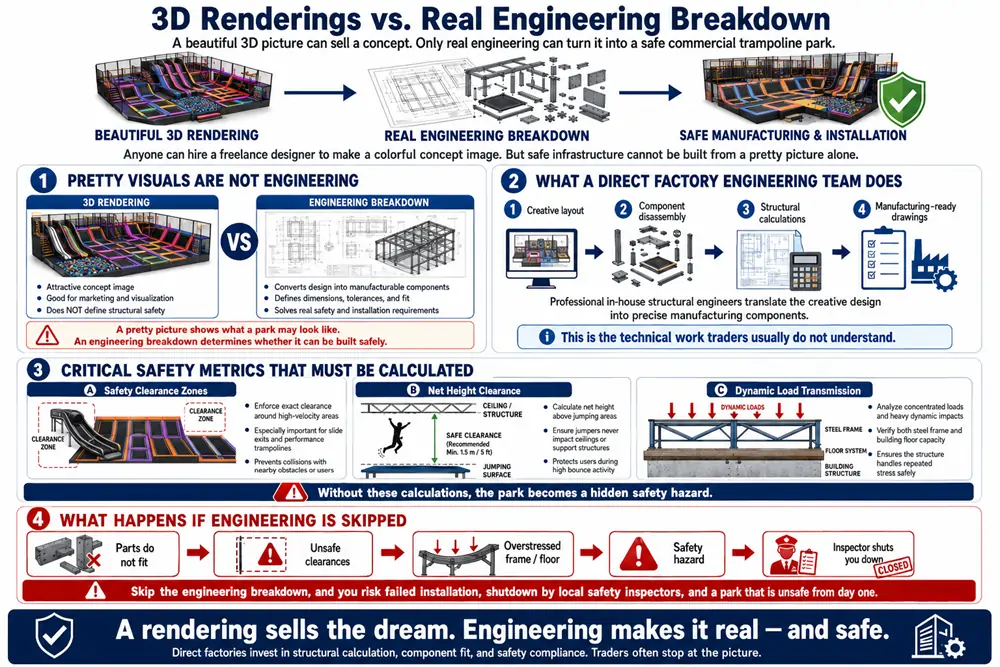
Anyone can hire a freelance graphic designer to draw a beautiful, colourful 3D picture of a trampoline park. But you cannot build a safe commercial infrastructure from a pretty picture. The real challenge lies in the engineering breakdown.
A direct factory utilises professional, in-house structural engineers to disassemble the creative design into precise manufacturing components. Our engineering team focuses on critical safety metrics that traders simply do not understand:
- Enforce exact safety clearance zones around high-velocity areas like slide exits and high-performance trampolines.
- Calculating net height clearances to ensure jumpers never impact the ceiling or supporting structures.
- Analysing dynamic load transmission, specifically managing concentrated loads and heavy dynamic impacts to ensure the building floor and the steel frame can handle the stress safely.
Without this technical calculation, your park is a safety hazard. If an engineering breakdown is skipped, parts will not fit, and your local safety inspector will shut you down.
5. Compliance: The Fake Certificate Gamble
If your park is located in North America or Europe, you must comply with strict regional safety standards. You need a legitimate EN1176 (European Standard) or ASTM (American Standard) compliance certification.
Traders rarely invest tens of thousands of dollars into independent laboratory testing. Instead, they often borrow factory certificates, alter the headers using software, and present them as their own.
This works during the sales stage, but it fails under official scrutiny. When a municipal inspector or insurance underwriter demands the official testing records and cross-references the registration numbers with the laboratory database, fake documents are flagged instantly. Your occupancy permit is denied, your business insurance is voided, and you are left holding an unopenable facility. Dealing with a verified manufacturer guarantees that the safety stamps on your equipment are legally bulletproof.
6. The After-Sales Communication Loop
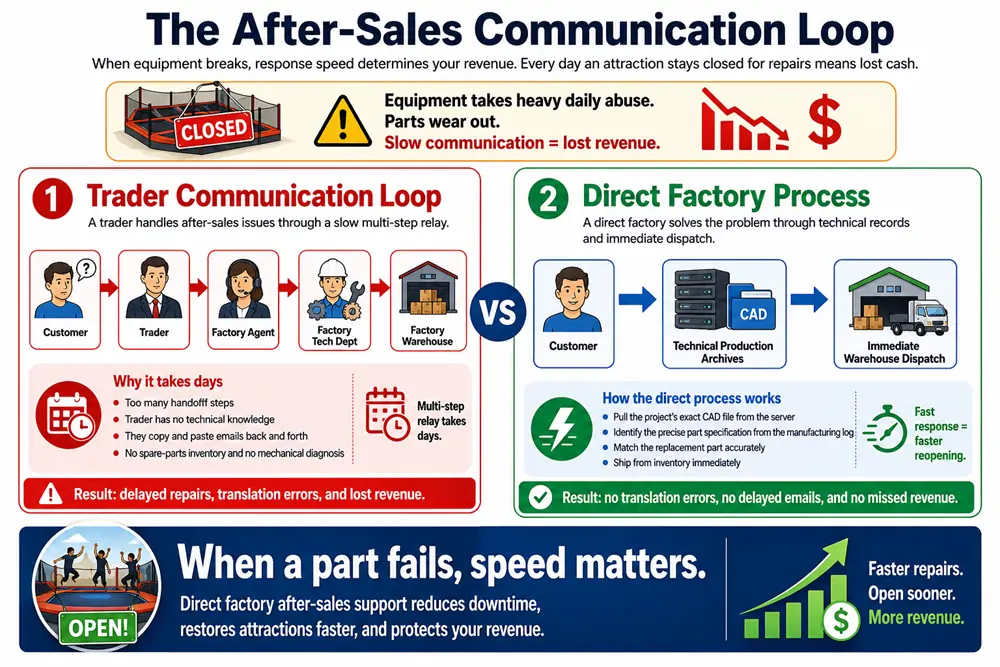
Equipment takes heavy daily abuse. Parts wear out, and when they do, your response speed determines your revenue. Every day an attraction is closed for repairs, you are losing cash.
Look at how a trader handles a broken component:
[Trader Communication Loop]
Customer ──► Trader ──► Factory Agent ──► Factory Tech Dept ──► Factory Warehouse
This multi-step relay takes days. The trader has no technical knowledge, so they just copy and paste emails back and forth, acting as a human message machine. They have no inventory. They cannot diagnose a mechanical issue.
Now, look at the direct factory process:
[Direct Factory Process]
Customer ──► Technical Production Archives ──► Immediate Warehouse Dispatch
We pull your project’s exact CAD file from our server, identify the precise part specification from your manufacturing log, and ship the replacement from our inventory immediately. No translation errors, no delayed emails, and no missed revenue.
7. How to Identify a Real Manufacturer in 3 Minutes
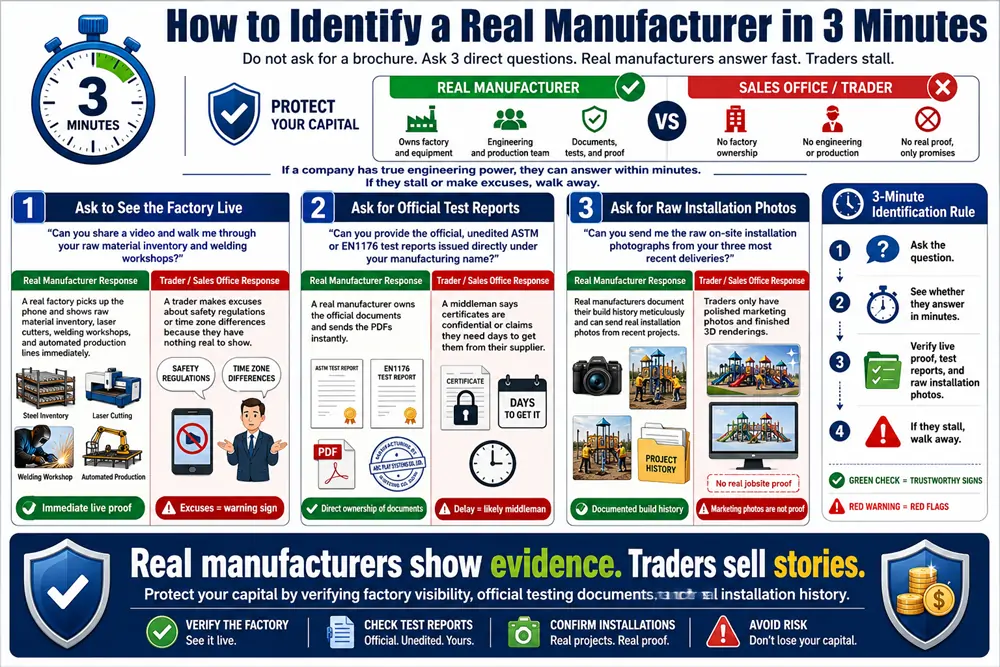
If you want to protect your capital and find out if a company is a real manufacturer or just a sales office, do not ask for a brochure. Ask these three direct questions. If they have true engineering power, they will provide the answers within minutes. If they stall or make excuses, walk away.
- "Can you share a video and walk me through your raw material inventory and welding workshops?" A real factory will pick up its phone and show you its laser cutters and automated production lines immediately. A trader will make excuses about safety regulations or time zone differences because they have nothing to show.
- "Can you provide the official, unedited ASTM or EN1176 test reports issued directly under your manufacturing name?" A real manufacturer owns these documents and will send the PDFs instantly. A middleman will tell you that certificates are "confidential" or will take days to get them from their supplier.
- "Can you send me the raw on-site installation photographs from your three most recent deliveries?" Real manufacturers document their build history meticulously. Traders only have access to finished 3D renderings and polished marketing photos.
Sales-Grade FAQ: Objection Handling
Q: A trading company quoted me a lower total price than a factory. Isn't it cheaper to buy from them?
Absolutely not. Any low upfront quote from a trader means they are secretly cutting raw material quality to protect their markup. My Experience: I have analysed these low-cost quotes for 15 years. A trader cannot sell below factory cost without altering the product. To keep their profit margin intact while offering a low price, they secretly instruct the factory to use thin steel pipes under 1.2mm and untreated, low-grade springs. This severely reduces your park's lifespan and skyrockets your maintenance costs. You pay less on day one, but the high structural failure rates will destroy your business by year two.
Q: Traders claim they offer better communication because their sales staff speak better English. Is that true?
No. Polished English cannot fix a mismatched structural frame or a rejected safety permit. My Experience: Do not mistake smooth sales talk for professional engineering capability. When your local inspector rejects your installation because the buffer zones do not meet ASTM criteria, a trader's language skills will not help you. Real direct factories maintain dedicated, fluent export engineering and sales divisions. We communicate using exact technical data, CAD drawings, and load calculations. You need an engineering solution, not a conversationalist.
Q: Can a trading company handle custom designs better because they source from multiple suppliers?
No. Sourcing from multiple unlinked suppliers guarantees a dangerous installation disaster. My Experience: When a trader splits your floor plan among separate workshops—buying frames from one place and padding from another—the structural tolerances never match. The bolt holes fail to align, and the safety padding sizes deviate from the frames. A direct factory controls the entire ecosystem under one roof, ensuring every single component fits together perfectly before it ever leaves the shipping dock.
Q: Does it really matter if my steel frames are slightly under the 2.0mm factory trampoline standard?
Yes. Thin steel will bend and deform permanently under the continuous weight of jumping adults. My Experience: Children are light, but corporate groups and adults place massive dynamic loads on a trampoline park grid. If your supplier uses cheap steel under the 1.2mm structural threshold, the entire frame will warp over time. This deformation creates uneven tension on the jump mats, causes springs to snap rapidly, and creates serious liability risks that can result in injuries and lawsuits.
Q: How do I know what my true trampoline park equipment cost should be without hidden fees?
By demanding a fully itemised material breakdown directly from a verified direct factory. My Experience: Middlemen love to lump costs together into a single, ambiguous package price. They hide their massive 20% to 30% profit margins inside inflated line items like "specialised overseas installation guidance" or "premium project management fees." When you bypass them and deal with a direct factory, you see the exact cost per square meter of steel, padding, and springs, giving you a clean financial blueprint to accurately calculate your true ROI.