We make a living manufacturing commercial indoor playgrounds. Our factory builds playgrounds that are extremely sturdy and durable. But every year, I see customers spend tens of thousands of dollars on high-end equipment, only to need maintenance within two or three years. Why does this happen? Because they let untrained cleaning staff attack industrial-grade materials with bleach, heavy water, and the wrong chemicals. When your PVC pads crack, your steel bases rust, or your park smells like a dirty locker room, parents will stop bringing their kids. It is that simple. You lose your revenue.
If you want to protect your investment, you need to understand the physical properties of the materials in your park. You need to clean like a manufacturer. Here is the unvarnished truth from the factory floor on exactly how to clean indoor playground equipment to double its lifespan and keep your customers coming back.
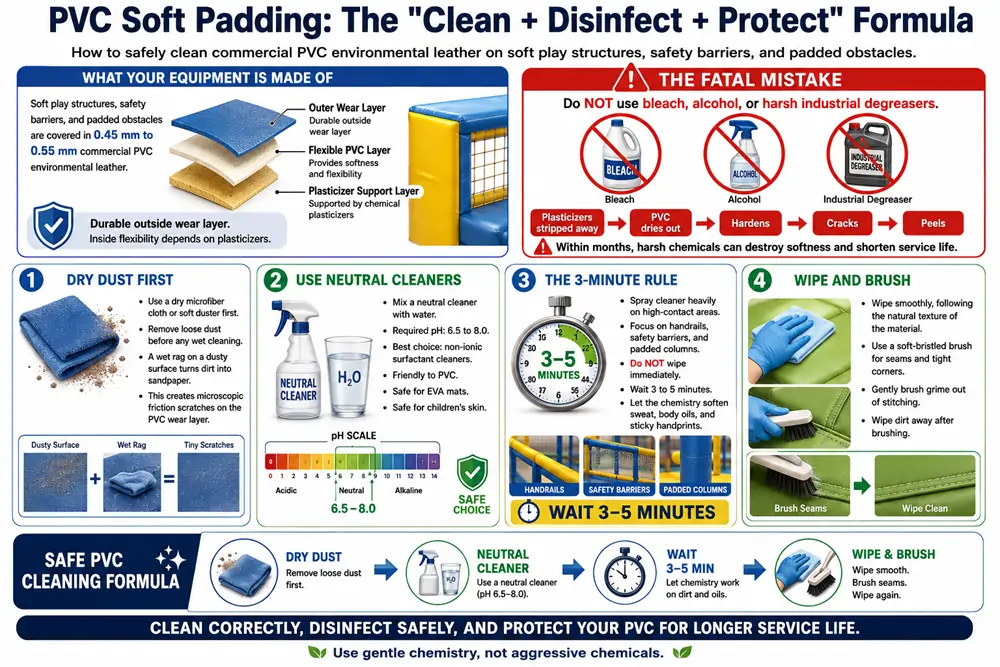
1. PVC Soft Padding: The "Clean + Disinfect + Protect" Formula
Your soft play structures, safety barriers, and padded obstacles are covered in 0.45mm to 0.55mm commercial PVC environmental leather. This material has a durable wear layer on the outside. On the inside, it relies on chemical plasticisers to stay soft and flexible. Many operators make a fatal mistake here. They use bleach, alcohol, or harsh industrial degreasers. These chemicals strip the plasticisers. Within months, your PVC will dry out, harden, crack, and peel.
Here is the exact factory standard for cleaning PVC:
- Dry Dust First: Always use a dry microfiber cloth or soft duster to remove surface dust first. If you wipe a dusty surface with a wet rag, the dirt acts like sandpaper. You will create microscopic friction scratches on the PVC wear layer.
- Use Neutral Cleaners: Apply a neutral cleaner mixed with water. The pH level must be strictly between 6.5 and 8.0. Non-ionic surfactant cleaners are the absolute best choice. They are PVC-friendly, safe for EVA mats, and completely safe for children's skin.
- The 3-Minute Rule: Spray the cleaner heavily on high-contact areas. Focus on handrails, safety barriers, and padded columns. Do not wipe immediately. Wait 3 to 5 minutes. You must let the chemistry do the work to soften the sweat, body oils, and sticky handprints.
- Wipe and Brush: Wipe it down smoothly, following the natural texture of the material. For seams and tight corners where grime hides, use a soft-bristled brush. Gently brush the dirt out of the stitching, then wipe it away.
2. The Ball Pit: Machine Washing and Deep Floor Extraction
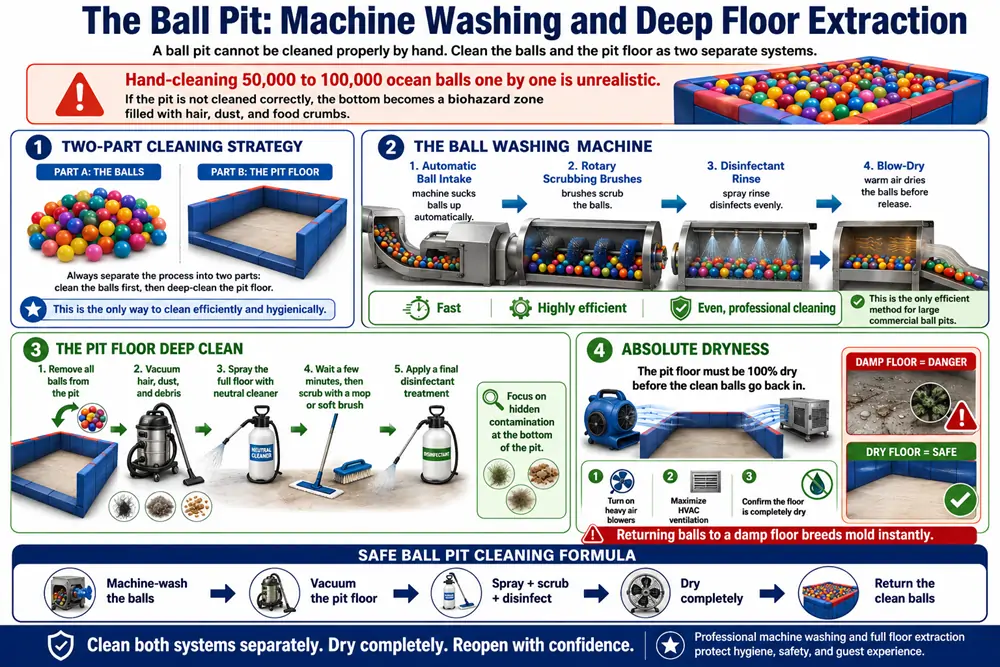
Cleaning a pit with 50,000 to 100,000 plastic ocean balls by hand is a complete joke. If you try to wipe them individually, you will fail. If you don't clean the pit properly, the bottom becomes a biohazard zone filled with hair, dust, and food crumbs.
You must separate this process into two parts: the balls and the pit floor.
- The Ball Washing Machine: This is the only efficient method. A professional ball washing machine sucks the balls up automatically. It runs them through rotary scrubbing brushes, sprays them with a disinfectant rinse, and blow-dries them in one continuous loop. It is fast, highly efficient, and guarantees an even clean.
- The Pit Floor Deep Clean: Once the balls are out of the pit, you must attack the floor. Use a heavy-duty industrial vacuum to suck up all the hair, dust, and debris. Spray the entire floor surface with your neutral cleaner. Wait a few minutes. Scrub it with a mop or soft brush. Apply a final disinfectant treatment.
- Absolute Dryness: You must turn on heavy air blowers or maximise your HVAC ventilation. Ensure the pit floor is 100% dry before returning the clean balls. Returning balls to a damp floor breeds mould instantly.
3. Steel Frame Foundations: Water Control and Rust Prevention
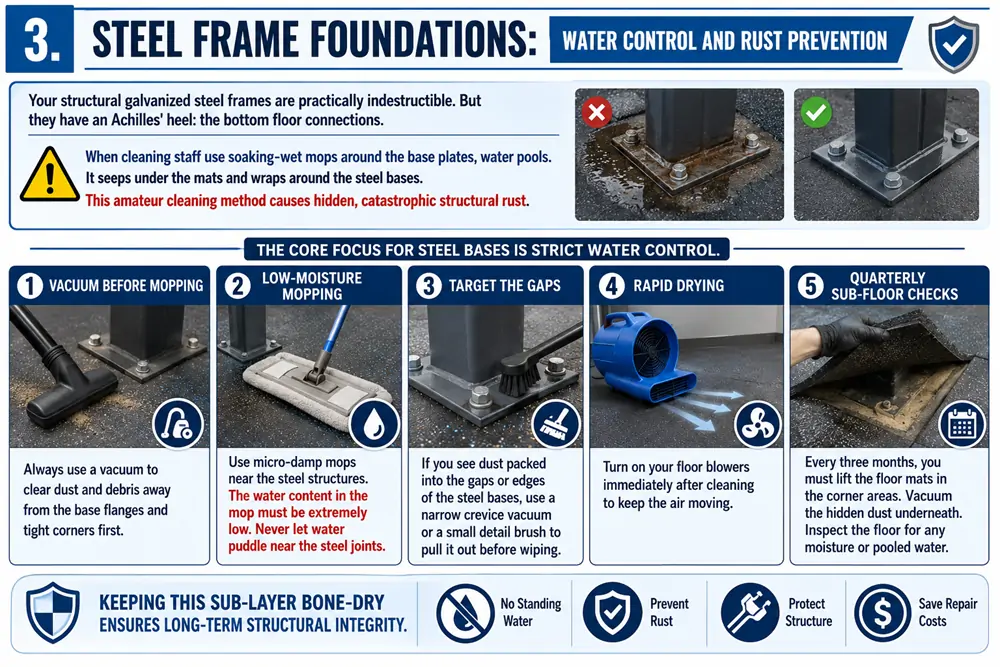
Your structural galvanised steel frames are practically indestructible. But they have an Achilles' heel: the bottom floor connections. When cleaning staff use soaking-wet mops around the base plates, water pools. It seeps under the mats and wraps around the steel bases. This外行 (amateur) cleaning method causes hidden, catastrophic structural rust.
The core focus for steel bases is strict water control.
- Vacuum Before Mopping: Always use a vacuum to clear dust and debris away from the base flanges and tight corners first.
- Low-Moisture Mopping: Use micro-damp mops near the steel structures. The water content in the mop must be extremely low. Never let water puddle near the steel joints.
- Target the Gaps: If you see dust packed into the gaps or edges of the steel bases, use a narrow crevice vacuum or a small detail brush to pull it out before wiping.
- Rapid Drying: Turn on your floor blowers immediately after cleaning to keep the air moving.
- Quarterly Sub-Floor Checks: Every three months, you must lift the floor mats in the corner areas. Vacuum the hidden dust underneath. Inspect the floor for any moisture or pooled water. Keeping this sub-layer bone-dry ensures long-term structural integrity.
4. High-Altitude Safety Nets: Dry Dusting Only
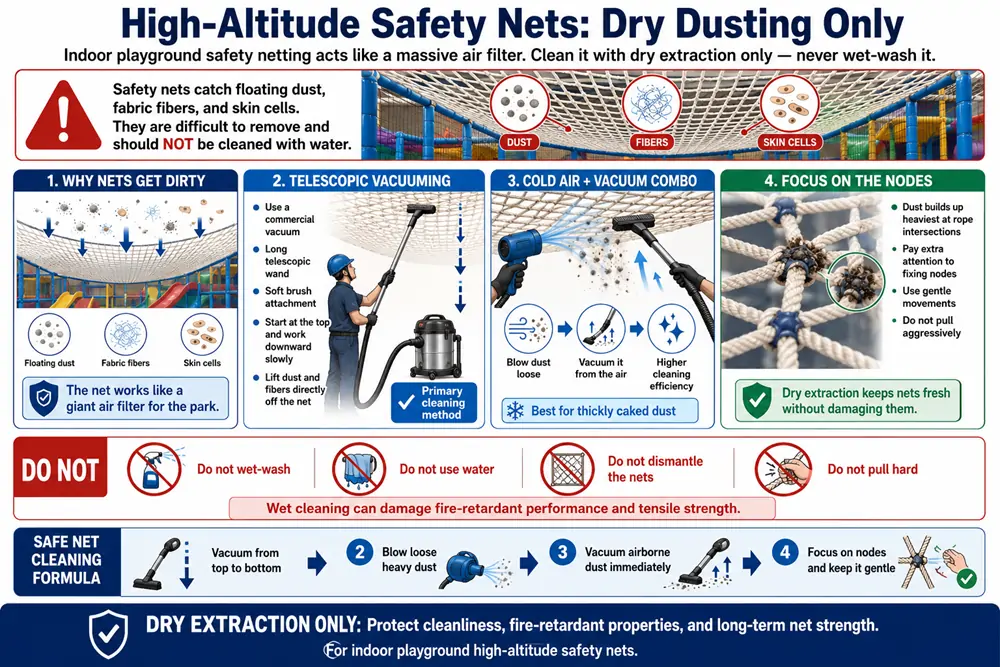
Your high-altitude safety netting acts like a massive air filter for your park. It catches floating dust, fabric fibres, and skin cells. However, you cannot easily take it down, and you absolutely should not wet-wash it.
The secret to cleaning safety nets is dry extraction.
- Telescopic Vacuuming: Use a commercial vacuum equipped with a long telescopic wand and a soft brush attachment. Start from the very top and work your way down slowly. Vacuum the adhered dust and fibres right off the netting.
- Cold Air Blowing: For areas where dust is thickly caked on, use a low-pressure cold air blower. Blow the dust loose, and simultaneously use the vacuum to suck it out of the air. This drastically increases your efficiency.
- Focus on the Nodes: Dust accumulates heaviest at the rope intersections and fixing nodes. Focus your attention there.
- Keep It Gentle: Do not pull aggressively. You do not need to dismantle the nets. You do not need water. Dry extraction leaves the nets looking fresh without destroying their fire-retardant properties or tensile strength.
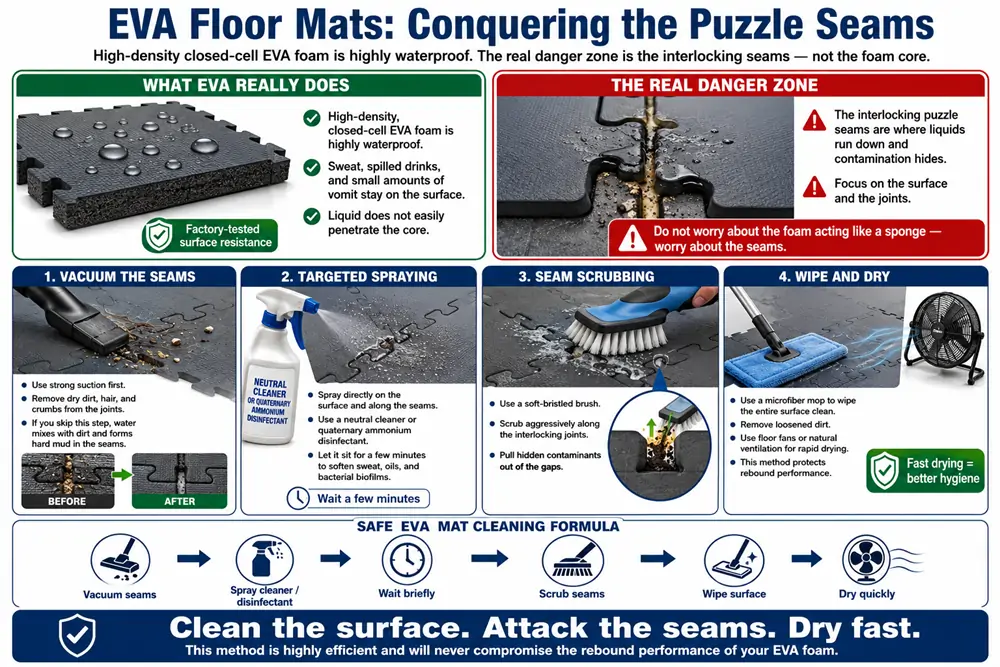
5. EVA Floor Mats: Conquering the Puzzle Seams
Many people think EVA foam mats act like giant sponges. They do not. High-density, closed-cell EVA foam is highly waterproof. Sweat, spilt drinks, or small amounts of vomit will not easily penetrate the core of the mat. We have tested this in the factory. The liquid stays on the surface.
The real danger zone is the interlocking puzzle seams. That is where liquids run down and rot. Your focus must be on the surface and the joints, not worrying about the mat absorbing water.
- Vacuum the Seams: Use strong suction to pull dry dirt, hair, and crumbs out of the interlocking joints first. If you skip this, water will mix with the dirt and create hard mud in the seams.
- Targeted Spraying: Spray your neutral cleaner or a quaternary ammonium disinfectant directly over the surface and heavily along the seams. Let it sit for a few minutes to soften sweat, oils, and bacterial biofilms.
- Seam Scrubbing: Use a soft-bristled brush to scrub aggressively right along the puzzle joints. This pulls out the hidden contaminants trapped in the gaps.
- Wipe and Dry: Use a microfiber mop to wipe the entire surface clean. This pulls the loosened dirt away. Use floor fans or natural ventilation to dry the mats quickly. This method is highly efficient and will never compromise the rebound performance of your EVA foam.
6. Eradicating the "Sour Smell" (Odour Elimination)
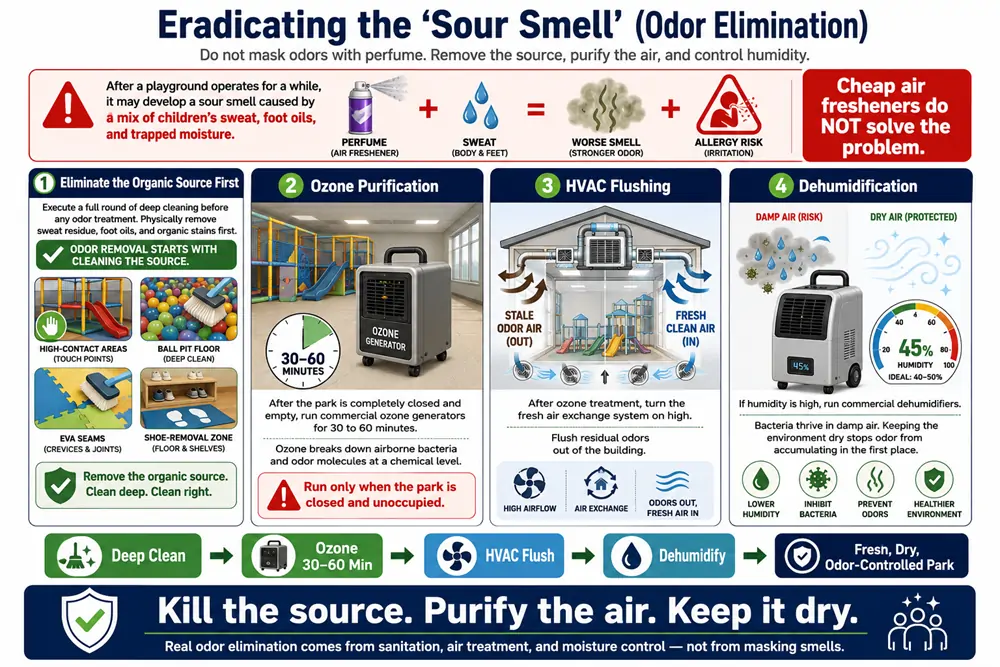
If your playground operates for a while, it will inevitably develop a unique "sour smell." This is a foul mix of children's sweat, foot oils, and trapped moisture. You cannot fix this by spraying cheap air fresheners. Perfume mixed with sweat smells worse and triggers allergies. You must kill the source.
- Eliminate the Organic Source First: Execute a full round of deep cleaning on high-contact areas, the ball pit floor, EVA seams, and the shoe-removal zone. You must physically remove the sweat residue and organic stains first.
- Ozone Purification: After the park is completely closed and empty, run commercial Ozone generators for 30 to 60 minutes. Ozone is a powerful gas that breaks down airborne bacteria and odour molecules at a chemical level.
- HVAC Flushing: After the Ozone treatment finishes, turn your fresh air exchange system on high. Flush the residual odours out of the building.
- Dehumidification: If your park's humidity is high, run commercial dehumidifiers. Bacteria thrive in damp air. Keeping the environment dry stops the smell from accumulating in the first place.
7. The Factory SOP: Standardised Cleaning Schedule
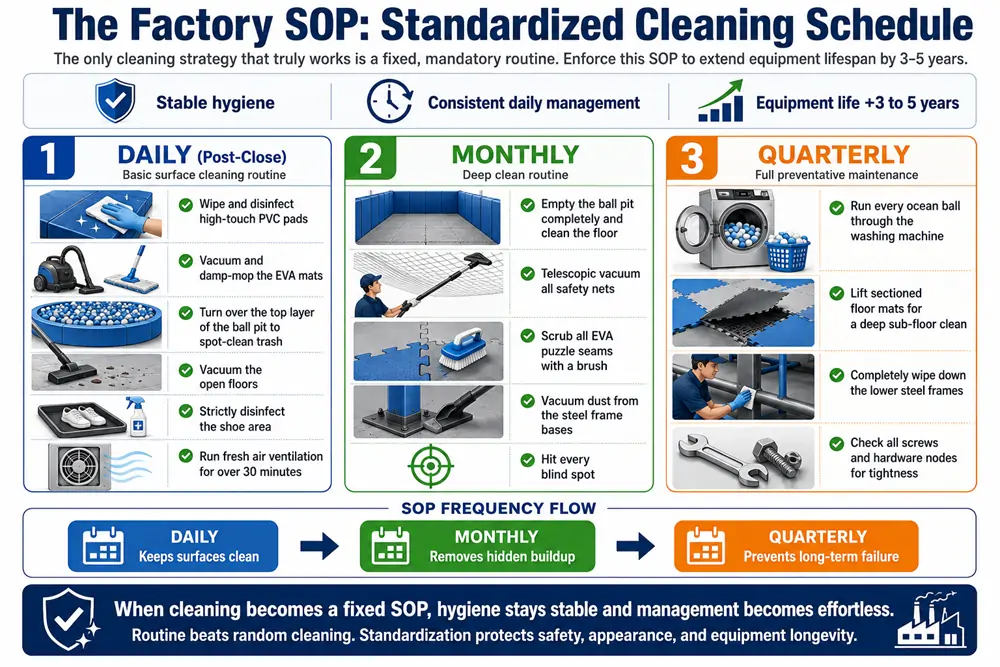
The only cleaning strategy that actually works is a fixed, mandatory routine. If you want to extend your equipment's lifespan by 3 to 5 years, you must enforce this Standard Operating Procedure (SOP):
- Daily (Post-Close): Perform basic surface cleaning. Wipe and disinfect high-touch PVC pads. Vacuum and damp-mop the EVA mats. Turn over the top layer of the ball pit to spot-clean trash. Vacuum the open floors. Strictly disinfect the shoe area. Run fresh air ventilation for over 30 minutes.
- Monthly: Execute a deep clean. Empty the ball pit completely and clean the floor. Telescopic vacuum all safety nets. Scrub all EVA puzzle seams with a brush. Vacuum the dust from the steel frame bases. Hit every blind spot.
- Quarterly: Conduct full preventative maintenance. Run every ocean ball through the washing machine. Lift sectioned floor mats for a deep sub-floor clean. Completely wipe down the lower steel frames. Check all screws and hardware nodes for tightness.
When you make this a fixed SOP, your hygiene stays incredibly stable, and your daily management becomes effortless.
Sales-Expert FAQ: Handling Your Maintenance Doubts
Q: Can I just use diluted bleach to disinfect my soft padding quickly?
Absolutely not. Bleach chemically strips the plasticisers from PVC and will permanently destroy your equipment. My Experience: I have seen owners ruin $50,000 worth of soft play structures in less than six months because their staff used bleach. It causes the 0.55mm vinyl to harden, crack, and flake off. You must strictly use a neutral pH cleaner (6.5 to 8.0) and safe disinfectants. This protects the material while killing the germs.
Q: Do I really need to buy a dedicated ball washing machine?
Yes. Cleaning 50,000 balls by hand is a complete operational impossibility. My Experience: If you don't use a machine, your staff will simply spray the top layer of the balls and ignore the rest. The bottom of the pit will become a filthy biohazard. All top-tier indoor playground makers will tell you that a professional machine is mandatory. It scrubs, disinfects, and dries the entire inventory rapidly, ensuring parents trust your hygiene standards.
Q: Will spilling drinks completely ruin my EVA floor mats?
No, but ignoring the puzzle seams will cause massive odour problems. My Experience: High-density, closed-cell EVA foam is actually highly water-resistant. The liquid does not penetrate the foam easily. The real danger is the liquid flowing into the interlocking puzzle seams. You do not need to replace the mats. You just need to spray a neutral cleaner into the seams, scrub them with a soft brush, and extract the residue.
Q: How do I permanently get rid of the sour foot smell in my park?
You must physically remove the sweat residue first, then use an Ozone generator. My Experience: Masking the smell with cheap air fresheners never works. You have to kill the bacteria causing the odour. First, deep clean the shoe zones and EVA seams. Then, after the park closes, run an Ozone machine for 30 to 60 minutes. The Ozone will safely neutralise the airborne bacteria and odour molecules. Flush the space with your HVAC system, and your park will smell completely fresh the next morning.