You want to build an indoor family entertainment centre in the United States. You secure your business funding. You find a massive commercial building in a good retail location. You start looking for equipment.
Do not sign the commercial lease yet. You cannot just buy steel frames, bolt them together in an empty warehouse, and start selling tickets to families. The local city council decides whether you open. Local building inspectors hold all the power. They enforce strict municipal zoning laws. They enforce non-negotiable fire codes.
I am Ayla. I run Yommi Play. We manufacture commercial indoor playground equipment. We export massive structural steel and soft play parks to the US market constantly. I deal with American municipal compliance standards every single day. I see new American investors delay their grand openings by six months simply because they fail their initial fire inspections. I see investors forced to tear down walls because they ignored ADA accessibility laws.
This is the direct playbook on how to open an indoor playground in the USA. I will show you exactly how to navigate the city permits, meet the local fire codes, pass your building inspections, and source the right equipment without destroying your initial capital.
Step 1: Zoning Laws and the Change of Use Permit
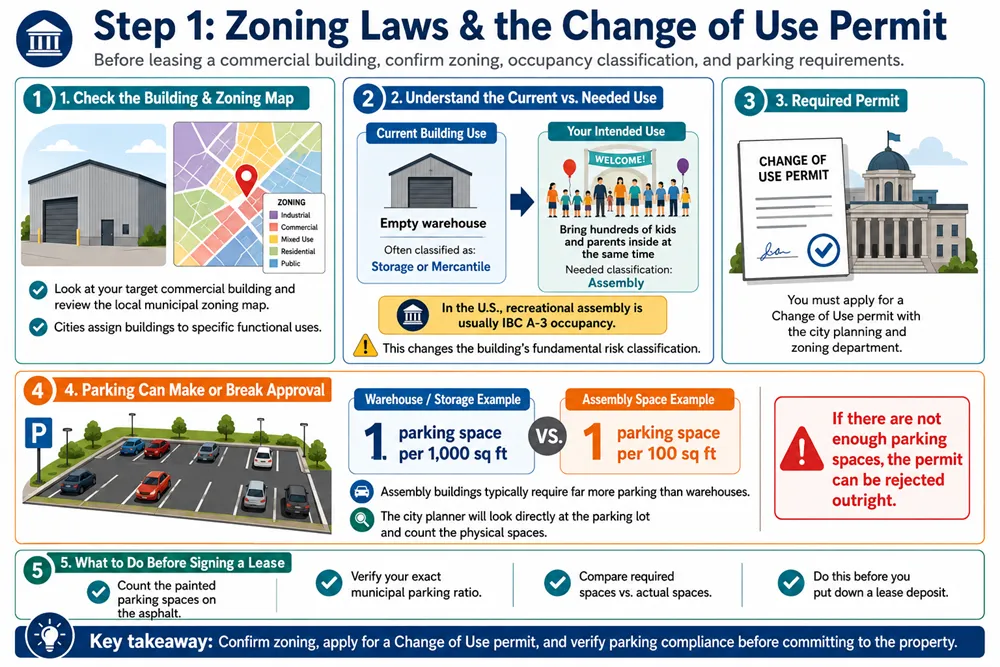
Look at your targeted commercial building. Look at the local municipal zoning map.
Cities zone buildings for specific functional uses. You found an empty warehouse. The city probably classifies that specific building as "Storage" or "Mercantile" use. You want to bring hundreds of kids and parents inside simultaneously. You are changing the fundamental risk classification of the building. You need an "Assembly" use classification. In the US, this is usually classified under the International Building Code (IBC) as an A-3 occupancy for recreation.
You must file for a Change of Use permit with the city planning and zoning department.
The city planner looks directly at your parking lot. Assembly buildings require significantly more parking spots per square foot than storage warehouses. A warehouse might only need one parking spot per 1,000 square feet. An assembly space might require one parking spot per 100 square feet of patron use area. Count the parking spaces painted on the asphalt outside. If you do not have enough physical spots, the city rejects your permit outright. Figure out your exact municipal parking ratio before you put down a deposit on a lease.
Step 2: ASTM F1918 Safety Compliance
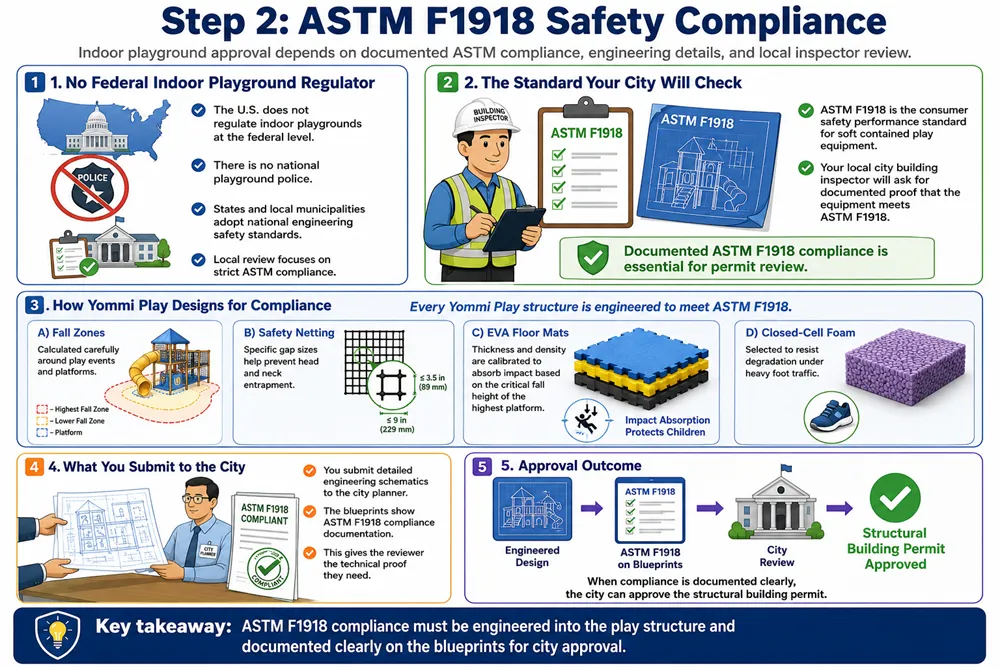
The United States does not regulate indoor playgrounds at the federal level. There is no national playground police. Instead, individual states and local municipalities adopt national engineering safety standards. They look for strict ASTM compliance.
ASTM F1918 is the standard consumer safety performance specification for soft-contained play equipment. Your local city building inspector will demand documented proof that your equipment meets this specific standard.
We engineer every Yommi Play structure to meet ASTM F1918. We calculate the fall zones meticulously. We design the safety netting enclosures with highly specific gap sizes. We do this to prevent head and neck entrapment. We calibrate the thickness and density of the EVA floor mats to absorb impact based on the critical fall height of the highest platform in your design. We use closed-cell foam that does not degrade under heavy foot traffic.
You hand our detailed engineering schematics to your city planner. They see the ASTM F1918 compliance documented on the blueprints. They approve the structural building permit.
Step 3: Managing the Fire Marshal and Material Testing
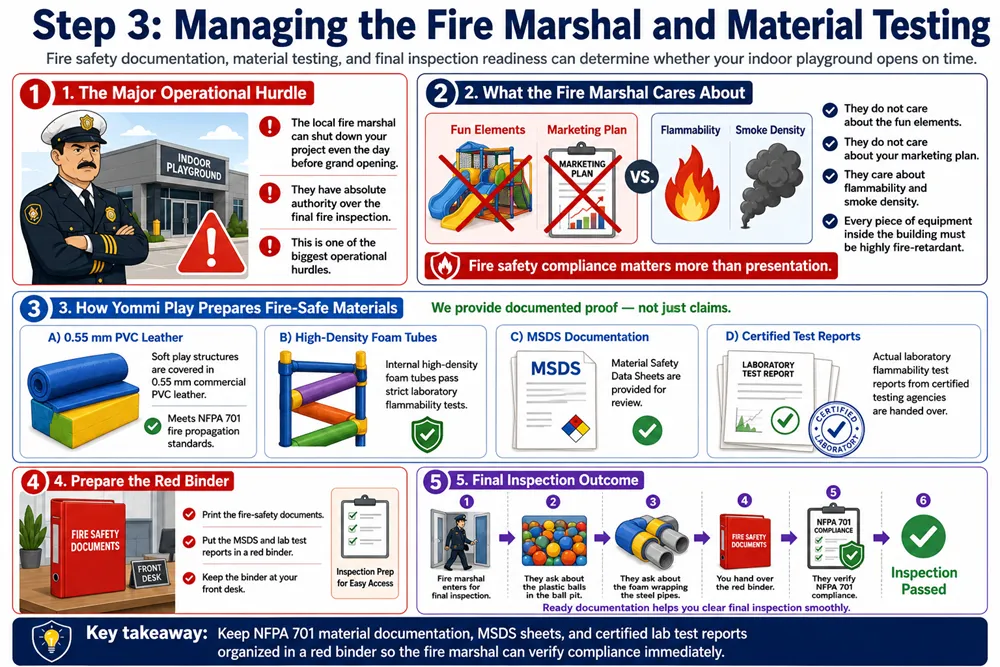
This is the major operational hurdle. The local fire marshal can completely shut down your project the day before your grand opening. They have absolute authority.
They do not care about the fun elements. They do not care about your marketing plan. They care about flammability and smoke density. Every single piece of equipment inside that building must be highly fire-retardant.
We cover our soft play structures in 0.55mm thick commercial PVC leather. It meets NFPA 701 fire propagation standards. The internal high-density foam tubes pass strict laboratory flammability tests. We do not just make claims. We provide the Material Safety Data Sheets (MSDS). We hand over the actual laboratory flammability test reports from certified testing agencies.
Print these documents out. Put them in a red binder. Keep that binder at your front desk. The fire marshal walks into your building for the final inspection. They ask about the thousands of plastic balls in the ball pit. They ask about the structural foam wrapping the steel pipes. You hand them the binder. They verify the NFPA 701 compliance. You pass the inspection.
Step 4: Sprinkler Systems and Ceiling Clearance
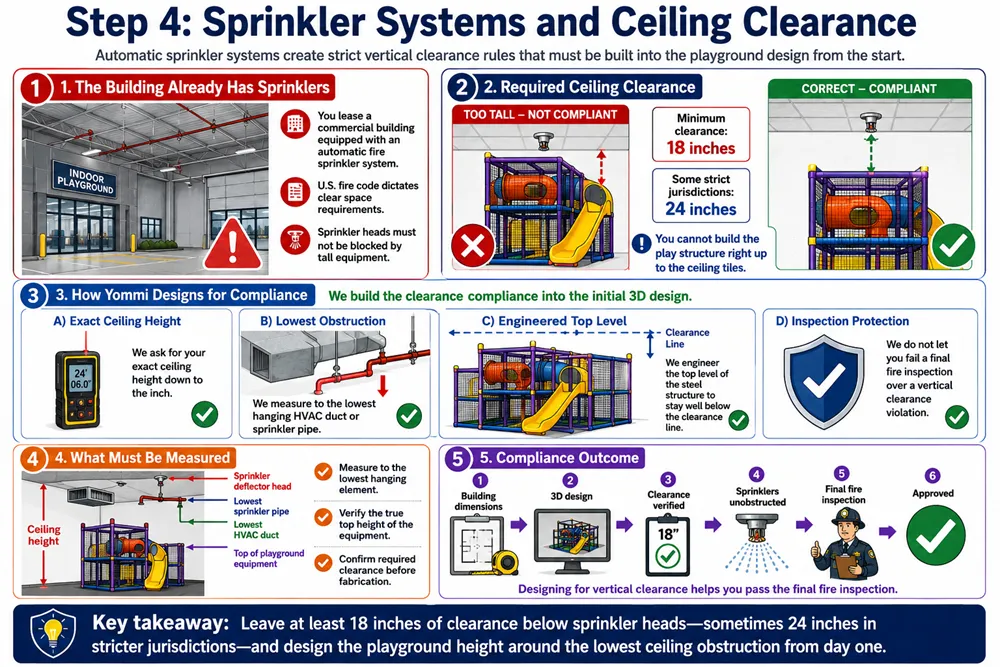
You lease a commercial building equipped with an automatic fire sprinkler system. The US fire code dictates clear space requirements.
You cannot build a massive multi-level play structure right up to the ceiling tiles. You must leave at least 18 inches of vertical clearance between the absolute top of your playground equipment and the sprinkler deflector heads. In some strict US jurisdictions, the local fire code demands 24 inches of clearance.
We ask for your exact ceiling height down to the inch. We measure to the lowest hanging HVAC duct or sprinkler pipe. We engineer the top level of your steel structure to stay well below that clearance line. We do not let you fail a final fire inspection over a vertical clearance violation. We build compliance into the initial 3D design.
Step 5: Egress Routes and 3D Floor Planning
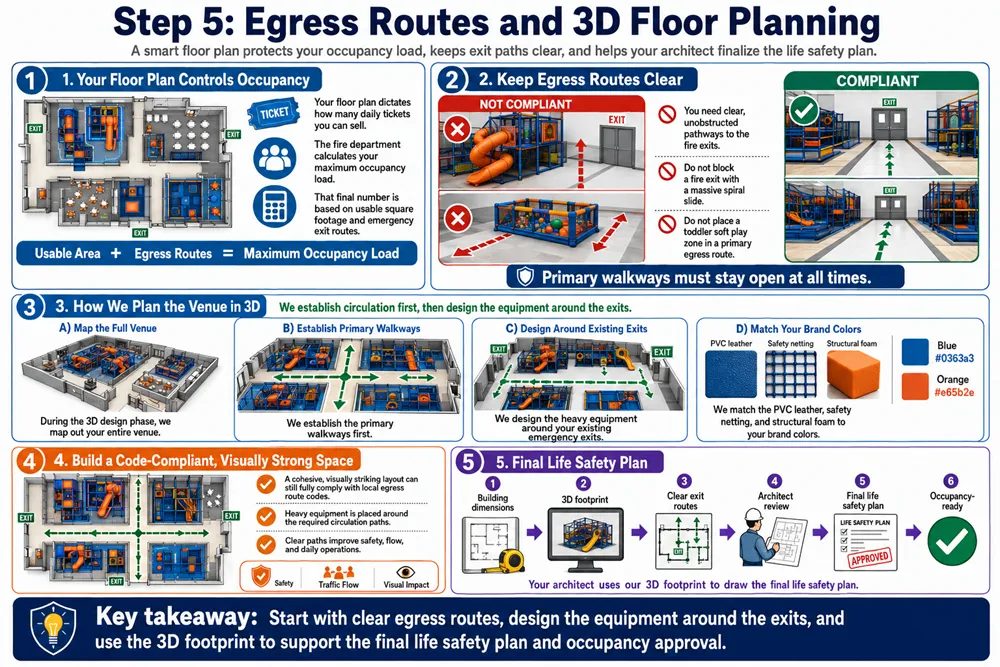
Your floor plan dictates how many daily tickets you can sell. The fire department calculates your maximum occupancy load. They base this final number on your total usable square footage and your emergency exit routes.
You need clear, unobstructed pathways to the fire exits. You cannot block a fire exit with a massive spiral slide. You cannot put a toddler soft play zone in the middle of a primary egress route.
During the 3D design phase, we map out your entire venue. We build the digital model using your exact brand colours. We match the PVC leather, the safety netting, and the structural foam specifically to your blue (#0363a3) and orange (#e65b2e) hex codes. We establish the primary walkways first. We design the heavy equipment around your existing emergency exits. We build a cohesive, visually striking space that completely complies with local egress route codes. Your architect uses our 3D footprint to draw the final life safety plan.
Step 6: ADA Accessibility Laws
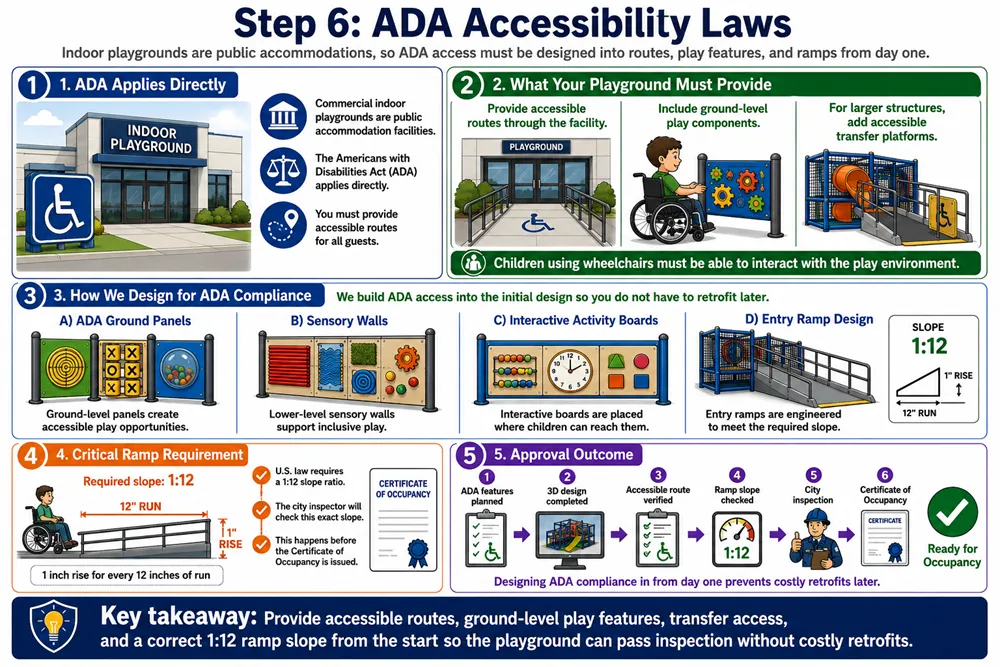
The Americans with Disabilities Act (ADA) applies directly to commercial indoor playgrounds. You operate a public accommodation facility. You must provide accessible routes for all guests.
You need ground-level play components. Kids using wheelchairs must be able to interact with the play environment. If your structure is large, you need accessible transfer platforms so children can move safely from a wheelchair onto the lower levels of the play structure.
We incorporate ADA-compliant ground panels. We design specific sensory walls and accessible interactive activity boards on the lower levels. We make sure the entry ramps have the correct 1:12 slope ratio required by US law. Your city inspector will check for this exact slope before issuing the Certificate of Occupancy. We build it in from day one, so you do not have to retrofit your equipment later.
Step 7: Bathrooms and Plumbing Fixtures
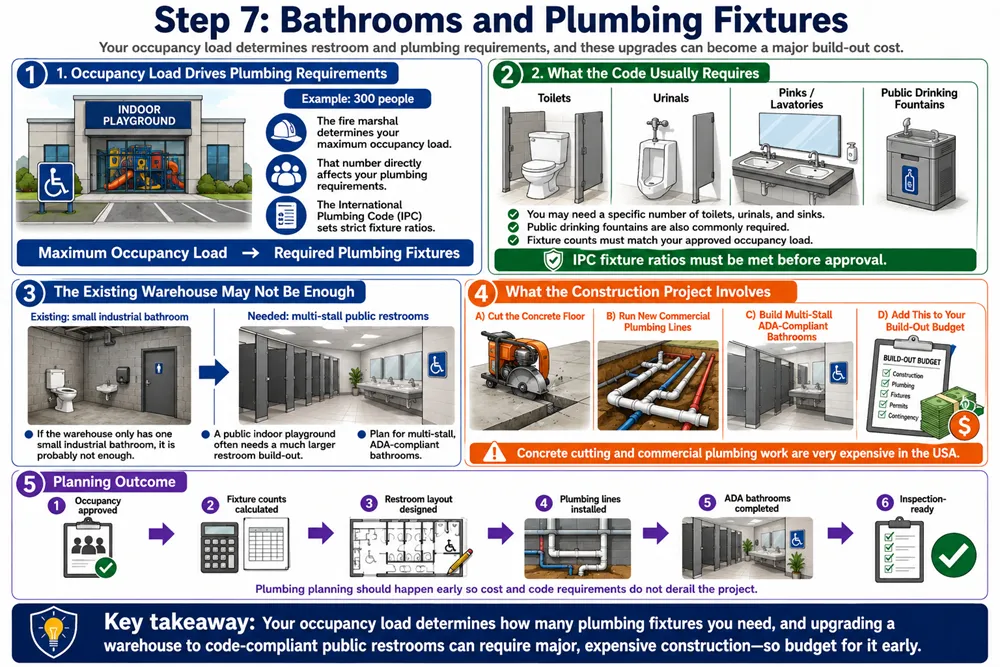
Your maximum occupancy load dictates your plumbing requirements. The International Plumbing Code (IPC) sets the strict fixture ratios.
If your fire marshal says your building can safely hold 300 people, the plumbing code requires a highly specific number of toilets, urinals, and sinks. It also usually requires public drinking fountains. If your warehouse only has one small industrial bathroom, you have a massive construction project ahead of you.
You have to cut the concrete floor. You have to run new commercial plumbing lines. You have to build out new multi-stall, ADA-compliant bathrooms. Factor this heavily into your initial build-out budget. Concrete cutting and commercial plumbing work are incredibly expensive in the USA.
Step 8: Adding Revenue Drivers and Arcades
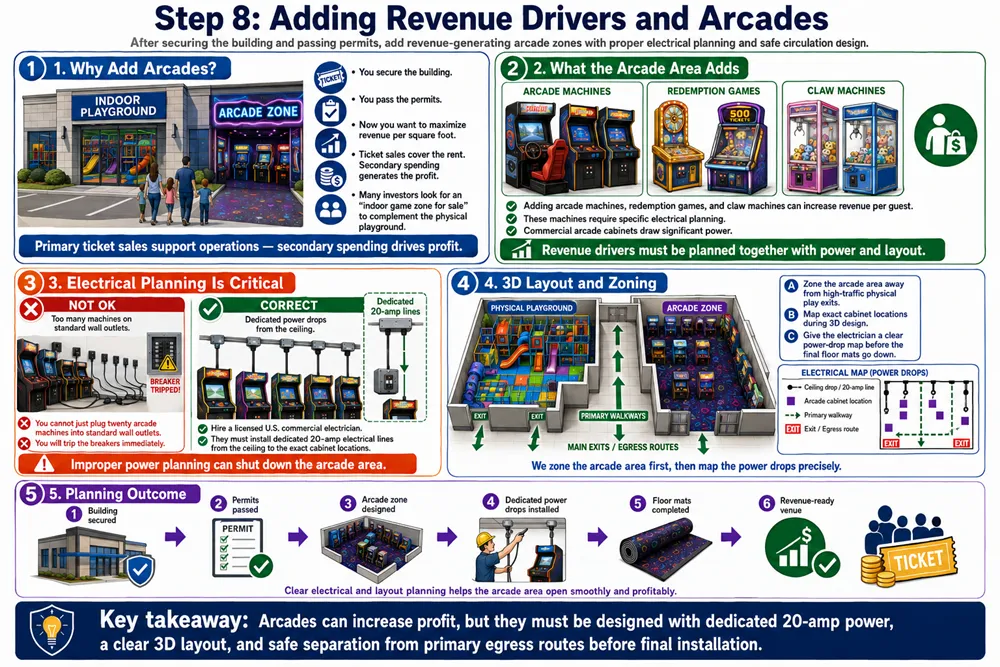
You secure the building. You pass the permits. Now you want to maximise the revenue per square foot. Ticket sales cover the rent. Secondary spending generates the profit.
Many investors look for a kids' indoor game zone for sale to complement the physical playground. Adding arcade machines, redemption games, and claw machines requires specific electrical planning. Commercial arcade cabinets draw significant power.
You cannot just plug twenty arcade machines into standard wall outlets. You will trip the breakers immediately. You must hire a licensed US commercial electrician. They need to drop dedicated 20-amp electrical lines from the ceiling down to the exact locations of the game cabinets. When we design your 3D layout, we zone the arcade area away from the high-traffic physical play exits. We give your electrician a clear map of where the power drops need to be installed before the final floor mats go down.
Step 9: Getting General Liability Insurance
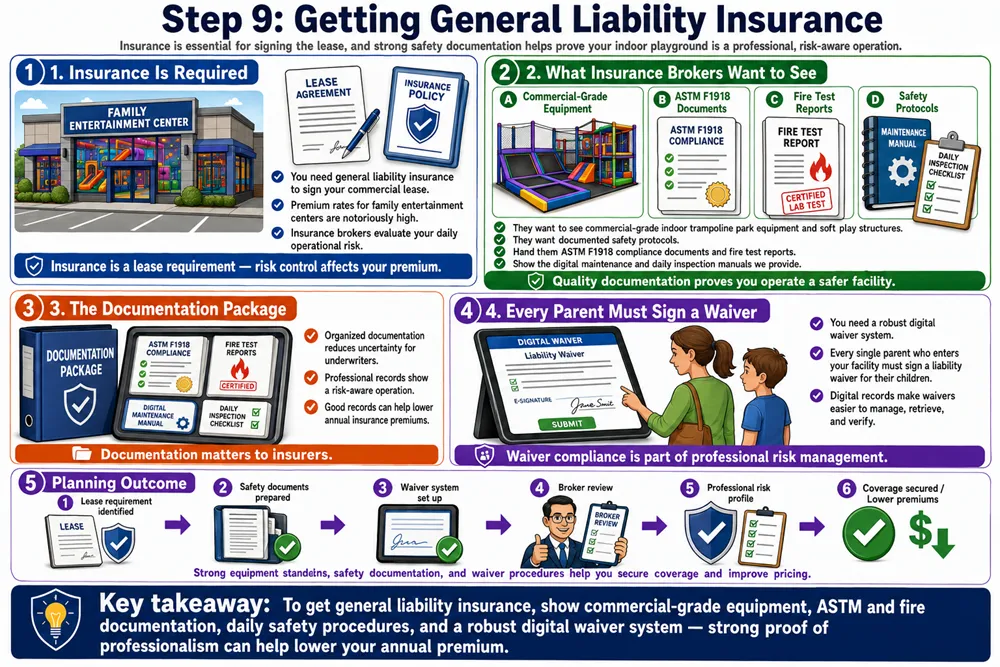
You need general liability insurance to sign your commercial lease. Premium rates for family entertainment centres are notoriously high. Insurance brokers evaluate your daily operational risk.
They want to see commercial-grade indoor trampoline park equipment and soft play structures. They want to see your documented safety protocols. Hand them our ASTM F1918 compliance documents. Hand them the fire test reports. Show them the digital maintenance and daily inspection manuals we provide.
Furthermore, you need a robust digital waiver system. Every single parent who enters your facility must sign a liability waiver for their children. Quality documentation proves you operate a highly professional, risk-aware facility. It lowers your annual insurance premiums.
Step 10: Vetting Your Factory Partner
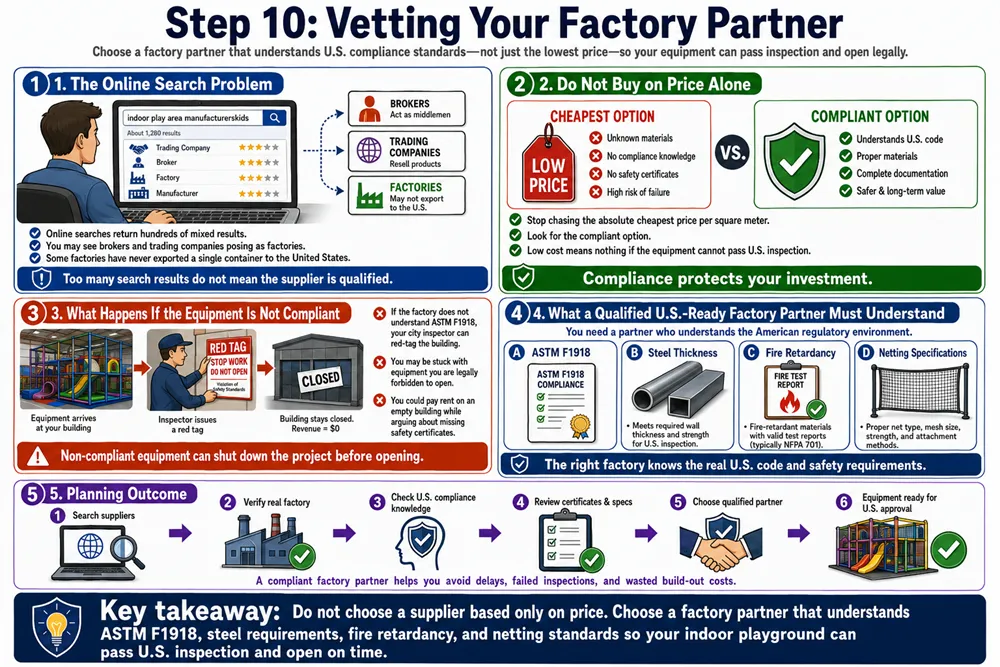
You need the equipment. You search online. Many investors type long phrases like indoor play area manufacturers into the search bar, hoping to find a direct factory. You get a hundred results. You see brokers. You see trading companies pretending to be factories. You see factories that have never exported a single container to the United States.
Stop looking for the absolute cheapest price per square meter. Look for the compliant option.
If you buy cheap equipment from a factory that does not understand ASTM F1918, your local US city inspector will red-tag your building. You will be stuck with a warehouse full of steel that you are legally forbidden to open. You will pay rent on an empty building while you argue with an overseas supplier about safety certificates they do not possess.
You need a partner who understands the American regulatory environment. We know the steel thickness required. We know the fire retardancy standards. We know the netting specifications.
Step 11: Third-Party Installation Sign-Off
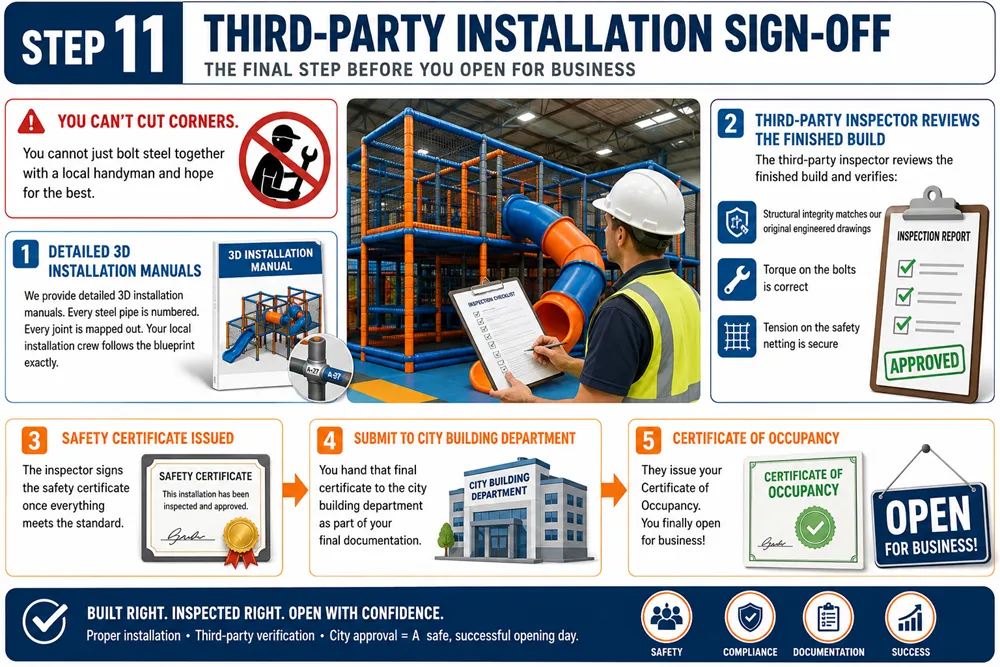
You cannot just bolt steel together with a local handyman and hope for the best.
Many US cities require a certified third-party structural inspector to sign off on the equipment installation before you can open to the public. We provide detailed 3D installation manuals. Every steel pipe is numbered. Every joint is mapped out. Your local installation crew follows the blueprint exactly.
The third-party inspector reviews the finished build. They verifythat the structural integrity matches our original engineered drawings. They check the torque on the bolts. They check the tension on the safety netting. They sign the safety certificate. You hand that final certificate to the city building department. They issue your Certificate of Occupancy. You finally open for business.
Frequently Asked Questions (FAQ)
Q1: How long does the municipal permit process take in the USA? It varies wildly by city and state. A simple permit update for an existing assembly space takes four weeks. A full Change of Use permit with comprehensive architectural plan reviews takes three to six months. Do not order your equipment until you have initial zoning approval from the city planning department.
Q2: Do I need an American architect? Yes. We supply the 3D equipment designs and the structural load data. But you need a local licensed American architect to draw up the official floor plans. They submit the plans for the bathrooms, the emergency exits, and the HVAC system to the city. They stamp the plans with their state license.
Q3: Does the equipment need to be UL Listed? The physical steel and foam do not. The electrical components absolutely do. If you buy interactive electronic strike boards, mmotorisedwipeout sweepers, or arcade machines from us, the power supplies and electrical boxes must meet US standards. We use UL-compliant electrical components for all American exports to ensure you pass the local electrical inspection.
Q4: Will the city inspect the equipment during the build? Yes. City building inspectors do rough-in inspections. They check the bare steel framing. They check the electrical wiring before we put the soft PVC padding over it. Keep your site clean. Follow the installation manual. Pass the rough-in inspection, then finish securing the padding.
Start the Build Process
Opening an indoor playground requires navigating intense local bureaucracy. Figure out your zoning. Secure the correct parking ratio. Buy equipment that actually passes the American Fire Marshal's test.
Contact the Yommi Play engineering team today. Send Ayla your building layout. We will build a highly compliant 3D design using your brand colours. We will get your park legally ready for the US market.