What Does an Indoor Playground Warranty Actually Cover?
Most buyers ask one question first: "What's the overall warranty?"
Fair enough. But here's the thing — there is no single "overall warranty." A commercial indoor playground is a system of different materials, each ageing at its own pace. The steel frame doesn't fail the same way a foam pad does. So a serious manufacturer breaks the warranty down by component category.
That's not a red flag. It's the opposite. A factory that gives you one blanket number is either hiding something or hasn't sold enough units to know the difference.
Let me walk you through what a real warranty looks like — the kind we've used across 317+ projects in 38 countries. If you're shopping for equipment right now, save this page. It'll save you money later.
Why Warranty Matters More Than You Think
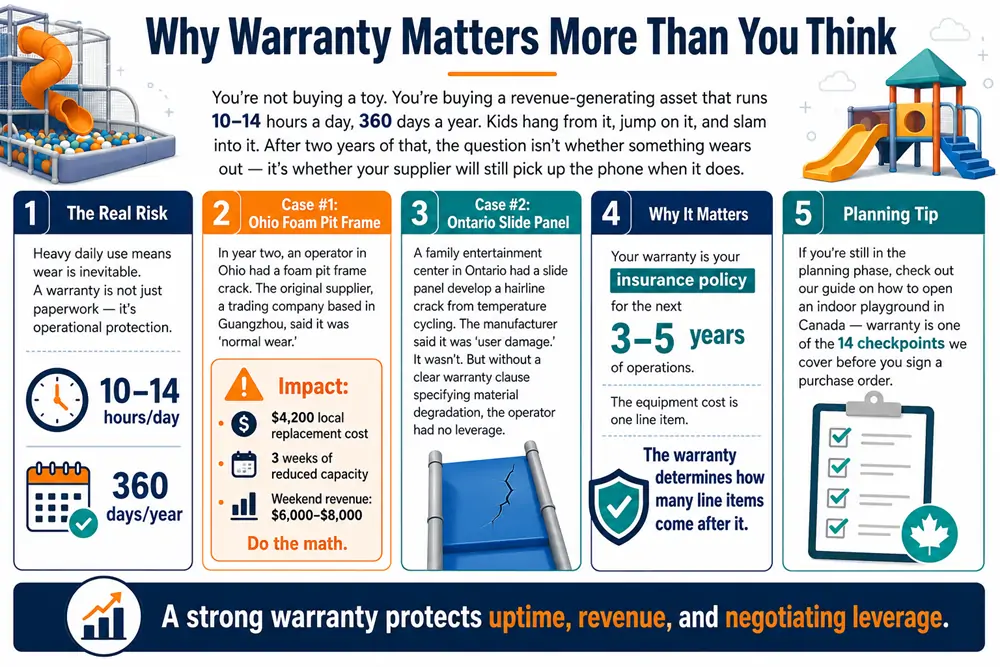
You're not buying a toy. You're buying a revenue-generating asset that runs 10–14 hours a day, 360 days a year. Kids hang from it, jump on it, slam into it. After two years of that, the question isn't whether something wears out — it's whether your supplier will still pick up the phone when it does.
I'll give you a real scenario. An operator in Ohio had a foam pit frame crack during year two. The original supplier — a trading company based in Guangzhou — told him "that's normal wear." Cost him $4,200 to source a local replacement and three weeks of reduced capacity. His weekend revenue was $6,000–$8,000. Do the math.
Another case: a family entertainment centre in Ontario had a slide panel develop a hairline crack from temperature cycling. The manufacturer said it was "user damage." It wasn't. But without a clear warranty clause specifying material degradation, the operator had no leverage.
Your warranty is your insurance policy for the next 3–5 years of operations. The equipment cost is one line item. The warranty determines how many line items come after it.
If you're still in the planning phase, check out our guide on how to open an indoor playground in Canada — warranty is one of the key checkpoints to nail before you sign a purchase order.
Standard Warranty Periods by Component Type
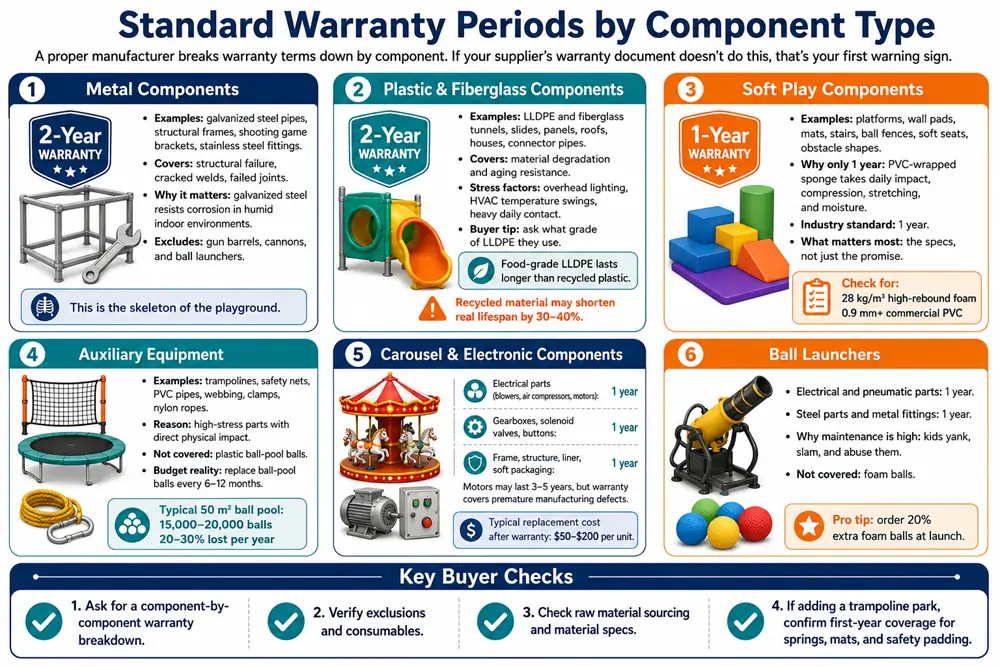
Here's how a proper manufacturer structures indoor playground warranty terms. If your supplier's warranty document doesn't break things down like this, that's your first warning sign.
Metal Components — 2-Year Warranty
Galvanised steel pipes, structural frames, shooting game metal brackets, and all stainless steel fittings (bolts, screws, nuts, washers) carry a 2-year warranty against structural failure.
This covers the skeleton of your playground — the part that holds everything together. If a weld cracks or a joint fails within two years, that's on the manufacturer. Galvanised steel is specifically chosen because it resists corrosion in humid indoor environments, which is why it's the only frame material we use. If you want to understand why that matters, we wrote a detailed comparison of galvanised steel vs standard steel for playground frames.
What's excluded from the metal warranty: gun barrels, cannons, and ball launchers. Those are high-impact moving parts with their own warranty category (covered below).
Plastic & Fibreglass Components — 2-Year Warranty
Parts made from LLDPE (Low-Density Polyethene) and fibreglass — tunnels, swing seats, seesaws, lookout towers, cubes, slides, panels, connector pipes, plastic houses, themed roofs — come with a 2-year warranty against material degradation.
These components face temperature swings from HVAC cycling, humidity fluctuations, and constant physical contact from thousands of kids per week. A 2-year warranty on ageing resistance means the manufacturer is confident in their raw material sourcing and moulding process.
Here's a tip most buyers miss: ask the manufacturer what grade of LLDPE they use. UV-stabilized virgin LLDPE — the standard for commercial playground equipment — has very different ageing characteristics from recycled plastic. A factory that uses recycled material can still offer a 2-year warranty on paper, but the real-world lifespan will be 30–40% shorter. If they hesitate when you ask about material sourcing, that tells you everything.
Soft Play Components — 1-Year Warranty
This is where things get real. Soft play equipment — platforms, themed panels, cartoon decoration boards, wall pads, climbing frames, stairs, ball fences, sand pits, bridge sandbags, floor mats, slide mats, soft seats, and various obstacle shapes — carries a 1-year warranty.
The reason is simple: PVC leather-wrapped sponge products absorb impact daily. They compress, they stretch, they get wet from spilt drinks and sweaty kids. A 1-year warranty is industry standard. Some factories will promise 2 years on soft play, but in practice, the foam density and PVC thickness they use won't hold up that long.
What separates a good soft play warranty from a bad one isn't the number — it's whether the manufacturer specifies the foam density (we use 28kg/m³ high-rebound foam) and PVC thickness (0.9mm+ commercial grade). Without those specs, "2-year warranty" is just a marketing line.
Auxiliary Equipment — 1-Year Warranty
Trampolines, safety nets, PVC pipes, webbing equipment, clamps, and nylon ropes all carry a 1-year warranty. These are high-stress components that take direct physical impact every operating hour.
One important note: plastic balls for ball pools are not covered under any warranty. They're consumables. Budget for replacement every 6–12 months depending on traffic volume. A typical 50m² ball pool uses 15,000–20,000 balls, and you'll lose roughly 20–30% per year to cracking, discolouration, and kids walking off with them. It's a real operating cost that catches new operators off guard.
If you're building a trampoline park alongside your indoor playground, the warranty structure is slightly different — trampoline park equipment has its own set of warranty considerations around springs, mats, and safety padding. When comparing trampoline park manufacturers USA operators recommend, look for those that include spring and mat replacement coverage in their first-year package rather than treating them as paid add-ons.
Carousel & Electronic Components — 1-Year Warranty
Children's carousels and electronic play equipment have the most complex warranty structure because they combine mechanical, electrical, and soft elements in one unit.
Here's the breakdown:
- Electronic/electrical parts: blowers, air compressors, motors — 1 year. These are the highest-failure-rate components in any indoor playground. A blower motor running 12 hours a day will typically last 3–5 years, but the warranty covers premature failure from manufacturing defects.
- Gearboxes, solenoid valves, buttons: 1 year. These are mechanical wear items. After warranty, replacement cost is typically $50–$200 per unit depending on the component.
- Frame, structure, liner, and soft packaging: 1 year. The structural elements of a carousel are simpler than those of a multi-level play structure, so the warranty reflects that.
Ball Launchers — 1-Year Warranty
Ball launchers and interactive shooting games are popular revenue drivers, but they're also among the most maintenance-intensive components in a playground.
Warranty coverage:
- Electrical and pneumatic parts: 1 year. The compressor and valve system are the heart of the launcher. If these fail within year one, that's a manufacturing defect.
- Steel parts and metal fittings: 1 year. Gun barrels, brackets, support columns, gun seats, and mounting hardware. These take direct impact from kids yanking, slamming, and generally abusing them.
- Foam balls: not covered. Same logic as ball pool balls — they're consumables.
Pro tip: always order 20% more foam balls than you think you need at launch. They disappear faster than you expect.
What's NOT Covered — The Exclusions That Matter
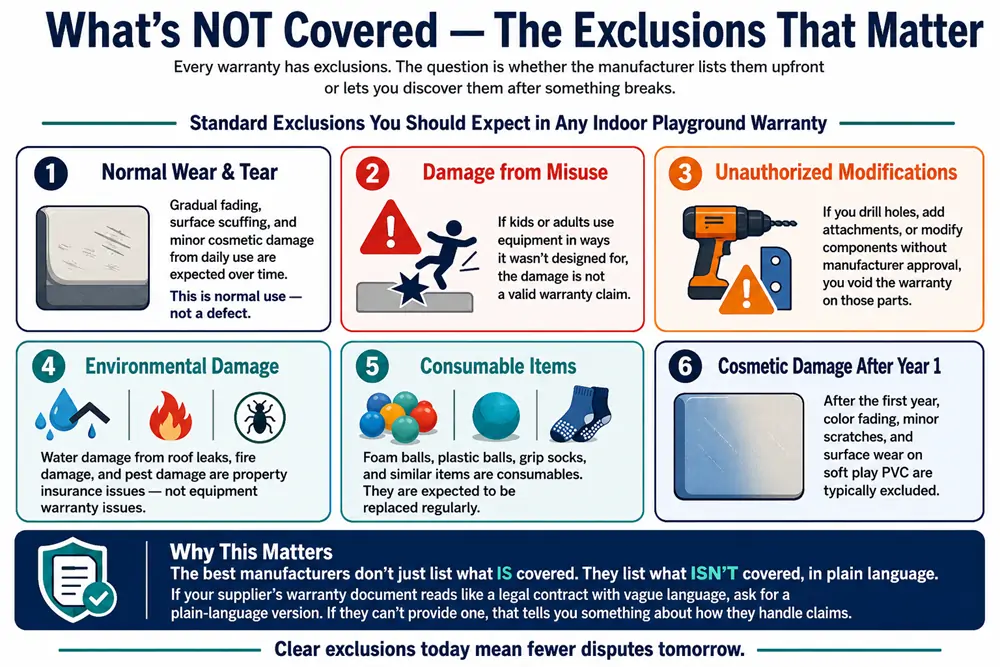
Every warranty has exclusions. The question is whether the manufacturer lists them upfront or lets you discover them after something breaks.
Here are the standard exclusions you should expect in any indoor playground warranty:
- Normal wear and tear — gradual fading, surface scuffing, minor cosmetic damage from daily use. This is expected and not a defect.
- Damage from misuse — if kids (or adults) use equipment in ways it wasn't designed for, that's not a warranty claim.
- Unauthorised modifications — if you drill holes, add attachments, or modify components without manufacturer approval, you void the warranty on those parts.
- Environmental damage — water damage from roof leaks, fire damage, pest damage. These are property insurance issues, not equipment warranty issues.
- Consumable items — foam balls, plastic balls, grip socks, and similar items that are expected to be replaced regularly.
- Cosmetic damage after year 1 — colour fading, minor scratches, and surface wear on soft play PVC after the first year.
The best manufacturers don't just list what IS covered. They list what ISN'T covered, in plain language. If your supplier's warranty document reads like a legal contract with vague language, ask for a plain-language version. If they can't provide one, that tells you something about how they handle claims.
The Warranty Scam Nobody Talks About
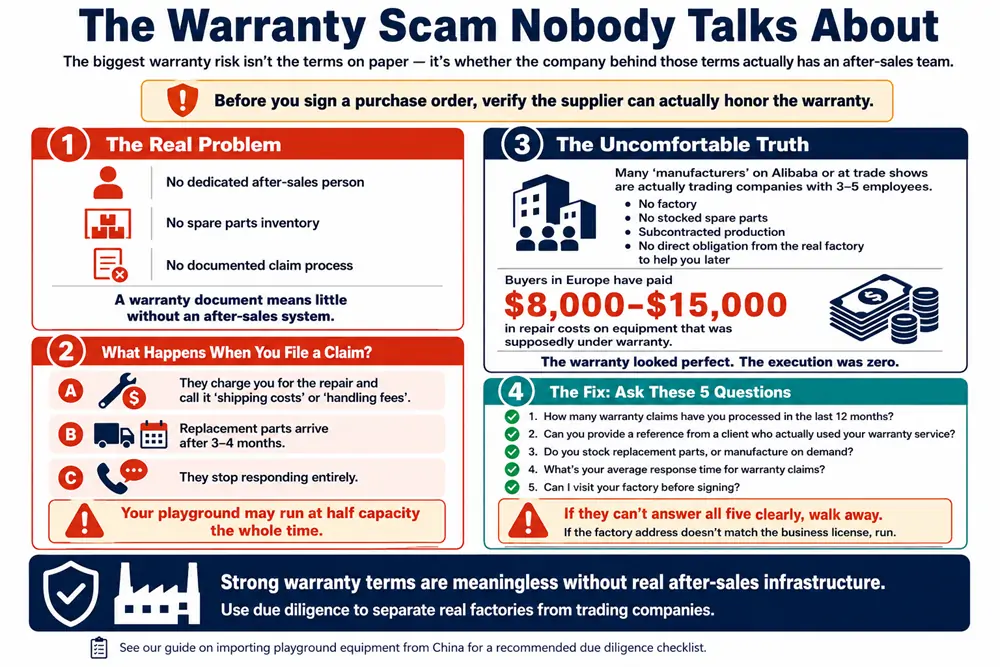
Here's what I tell every buyer before they sign a purchase order: the biggest warranty risk isn't the terms on paper — it's whether the company behind those terms actually has a team to handle claims.
Some trading companies and newly established export firms have no after-sales system at all. No dedicated support person. No spare parts inventory. No documented process for handling claims.
So what happens? When you call them about a warranty issue, one of three things happens:
- They charge you for the repair and call it "shipping costs" or "handling fees"
- They send you replacement parts after 3–4 months — your playground is running at half capacity the whole time
- They stop responding entirely
I've seen buyers in Europe pay $8,000–$15,000 in repair costs on equipment that was supposedly under warranty — because the supplier had no infrastructure to honour it. The warranty document looked perfect. The execution was zero.
Here's the uncomfortable truth: many "manufacturers" you find on Alibaba or at trade shows are actually trading companies with 3–5 employees. They don't have a factory. They don't stock parts. They sub everything out. When you call them two years later about a warranty claim, they have to go back to whoever actually made the equipment — and that factory has no relationship with you and no obligation to help.
The fix: before you buy, ask these five questions:
- How many warranty claims have you processed in the last 12 months?
- Can you provide a reference from a client who actually used your warranty service?
- Do you stock replacement parts, or do you manufacture on demand?
- What's your average response time for warranty claims?
- Can I visit your factory before signing?
If they can't answer all five clearly, walk away. If they say "yes, you can visit," but the factory address doesn't match their business license, run.
For more on how to separate real factories from trading companies, our guide on importing playground equipment from China covers the due diligence checklist we recommend to every buyer.
How to Evaluate a Manufacturer's Warranty Before You Buy
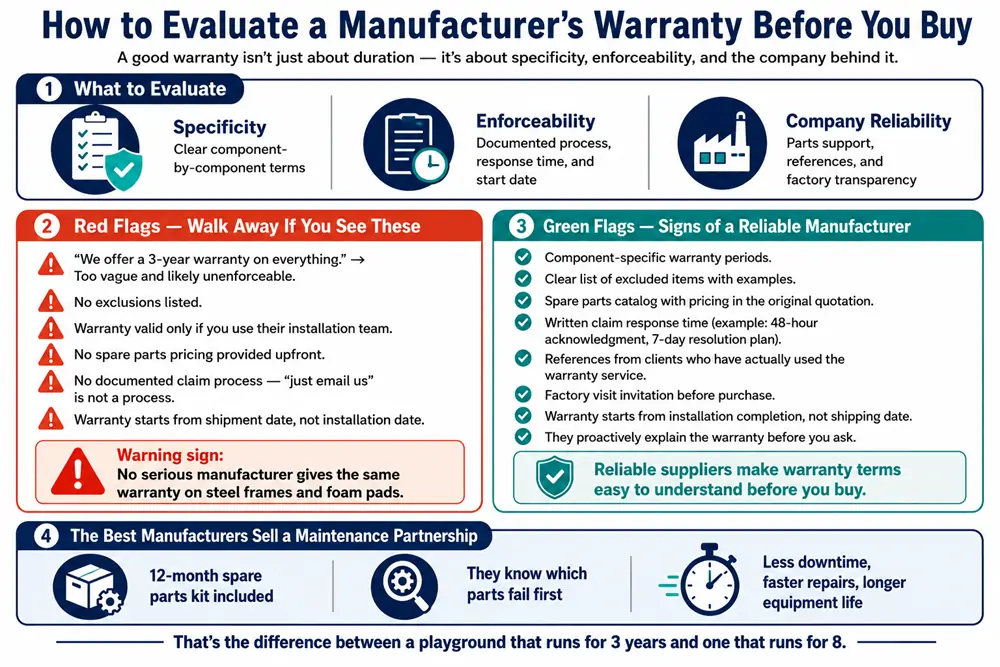
A good warranty isn't just about duration. It's about specificity, enforceability, and the company behind it.
Here's a comprehensive checklist we use internally when evaluating suppliers (yes, even manufacturers evaluate other manufacturers for components we don't produce in-house). Whether you're sourcing soft play apparatus for a new build or replacing worn-out components in an existing venue, these questions will tell you everything you need to know:
Red Flags — Walk Away If You See These
- "We offer a 3-year warranty on everything" — too vague, probably unenforceable. No serious manufacturer gives the same warranty on steel frames and foam pads.
- No mention of what's excluded — a warranty without exclusions is a warranty without substance.
- Warranty only valid if you use their installation team — this is a lock-in tactic, not a quality measure.
- No spare parts pricing provided upfront — if they won't tell you what parts cost during the sales process, imagine what they'll charge after you've paid.
- No documented claim process — "just email us" isn't a process.
- Warranty starts from the shipment date, not the installation date — your equipment might sit in a warehouse for 3 months. A fair warranty starts when the equipment goes live.
Green Flags — Signs of a Reliable Manufacturer
- Component-specific warranty periods (like the breakdown in this article)
- Clear list of excluded items with specific examples
- Spare parts catalogue with pricing included in the original quotation
- Written claim response time (e.g., 48-hour acknowledgement, 7-day resolution plan)
- References from clients who've actually used the warranty service
- Factory visit invitation before purchase
- Warranty starts from installation completion, not the shipping date
- They proactively explain warranty terms before you ask
The best manufacturers don't just sell you equipment — they sell you a maintenance partnership. The best ones include a 12-month spare parts kit with every installation, because they know which parts fail first and would rather you have them on hand than wait for a shipment from China.
That's the difference between a playground that runs for 3 years and one that runs for 8.
Warranty and Your Business Plan
One thing that surprises new operators: warranty terms should be a line item in your business plan, not an afterthought.
Here's why. If your soft play warranty is 1 year and you know those components will need refreshing at month 18, you should budget for that during the planning phase. A typical soft play refresh for a 500m² playground runs $3,000–$7,000 depending on what needs replacing.
Same with ball pool balls, foam launcher ammo, and grip socks. These are consumables. They're not covered by warranty. And they add up.
Smart operators budget 3–5% of initial equipment cost per year for maintenance and consumables. That means a $150,000 playground should have $4,500–$7,500 annually earmarked for upkeep. If your warranty covers manufacturing defects (and it should), that budget goes toward wear items and upgrades instead of emergency repairs.
For a detailed breakdown of how warranty factors into your overall investment, see our trampoline park and indoor playground investment budget guide.
FAQ
Q: Does the indoor playground warranty cover normal wear and tear?
A: No. A standard indoor playground warranty covers manufacturing defects and material failures — not gradual wear from normal daily operation. Soft play components, for example, are expected to show signs of wear after 12–18 months of heavy use. The warranty protects you against premature failure, meaning the component breaks or degrades faster than it should under normal conditions. If a foam pad loses its bounce in month 4, that's a warranty claim. If it shows minor surface wear in month 14, that's normal.
Q: What happens if a component fails during the warranty period?
A: A reliable manufacturer will ship replacement parts free of charge and provide installation guidance — typically a video call or step-by-step documentation. Some manufacturers cover shipping costs; others will ship parts freight collect. Always clarify this before signing the purchase agreement. Response time matters too: a good supplier acknowledges claims within 48 hours and ships replacement parts within 7–10 business days. If they can't commit to that timeline, your playground could be running at reduced capacity for weeks.
Q: Can I extend the warranty on my indoor playground equipment?
A: Yes, most established manufacturers offer extended warranty packages for an additional fee — typically 10–15% of the original equipment cost per extra year. This is worth considering for high-traffic venues operating 12+ hours per day or facilities in regions where sourcing local replacement parts is difficult. Before purchasing an extension, ask exactly what it covers. Some manufacturers extend coverage on metal and plastic components but exclude soft play and electronic items from the extended plan. Others offer tiered packages — a basic extension covering structural components only, or a premium extension covering everything except consumables. Always get the extended warranty terms in writing before your original warranty expires.
Q: Are foam balls and consumable items covered under warranty?
A: No. Plastic balls for ball pools, foam balls for launchers, grip socks, and similar consumable items are explicitly excluded from all standard indoor playground warranty agreements. These items are expected to wear out through normal use and should be budgeted as recurring operating expenses. For a typical 500m² facility, consumable replacement costs run $1,500–$3,000 per year depending on traffic volume. Grip socks are a separate revenue line for most operators — they sell them at $2–$4 per pair with a 60–70% margin. So while they're not covered by warranty, they often pay for themselves and then some. The real cost to watch is ball pool replacement, where you'll lose 20–30% of inventory annually.
Q: How do I verify if a manufacturer will actually honour their warranty?
A: Start by asking for references — not just testimonials on their website, but actual contact information for clients who've filed warranty claims. Call those references. Ask about response time, whether parts were shipped free, and how the manufacturer handled disputes. Also check if the company has a dedicated after-sales team (not just a sales rep who handles complaints). Manufacturers with 5+ years of export experience have typically processed real claims and built systems around them. If a company has been exporting for less than 2 years, its warranty process is probably untested.