I have been manufacturing and exporting commercial indoor playground equipment for over 10 years. Throughout my career, I have spoken with thousands of investors across North America, Europe, and Australia. Whether they are backed by private equity firms or risking their life savings to open a community Family Entertainment Centre (FEC), they all eventually ask the exact same question. They sit down, look at the blueprints, and ask: "Is this business actually profitable?"When you search online to find out what the typical income is for an indoor playground, you get wildly conflicting answers. Some trading companies promise you will make a million dollars and break even in six months. On the other hand, you will find failed owners on business forums complaining that rent and payroll ate every penny they made.
As the owner of one of the leading commercial playground equipment manufacturers, I do not sell anxiety, and I do not paint unrealistic dreams. Today, I am going to use real financial data from hundreds of our successful overseas clients to strip away the industry hype. We are going to break down the exact revenue structures, the hidden cost black holes, the operational secrets of top earners, and the real net profit you can actually take home.
1. The Real Gross Income: How Much Money Actually Comes In?
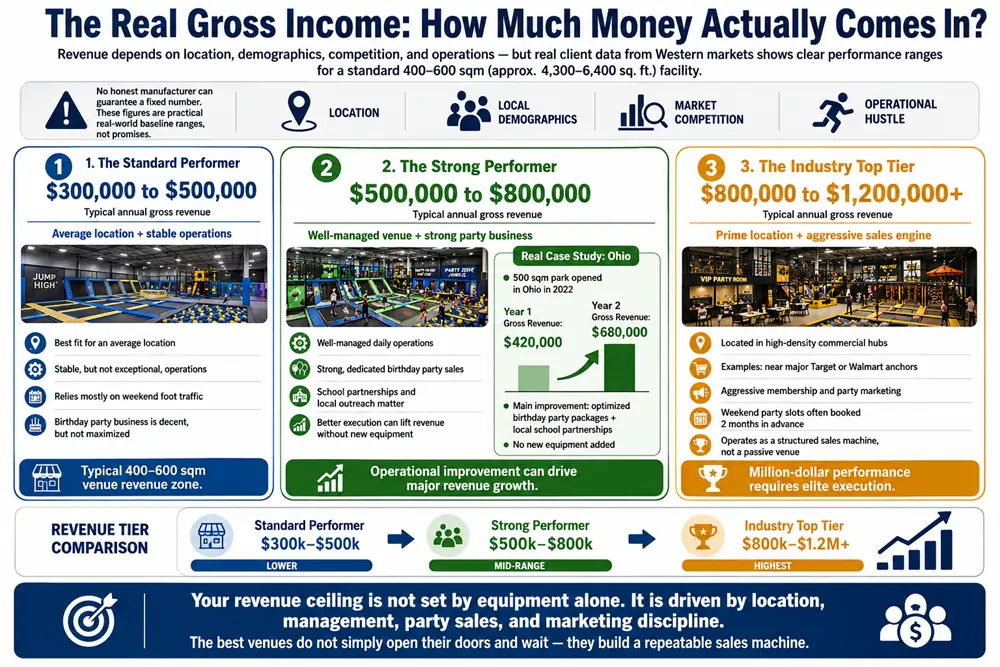
The most common question I get is how much a standard 400 to 600 square meter (approx. 4,300 to 6,400 sq. ft.) facility can make in a single year. The truth is, no honest manufacturer will guarantee a fixed number. Your location, local demographics, market competition, and operational hustle dictate your absolute ceiling.
However, based on our real-world client data in Western markets, here is the baseline of what you can expect:
• The Standard Performer ($300,000 to $500,000): If your location is average and your operations are stable but not exceptional, this is your zone. A 400-600 sqm venue typically generates $300,000 to $500,000 in gross annual revenue. This facility relies mostly on weekend foot traffic and does a decent, but not maximised, birthday party business.
• The Strong Performer ($500,000 to $800,000): If your facility is well-managed with a strong, dedicated party business, gross revenue usually reaches this tier. Let me share a real case study. I have a client who opened a 500-square-meter park in Ohio in 2022. In his first year, he hit $420,000. In his second year, he aggressively optimised his birthday party packages and pushed local school partnerships. His Year 2 gross revenue jumped to $680,000 without adding a single new piece of equipment.
• The Industry Top Tier ($800,000 to $1,200,000+): Venues located in high-density commercial hubs (like next to a major Target or Walmart anchor) that execute aggressive membership and party marketing can break the million-dollar mark. These are mature, fiercely operated venues. Their weekend party slots are fully booked two months in advance. They do not just open their doors and hope for the best; they operate a highly structured sales machine.
2. Foot Traffic & Ticket Pricing: The Weekday vs. Weekend Reality
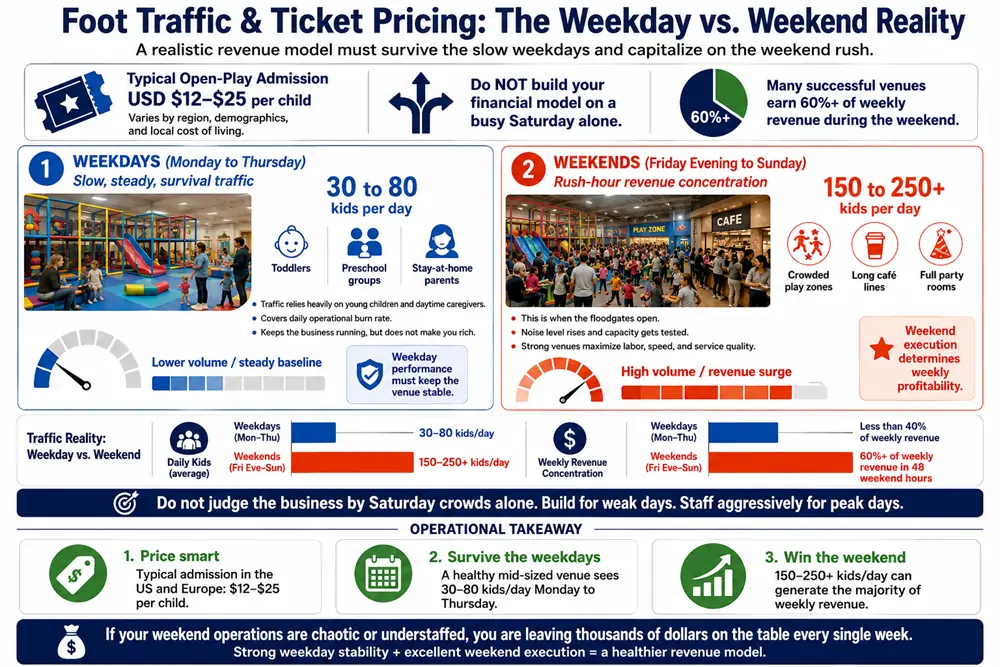
To understand the revenue, you must deeply understand the traffic flow. You cannot base your financial model on a busy Saturday afternoon. In the US and Europe, standard open-play admission typically ranges from $12 to $25 per child, depending on regional demographics and the local cost of living. The contrast between weekday and weekend traffic is absolutely staggering. You must build a business model that survives the slow days and capitalises on the rushes.
• Weekdays (Monday to Thursday): Your traffic will rely heavily on toddlers, preschool groups, and dedicated stay-at-home parents. A healthy, mid-sized venue sees about 30 to 80 kids per day during the week. This covers your daily operational burn rate, but it does not make you rich.
• Weekends (Friday Evening to Sunday): This is when the floodgates open. You will consistently see 150 to 250+ kids per day. The noise level rises, the café line gets long, and the party rooms are full.
Because of this intense concentration, many of our most successful clients generate more than 60% of their entire weekly revenue during the 48 hours of the weekend. If your weekend operations are chaotic or poorly staffed, you are leaving thousands of dollars on the table every single week.
3. The Golden Revenue Breakdown: Where is the Real Profit?
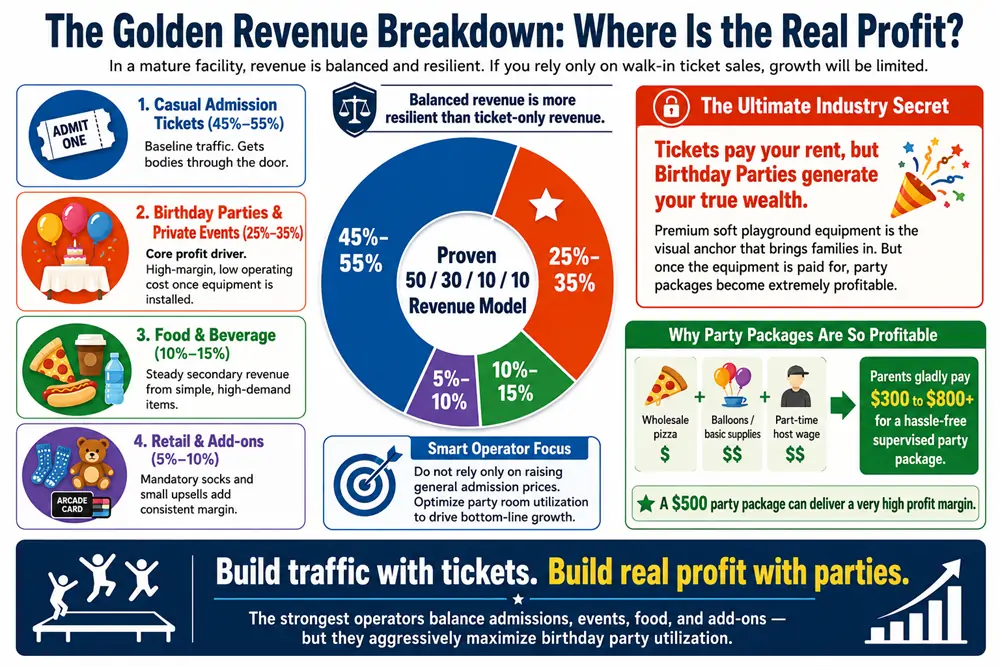
Many newcomers assume selling walk-in admission tickets is the main way to make money. In a mature facility, the revenue structure is far more balanced and resilient. If you only rely on ticket sales, you will struggle. Our most successful clients usually follow this proven "50/30/10/10" revenue breakdown:
• Casual Admission Tickets (45% - 55%): This is your baseline traffic. It gets bodies through the door.
• Birthday Parties & Private Events (25% - 35%): This is the core profit driver.
• Food & Beverage (10% - 15%): Pizza, hot dogs, speciality coffee, and bottled water.
• Retail & Add-ons (5% - 10%): Mandatory custom grip socks, small toys, and arcade cards.
Here is the ultimate industry secret: Tickets pay your rent, but Birthday Parties generate your true wealth. Your premium soft playground equipment is the visual anchor that brings people in. But once that physical equipment is paid for, hosting a birthday party costs you very little. A basic party requires a few boxes of wholesale pizza, some balloons, and a part-time host's hourly wage. Yet, parents gladly pay $300 to $800+ for these hassle-free, supervised packages. The profit margin on a $500 party package is incredibly high. Smart operators do not just raise their general admission ticket prices; they aggressively optimise their party room utilisation to drive bottom-line growth.
4. The Ultimate Profit Killers: Rent and Payroll
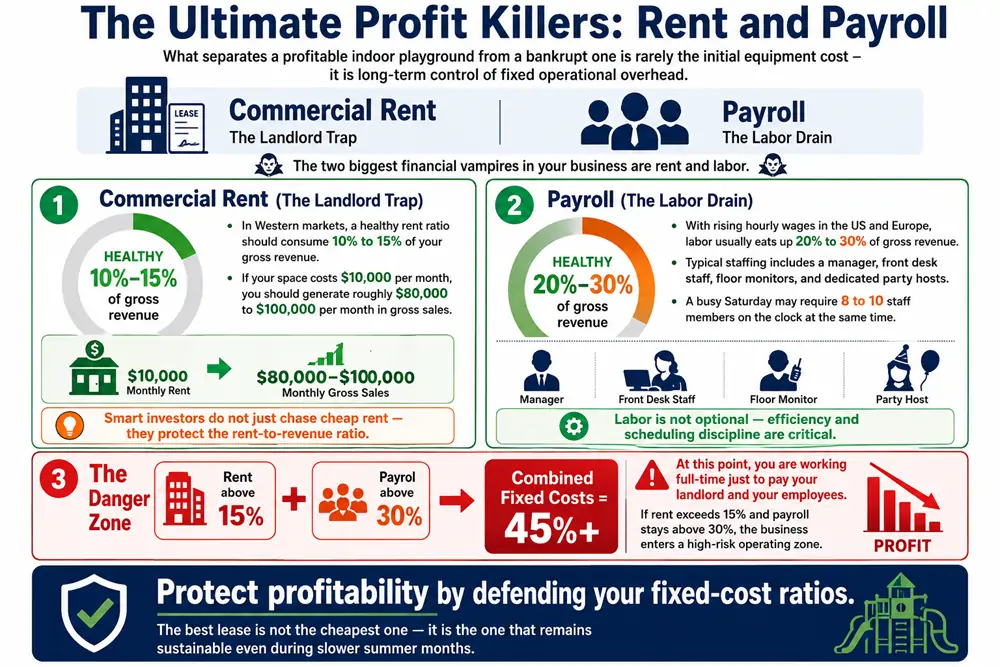
What separates a highly profitable indoor playground from a bankrupt one is rarely the initial equipment cost. The true difference lies in managing long-term, fixed operational overhead. The two biggest financial vampires in your business are commercial rent and payroll.
• Commercial Rent (The Landlord Trap): In Western markets, a healthy rent ratio should consume 10% to 15% of your gross revenue. If your space is $10,000 a month, you need to be generating roughly $80,000 to $100,000 a month in gross sales.
• Payroll (The Labour Drain): With rising hourly wages in the US and Europe, labour will usually eat up 20% to 30% of your gross revenue. You need a manager, front desk staff, floor monitors, and dedicated party hosts. A busy Saturday might require 8 to 10 staff members on the clock simultaneously.
The Danger Zone: If your rent exceeds 15% of your gross sales and your payroll consistently stays above 30%, your combined fixed costs are hitting 45% or higher. At that point, you are essentially working full-time just to pay your landlord and your employees. Smart investors do not just look for the cheapest rent; they look for a lease where the rent-to-revenue ratio remains highly defensible, even during the slower summer months.
5. The Hidden Operational Expenses You Must Not Ignore
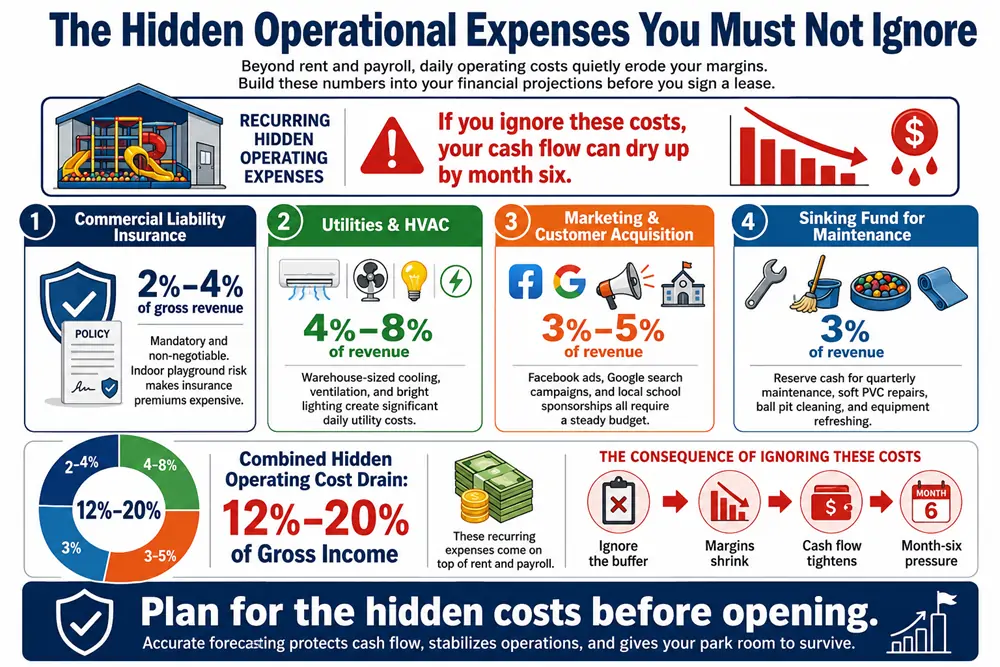
Beyond rent and payroll, first-time owners frequently underestimate the persistent, daily operational costs that chip away at the bottom line. You must bake these numbers into your financial projections before you sign a lease.
• Commercial Liability Insurance: This is mandatory and non-negotiable. Because an indoor playground involves physical risk, insurance underwriters will charge a premium. It typically costs 2% to 4% of your gross revenue.
• Utilities & HVAC: Running massive commercial air conditioning systems and bright lighting in a warehouse-sized space all day is expensive. Expect your utility bills to consume 4% to 8% of your revenue.
• Marketing & Customer Acquisition: You cannot just open the doors and expect people to show up. Running targeted Facebook ads, Google search campaigns, and local school sponsorships will cost another 3% to 5%.
• Sinking Fund for Maintenance: Soft PVC tears over time. Ball pits need cleaning. You should reserve 3% of your revenue for quarterly maintenance and equipment refreshing.
Combined, these hidden operational costs drain an additional 12% to 20% of your gross income. If you do not plan for this, your cash flow will dry up by month six.
6. The Real Net Profit Margin: What Goes in Your Pocket?
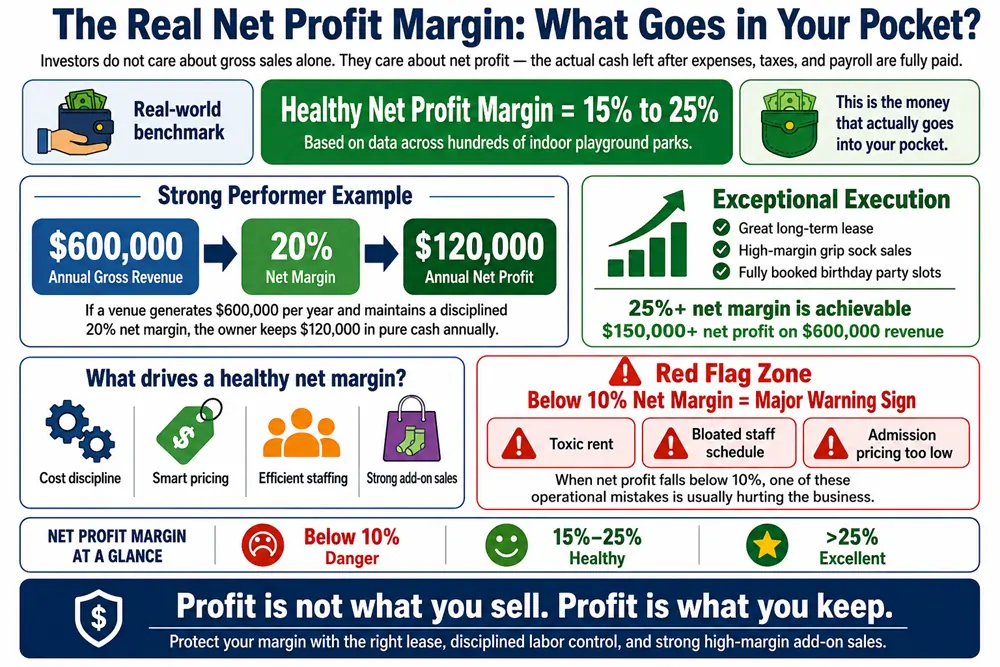
This is the moment of truth. When investors ask what the typical income is for an indoor playground, they are not asking about gross sales. They are asking about the net profit—the actual cash you take home after every single expense, tax, and payroll check is cleared. Based on our vast real-world data across hundreds of parks: A healthy, well-managed indoor playground operates on a Net Profit Margin of 15% to 25%.
Let us do the math clearly. If your venue is a "Strong Performer" generating $600,000 a year in gross revenue, and you maintain a disciplined 20% net margin, you are putting $120,000 in pure cash into your pocket annually. If you execute exceptionally well—locking in a great long-term lease, maximising high-margin grip sock sales, and completely selling out your birthday party slots—pushing that net margin above 25% ($150,000+ net) is entirely achievable. However, if your net margin drops below 10%, it is a massive red flag. It usually indicates one of three fatal errors: your rent is toxic, your staff schedule is bloated, or your admission pricing is far too low for your demographic.
7. The Profit Multiplier: What Do the Top Earners Do Differently?
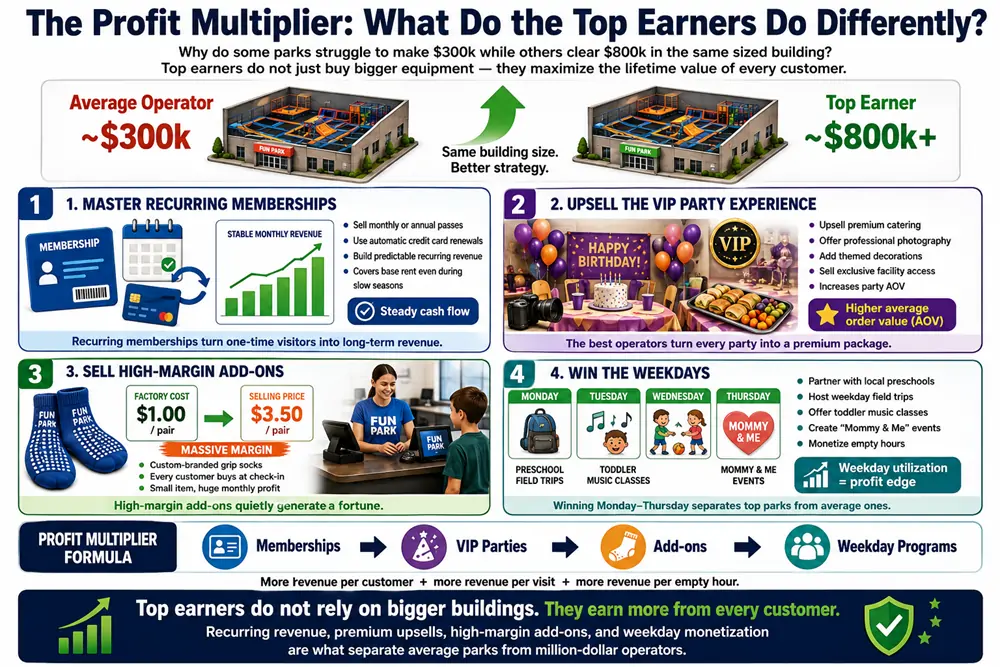
Why do some parks struggle to make $300k while others easily clear $800k in the exact same sized building? The top earners do not just buy bigger equipment; they execute better strategies. They maximise the lifetime value of every single customer that walks through their doors.
Here is exactly what the most profitable operators do differently:
• They Master Recurring Memberships: They do not rely on one-time visitors. They sell monthly or annual passes with automatic credit card renewals. This guarantees a steady stream of recurring revenue that covers their base rent on the 1st of every month, even during historically slow seasons.
• They Upsell the VIP Party Experience: They do not just sell a basic room and a slice of pizza. They upsell premium catering options, professional photography, elaborate themed decorations, and exclusive facility access. This massively increases the average order value (AOV) of every single party booking.
• They Sell High-Margin Add-ons: The most profitable parks make a fortune on grip socks. They buy custom-branded grip socks from the factory for $1.00 a pair and force every customer to buy them at the front desk for $3.50. That is a massive markup on thousands of customers a month.
• They Win the Weekdays: The best operators refuse to accept that Monday through Thursday must be dead. They partner with local preschools for field trips. They host toddler music classes. They create "Mommy & Me" events with local influencers to monetise the empty hours. Winning the weekdays is what truly separates the million-dollar parks from the average ones.
Sales-Expert FAQ: Handling Your Investment Doubts
Q: I want to maximise my profit margin, so should I pack every square inch of my building with soft playground equipment to attract more kids?
Absolutely not. Overcrowding your floor plan will drive parents away and completely destroy your most profitable revenue stream: birthday parties. My Experience: Novice investors think more equipment automatically equals more ticket sales. But you are ignoring the real decision-makers: the parents with the credit cards. If you do not provide a spacious, comfortable seating area with good Wi-Fi, clear sightlines, and premium coffee, parents will get exhausted and leave after 45 minutes. You will lose all your high-margin food and beverage revenue. More importantly, if you sacrifice building 2 or 3 dedicated, highly themed "Party Rooms" just to squeeze in another slide, you are actively killing the 30% of your business that generates the highest net profit. Strategic open space, parental comfort zones, and dedicated private party areas are how you drive up the average customer spend.
Q: To keep my upfront startup costs down and hit that 25% profit margin faster, can I buy cheap used equipment or buy from a discount online workshop?
This is the fastest shortcut to bankruptcy. The maintenance black hole of cheap equipment will devour your net profits by year two. My Experience: Commercial playground equipment faces violent, daily kinetic punishment from thousands of children. High-quality equipment from verified commercial playground equipment manufacturers is heavily engineered to withstand this constant abuse. Cheap 0.3mm PVC vinyl from a discount workshop will crack, split, and tear within months. This exposes the bare interior foam, which absorbs child sweat and creates terrible, permanent odours. If a child gets scratched on exposed wood, or if the local health department shuts down a section of your park, your local reputation is ruined instantly. In this business, a ruined reputation means your lucrative weekend party bookings will drop to zero. Buying premium, certified equipment upfront is not an expense; it is the only way to protect your long-term cash flow and brand reputation.
Q: I read online that opening an indoor playground is a great way to generate "passive income." Can I just hire a general manager and watch the profits roll in?
No. An indoor playground is an intense, highly active operational business, especially during its first two critical years. My Experience: I have never seen a highly successful park built by an absentee owner. To hit that coveted 20% to 25% net profit margin, you must actively manage staff payroll hours, monitor customer service quality, optimise your party booking funnels, and jump in to help during chaotic weekend rushes. You need to shake hands with parents and build community trust. Only after you have completely standardised your operating procedures (SOPs) and trained a highly loyal, highly competent general manager can you begin to step back. Do not mistake a high-cash-flow retail business for a passive stock investment. Your profit margin is a direct reflection of your daily operational discipline.
Q: Can I run a profitable venue if I decide to skip the café and just focus purely on admission and play?
You can, but you are intentionally throwing away your easiest profit centre and reducing the amount of time customers stay in your venue.
My Experience: Selling play time gets them in the door, but selling food keeps them there. The longer a family stays, the more they spend. If you do not offer food, parents will leave the moment their child gets hungry, taking their money to a nearby restaurant. You do not need a full commercial kitchen to be profitable. A simple café serving pre-packaged snacks, high-margin coffee, bottled water, and simple heat-and-serve pizzas can easily account for 10% to 15% of your total revenue. Food and beverage items typically carry a 60% to 70% profit margin. Cutting this out means you have to work twice as hard selling admission tickets just to make the same amount of net profit.