I have been manufacturing and exporting commercial indoor playground and trampoline equipment for over 10 years. Throughout my career, I have reviewed financial plans for hundreds of operators across North America and Europe. Whether they are first-time entrepreneurs or seasoned family entertainment centre (FEC) developers, the very first question they ask is always the same: "How much capital do I actually need to get this park open?"When you search for an indoor playground for sale or indoor playground equipment cost online, you are often flooded with incredibly low-cost quotes and overly optimistic promises of a three-month payback period.
As a source manufacturer, I want to provide you with a sobering piece of commercial reality: the equipment quote you receive from a factory represents only a fraction of your actual startup capital. If you build your entire business plan around that single quote, you run a massive risk of running out of cash during the construction phase. Today, I am going to use real financial data from hundreds of successful overseas projects to break down exactly what goes into the true indoor playground equipment cost. We will look at the hidden costs that trading companies hide from you, how to accurately calculate freight based on container volume, and what a realistic return on investment (ROI) timeframe looks like for a healthy indoor play facility.
1. Equipment Cost vs. Total Project Capital: The Big Picture
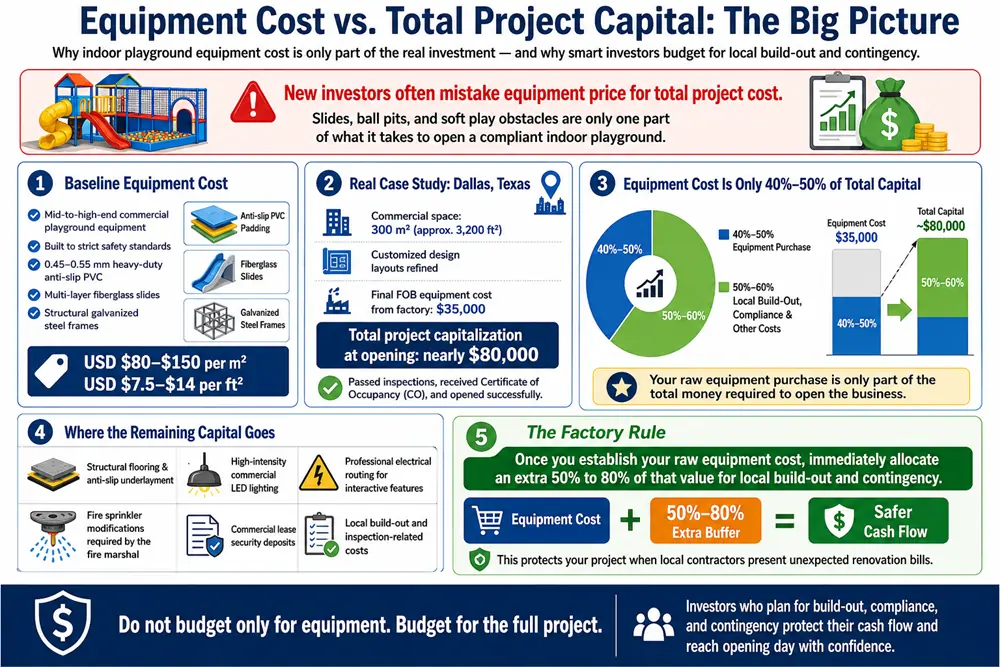
The most common mistake new investors make when analysing indoor playground equipment cost is focusing entirely on the physical hardware—the large slides, the ball pits, and the soft play obstacles. They treat the equipment price as the total cost of opening a business. For a mid-to-high-end commercial project that meets strict safety regulations utilising 0.45-0.55mm heavy-duty anti-slip PVC, multi-layer fibreglass slides, and structural galvanised steel frames, the baseline equipment price generally ranges from $80 to $150 per square meter ($7.5 to $14 per square foot). Let’s look at a real case study from last year. I manufactured a park for a client in Dallas, Texas. He leased a commercial space of 300 square meters (approximately 3,200 square feet). After refining the customised design layouts, the final FOB equipment cost from our factory came out to $35,000.
However, as an investor, you must establish this core financial framework from day one: your raw equipment purchase will only account for 40% to 50% of your total project capital. By the time our Dallas client successfully passed his inspections, received his Certificate of Occupancy (CO), and opened his doors, his total capitalisation was nearly $80,000. Where did the remaining capital go? It was spent on essential local infrastructure: structural flooring and anti-slip underlayment, upgraded high-intensity commercial LED lighting, professional electrical routing for interactive features, local fire sprinkler modifications to satisfy the fire marshal, and the commercial lease security deposits.
The Factory Rule: Once you establish your raw equipment cost, you must immediately allocate an extra 50% to 80% of that value into your financial spreadsheet as a local build-out and contingency fund. This ensures your cash flow remains secure when local contractors present unexpected renovation bills.
2. International Freight & Customs: The "Per Container" Calculation
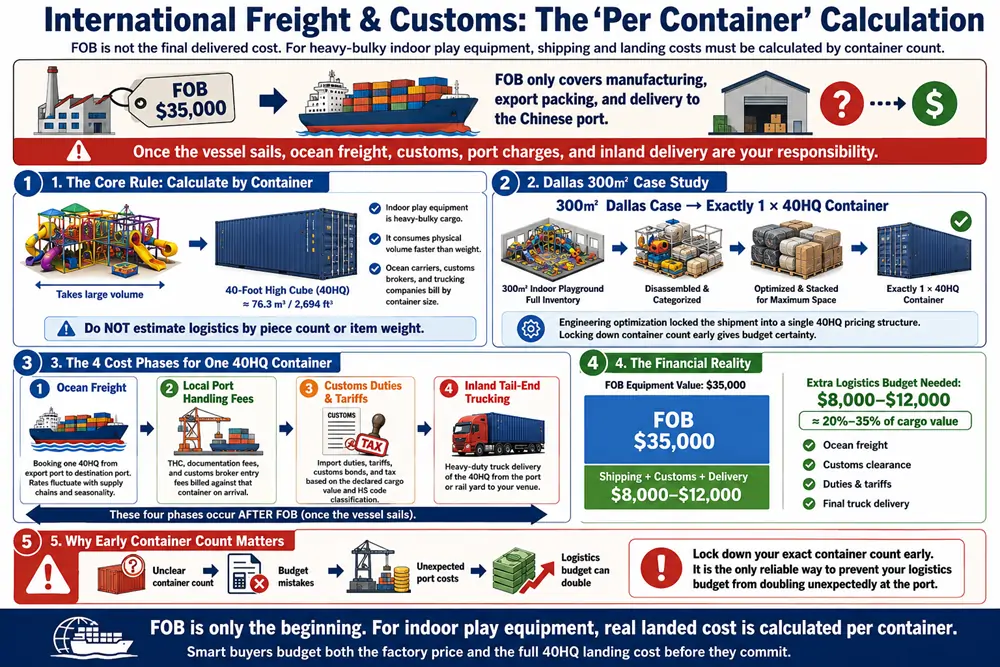
When a factory provides an FOB (Free On Board) quote of $35,000, new buyers often assume that is the cost of getting the goods to their venue. FOB only covers the cost of manufacturing, export packaging, and trucking the goods to the Chinese port. Once the vessel sets sail, all international ocean transit, customs duties, port handling, and domestic tail-end logistics belong to you. Here is the most critical logistical truth about this industry: you must calculate your shipping and landing costs strictly based on the number of shipping containers, not by weight or piece counts. Indoor play equipment is classified as a classic "heavy-bulky" cargo. It takes up a massive amount of physical volume relative to its weight. Every ocean carrier, customs broker, and domestic trucking company will bill you based on the container size.
Returning to our 300-square-meter Dallas case study: after our engineering team scientifically optimised the disassembly and stacking patterns, the entire playground inventory fit perfectly into exactly one 40-foot High Cube (40HQ) container. Therefore, his logistical budget was locked into the pricing structure of a single 40HQ container, which splits into four distinct phases:
• Ocean Freight: The cost of booking that specific 40HQ container from the export port to the domestic destination port (e.g., from Shenzhen to the Port of Long Beach). This fluctuates based on global supply chains and seasonal peaks.
• Local Port Handling Fees: Terminal Handling Charges (THC), documentation fees, and customs broker entry fees billed specifically against that single container upon arrival at the destination port.
• Customs Duties & Tariffs: The import tax calculated as a percentage of the declared equipment value inside that specific container, dictated by local customs classifications (HS Codes), alongside customs bonds.
• Inland Tail-End Trucking: The cost of hiring a heavy-duty semi-truck to pull that 40HQ container directly from the port terminal or rail yard to your venue's loading dock.
The Financial Reality: For an equipment order with an FOB value of $35,000 that completely fills one 40HQ container, you must reserve an additional $8,000 to $12,000 (roughly 20% to 35% of the cargo value) specifically to cover ocean freight, customs clearance, duties, and final truck delivery. Locking down your exact container count early is the only way to prevent your logistics budget from doubling unexpectedly at the port.
3. Overseas Installation Budgets: Balancing Labour and Travel Overhead
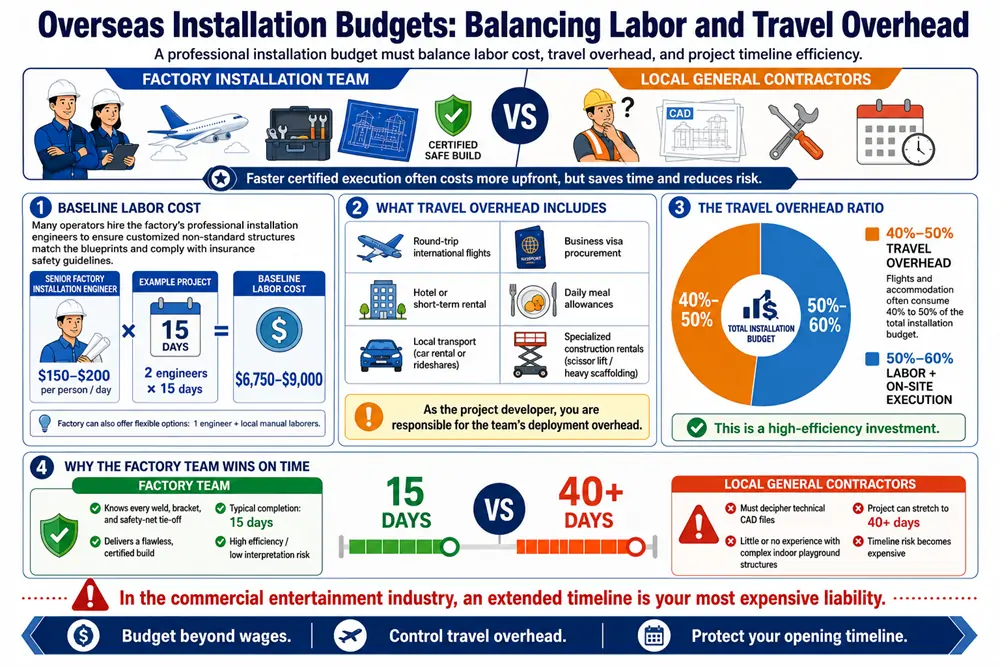
To guarantee that non-standard customised structures match the blueprints perfectly and comply with strict insurance safety guidelines, many operators hire the factory’s professional installation engineers to execute the build on-site.
The standard daily rate for a senior factory installation engineer is $150 to $200 per person, per day. For a mid-sized project like our Dallas venue, the build requires a team of 2 engineers working for 15 days, which equates to a baseline labour cost of $6,750 to $9,000.Of course, the factory typically offers installation options involving an engineer paired with local manual labourers, allowing the client to make their own choices and adjustments. However, a professional budget must look beyond daily wages. As the project developer, you are responsible for the team’s travel overhead during the deployment: round-trip international flights, business visa procurement, local hotel or short-term rental accommodations, daily meal allowances, local transport (car rental or rideshares), and specialised construction rentals such as a scissor lift or heavy scaffolding.
The Travel Overhead Ratio: Travel accommodations and flights typically consume 40% to 50% of your total installation budget. While this seems like an intense upfront cost, it represents a high-efficiency investment. A factory team knows every weld, bracket, and safety net tie-off; they will deliver a flawless, certified build in 15 days. If you hire local general contractors who have never built a complex indoor playground, they will spend weeks trying to decipher the technical CAD files, easily stretching the project to 40 days or more. In the commercial entertainment industry, an extended timeline is your most expensive liability.
4. The Invisible Cash Drain: Dead Rent During the Void Period
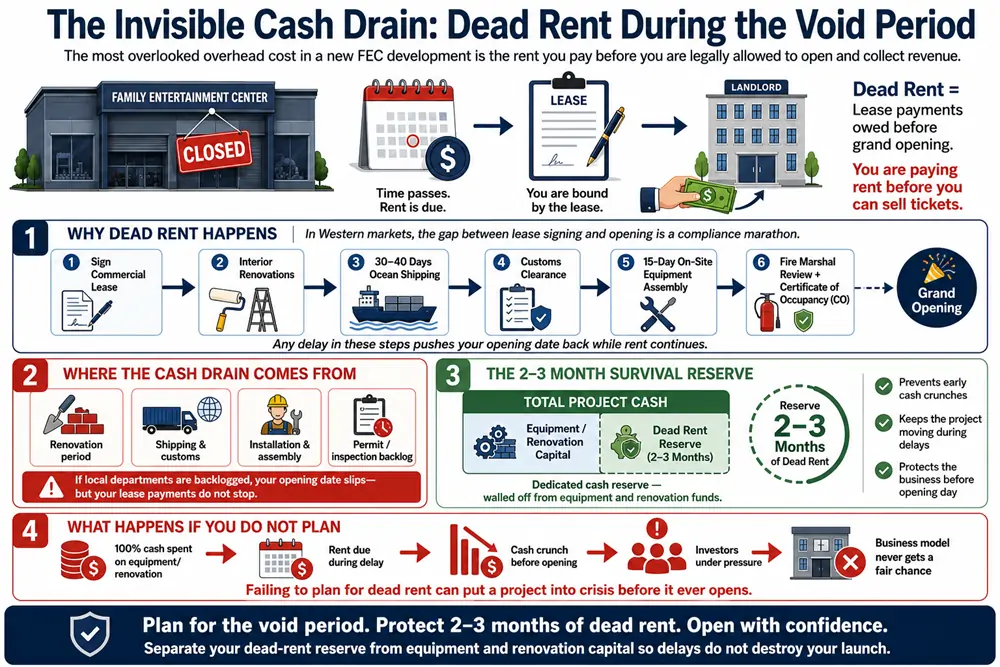
The single most overlooked overhead expense in a new FEC development is "dead rent"—the lease payments you are contractually obligated to pay to your commercial landlord before you are legally allowed to collect admission tickets from customers.
In Western markets, the timeline between signing your commercial lease and cutting the grand opening ribbon is a multi-step compliance marathon. You must execute your interior renovations, wait 30 to 40 days for the ocean container to cross the sea, clear customs, complete the 15-day on-site equipment assembly, schedule a field review with the local fire marshal, and wait for the building department to process and issue your Certificate of Occupancy (CO). If any local department experiences a backlog, your opening date slips. You must hold a dedicated cash reserve covering 2 to 3 months of dead rent that is completely walled off from your equipment or renovation capital. Failing to plan for this period forces investors into cash crunches before they ever have a chance to prove their business model.
5. Revenue Modelling: The Birthday Party Profit Engine
Now that we have covered the expense structure, let’s examine how a healthy indoor playground converts its footprint into consistent cash flow. Successful parks do not survive solely on casual walk-in admissions; they run an ecosystem built on group events.
Let's break down the revenue performance of our 300-square-meter case study:
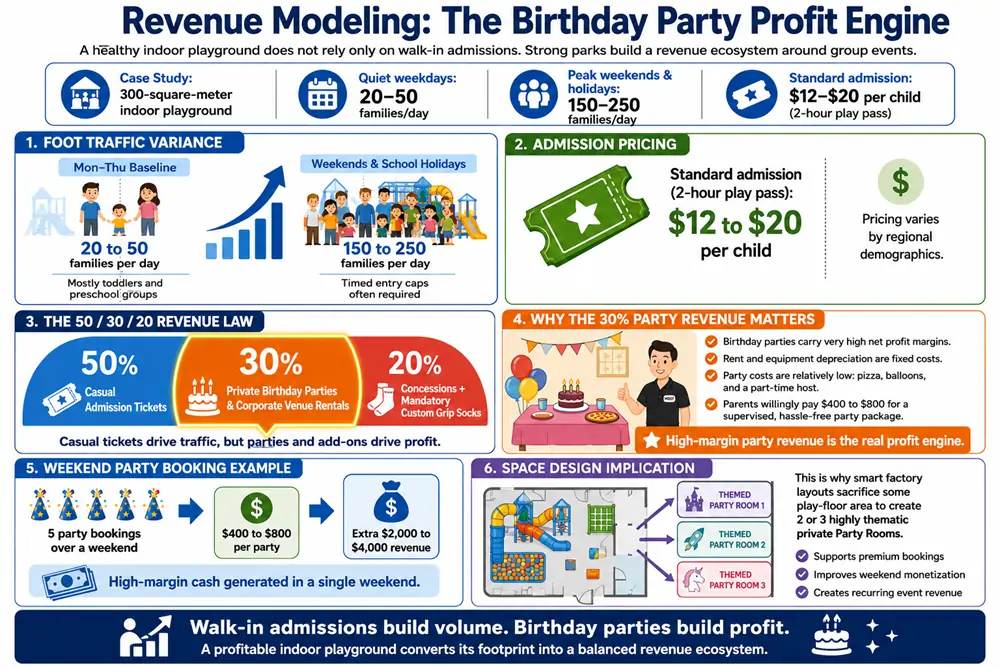
• Foot Traffic Variance: Mondays through Thursdays are quiet baseline periods, averaging 20 to 50 families per day (mostly toddlers and preschool groups). Weekends and school holidays see massive spikes, frequently hitting 150 to 250 families per day, requiring timed entry caps to manage capacity.
• Admission Pricing: Depending on regional demographics, standard admission (a 2-hour play pass) typically sits between $12 and $20 per child.
• The 50/30/20 Revenue Law: In a highly profitable indoor playground, casual admission tickets only generate 50% of total annual gross revenue. The most lucrative 30% of gross revenue is generated by private Birthday Parties and corporate venue rentals. The remaining 20% comes from high-margin concession sales (pizza, speciality coffees, juices) and mandatory custom grip socks.
Pay close attention to that 30% party revenue. Birthday parties carry an incredible net profit margin. Your building rent and equipment depreciation are completely fixed costs; hosting a party requires nothing more than a few boxes of wholesale pizza, balloons, and a part-time host's hourly wage. Yet parents willingly pay a premium of $400 to $800 for a hassle-free, supervised weekend party package. If your facility hooks 5 party bookings over a weekend, you bring in an extra $2,000 to $4,000 in pure high-margin cash. This is why, when facilities design your space, they will actively sacrifice a portion of the play floor to carve out 2 or 3 highly thematic, private Party Rooms.
6. Maintenance, Wear, and Asset Depreciation: The Cost of Quality
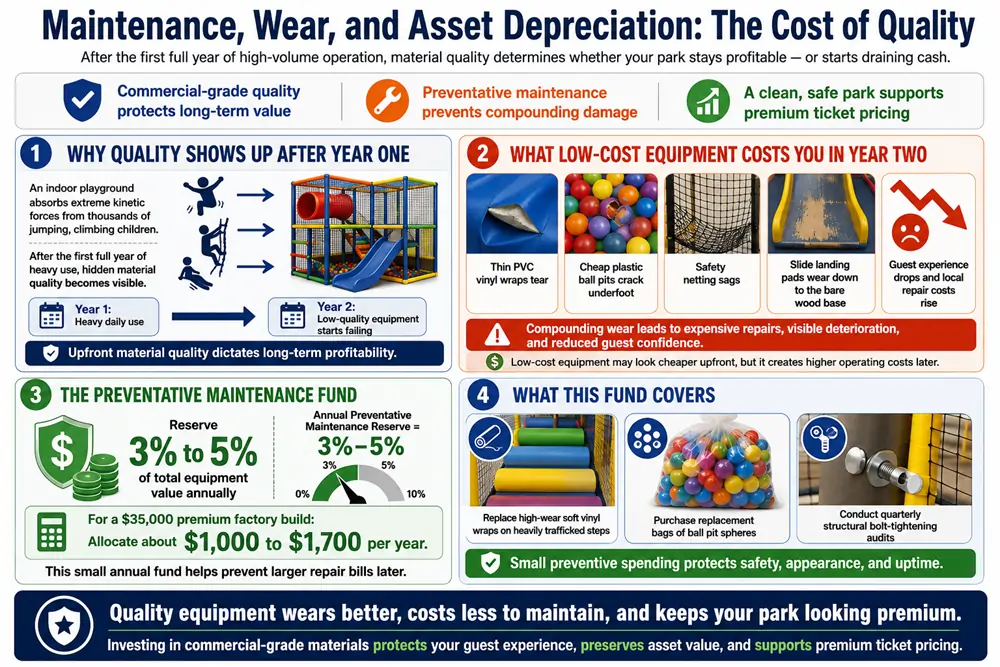
After your facility completes its first full year of high-volume operation, you will see exactly why upfront material quality dictates long-term profitability. An indoor playground is subject to extreme kinetic forces from thousands of jumping, climbing children. If you purchase low-cost equipment built below commercial specifications, the second year of operations will trigger a wave of compounding expenses: thin PVC vinyl wraps will tear, cheap plastic ball pits will crack underfoot, safety netting will sag, and slide landing pads will wear down to the bare wood base. This triggers expensive local repair costs and ruins your guest experience.
For a well-built park, you should structure your financial model to reserve 3% to 5% of your total equipment value annually as a preventative maintenance fund.
For a $35,000 premium factory build, this means allocating just $1,000 to $1,700 a year. This small fund easily covers replacing high-wear soft vinyl wraps on heavily trafficked steps, purchasing a few replacement bags of ball pit spheres, and conducting quarterly structural bolt-tightening audits. Investing in commercial-grade materials keeps your facility looking immaculate and safe, which protects your premium ticket pricing.
7. Establishing Realistic ROI and Payback Expectations
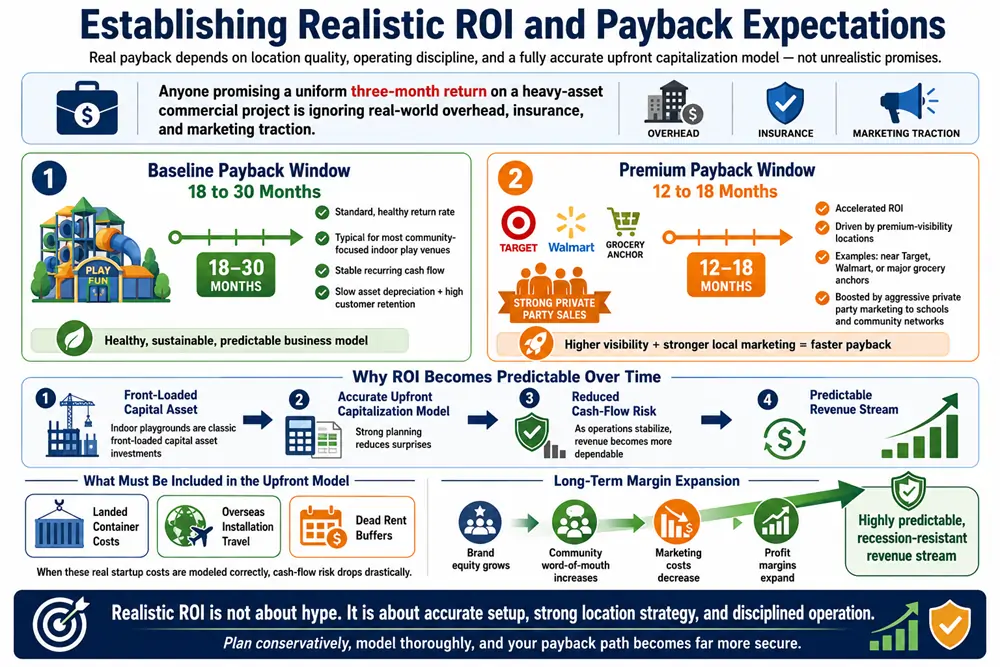
Every investor wants to know their precise payback timeline. Anyone promising a uniform three-month return on a heavy asset commercial project is ignoring the realities of local overhead, insurance, and marketing traction. Here is what the actual market statistics tell us about well-managed locations:
• The Baseline Payback Window (18 to 30 Months): This is the standard, healthy return rate for the vast majority of community-focused indoor play venues. It represents a stable, recurring cash flow business where asset depreciation is slow, and customer retention is high.
• The Premium Payback Window (12 to 18 Months): This accelerated ROI is achieved by operators who secure premium visibility locations (such as a commercial pad adjacent to a major Target, Walmart, or high-traffic grocery anchor) and aggressively market their private weekend party packages to local schools and community networks.
An indoor playground is a classic front-loaded capital asset investment. Once you build an accurate upfront capitalisation model that accounts for landed container costs, overseas installation travel, and dead rent buffers, your cash flow risks drop drastically. As your venue establishes its brand equity and community word-of-mouth grows, your marketing costs decrease, and your profit margins steadily expand into a highly predictable, recession-resistant revenue stream.
Sales-Expert FAQ: Resolving Your Financial and Investment Objections
Q: A freight forwarder gave me a general international shipping quote. How can I verify it to ensure my total landed indoor playground equipment cost doesn't spiral out of control?
You must demand that your manufacturer provide a binding "Total Container Count and Packing List" before locking in your freight contracts. My Experience: International logistics, customs port clearances, and tail-end semi-truck deliveries are billed entirely on a per-container structure. For example, a 300-square-meter project should be engineered and packed to fit precisely into exactly one 40-foot High Cube (40HQ) container. This makes your $8,000 to $12,000 logistics budget highly accurate and safe. If you work with inexperienced indoor play area suppliers who do not understand dense cargo packaging, they might miscalculate and spill over into a second container. That single packing failure will instantly double your ocean freight and inland trucking costs. Always tie your shipping contract to a specific container count.
Q: I found an online workshop offering a visually identical design for a significantly lower price. Why shouldn't I buy from them to maximise my short-term ROI?
Purchasing from unverified low-cost workshops swaps your upfront savings for extreme maintenance liabilities and potential safety closures. My Experience: Commercial play equipment faces relentless structural punishment. Low-cost workshops save money by using 0.3mm thin PVC covers, low-density foam cores, and thin-walled steel pipes that do not meet Western ASTM or EN safety compliance. Within six months, the vinyl surfaces crack, revealing bare wood and foam that absorb sweat and develop permanent odours. When an inspector sees these compromised surfaces, they can fine or temporarily close your venue. Fixing these issues post-opening using local contractors will quickly cost you triple what you saved initially, while a wave of negative Google Reviews will decimate your birthday party booking pipeline. High-quality equipment is your primary cash flow insurance policy.
Q: Factory-led installation requires me to cover flights and hotels for an overseas crew. Can't I save that money by hiring local handymen to assemble the framework?
Hiring an untrained local crew to build a custom commercial playground will almost always cost you double in extended timelines and dead rent. My Experience: Western commercial carpentry and handyman labour is billed at premium hourly rates. A non-standard indoor playground contains thousands of interlocking pipes, tension clamps, and safety net nodes. A factory engineering crew has built these structures dozens of times; they work with extreme speed and can hand over a completed, certified facility in 15 days. A local crew will spend hours deciphering the highly technical CAD schematics through trial and error. If a local crew takes 45 days instead of 15, those 30 extra days of delayed opening mean you are paying an entire month of base rent to your landlord with zero customer revenue. The factory team's travel package is always the most cost-effective path to opening day.
Q: Managing custom food menus and birthday parties sounds complex. Can I build a profitable business model by strictly focusing on casual admission ticket sales?
Relying solely on open-play admission tickets leaves your business highly vulnerable to weekday cash flow dips and cuts out your highest-margin profit centre. My Experience: Walk-in casual foot traffic is highly unpredictable and weather-dependent. On a rainy Saturday, you will hit capacity, but on a clear Tuesday morning, your play floor may sit empty. Private birthday parties, however, are booked months in advance and require non-refundable upfront deposits, providing highly predictable baseline cash reserves. More importantly, every child celebrating a birthday invites 15 to 20 classmates to your park. This serves as a highly effective, zero-cost customer acquisition engine. Those 20 visiting families experience your facility for the first time on the parents' dime, directly converting into your next wave of regular open-play guests and future party bookings. High-quality hardware brings families through the door, but structured group events drive your long-term net profits.