Importing Playground Equipment from China: My 2026 Step-by-Step Guide
You want to start an indoor trampoline park business. Or a massive family entertainment centre. The equipment import process looks complicated. You look at 40HQ containers. You look at customs paperwork. You think about wiring capital overseas without seeing the physical product first.
At Yommi, my team and I manufacture commercial jump parks and indoor playgrounds. We ship them globally every single month. Many investors pay heavy markups to local Western distributors. They do this to avoid the import process. You can bypass them. International sourcing should be transparent. Predictable. Highly profitable.
I wrote this blueprint to lay out our exact 2026 process. We ship from our factory floor to your building. No corporate talk. Just the actual logistics for ToB customer acquisition. Look at how we do it.
The Container Volume You Need
Before we set up trade terms, look at the physical volume. Playground equipment is bulky. It takes up significant space. We almost exclusively use 40HQ containers. A standard 40-foot container is 8 feet 6 inches tall. A 40HQ gives you an extra foot of height. That extra foot matters. It lets us stack large pre-welded steel frames vertically. You pay for the container freight regardless of what is inside. We make sure every cubic meter is filled. We pack revenue-generating equipment into every corner.
Step 1: Trade Terms (FOB, CIF, vs. DDP)
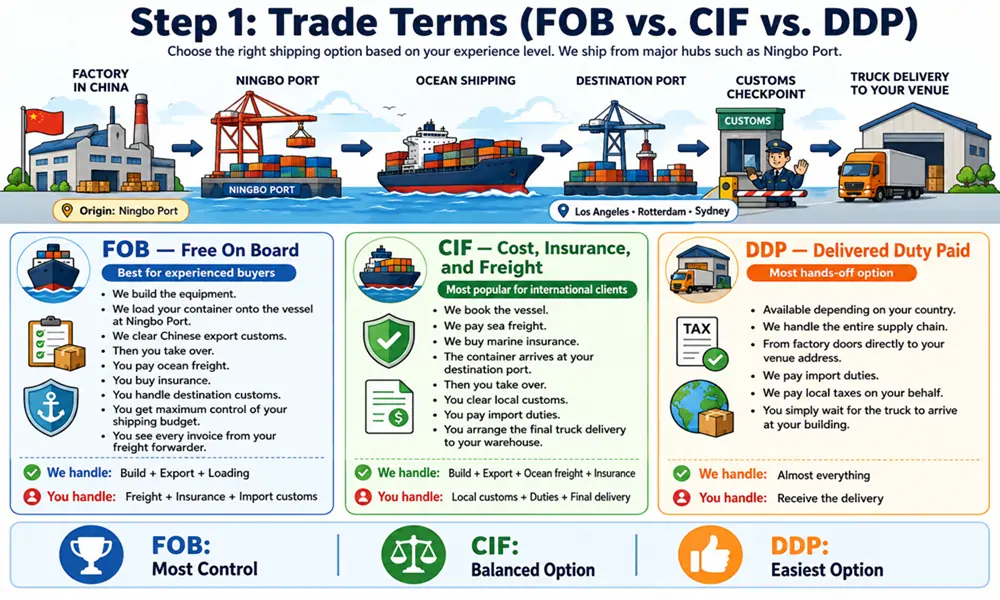
When we start discussing your project, the first logistical question I ask is how you want the equipment shipped. We operate out of major shipping hubs like the Ningbo Port. My logistics team provides three main options. It depends on your experience level.
FOB stands for Free On Board. My factory handles the build. We load your container onto the ocean vessel at Ningbo Port. We cleared Chinese export customs. Then we hand the keys to you. You take over. You pay the ocean freight. You buy the insurance. You deal with your local destination customs. It gives you maximum control over your shipping budget. You see every single invoice from your freight forwarder.
CIF means Cost, Insurance, and Freight. Most international clients pick this option. We do the heavy lifting across the ocean. We book the vessel. We pay the sea freight. We buy the marine insurance. The container arrives safely at your designated destination port. Los Angeles. Rotterdam. Sydney. Once the box drops at your port, you take over the process. You clear local customs. You pay your import duties. You arrange the final truck ride to your warehouse.
DDP is Delivered Duty Paid. This is the hands-off route. Depending on your country, my logistics team can set this up. We handle the entire supply chain. Factory doors directly to your venue's address. We pay all import duties. We pay local taxes on your behalf. You simply wait for the truck to arrive at your building.
Step 2: Customs Tariffs and HS Code 95069990
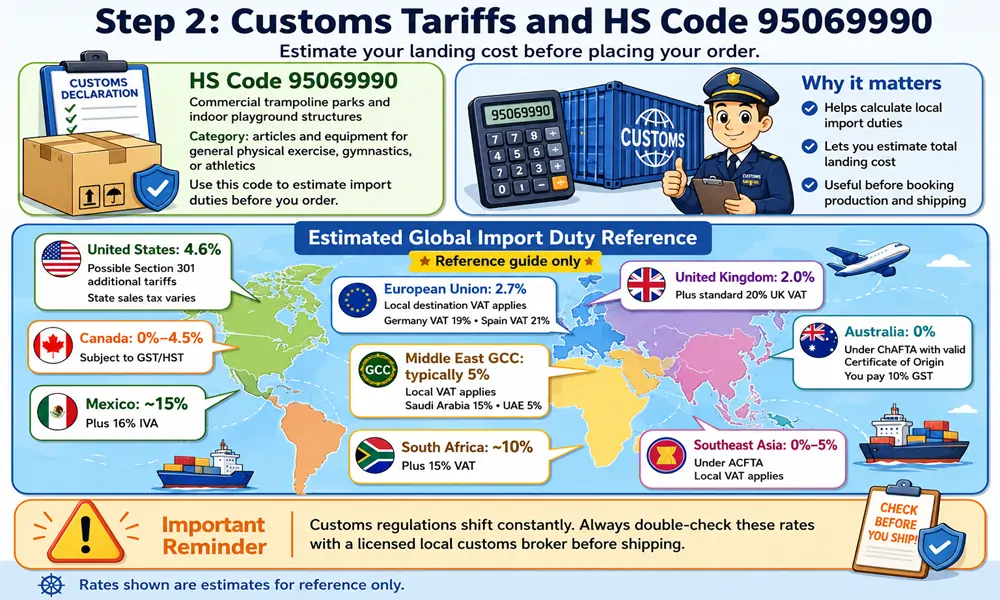
You need to figure out your landing costs. Commercial trampoline parks and indoor playground structures fall under a specific tracking number. HS Code 95069990. It covers articles and equipment for general physical exercise, gymnastics, or athletics.
Knowing this exact code allows you to calculate your local import duties before you place an order with us. I put together a reference guide for estimated global import duties.
The United States sits at 4.6%. But watch out. You might be subject to Section 301 additional tariffs. State sales tax varies. The European Union charges 2.7%. Plus your local destination VAT. Germany charges 19%. Spain charges 21%. The United Kingdom charges 2.0%. Plus the standard 20% UK VAT. Australia is 0%. We provide our valid Certificate of Origin under ChAFTA. You just pay the 10% GST. Canada ranges from 0% to 4.5%. It is subject to GST/HST. Mexico is roughly 15%. Plus 16% IVA. The Middle East GCC is typically 5%. Subject to local VAT. Saudi Arabia is 15%. The UAE is 5%. Southeast Asia falls between 0% and 5% under ACFTA. Local VAT applies. South Africa sits at approximately 10%. Plus 15% VAT.
Customs regulations shift constantly. Always double-check these rates with a licensed local customs broker before shipping.
Step 3: Packing Heavy-Duty Equipment
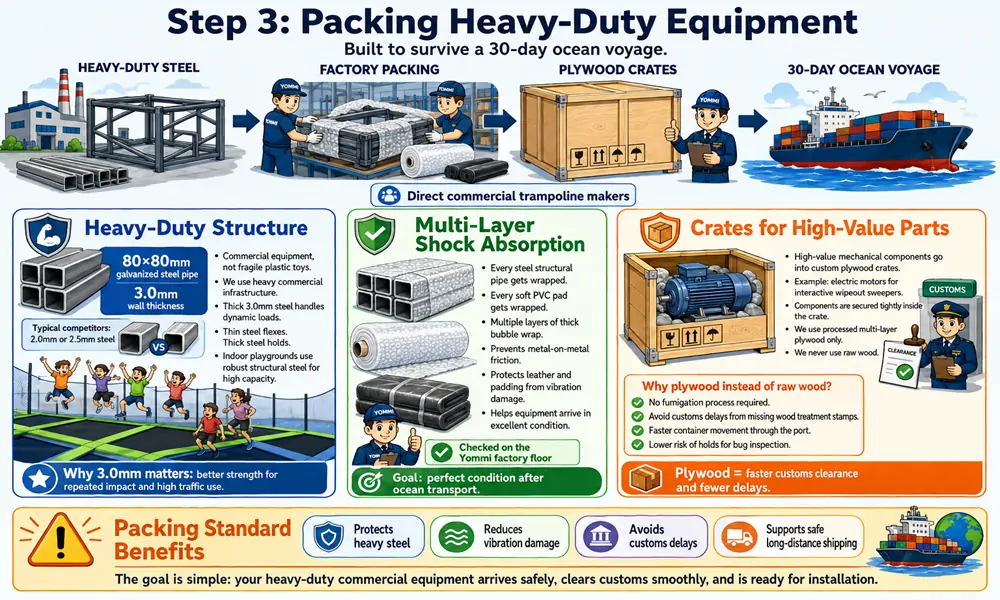
You are not importing fragile plastic toys. You are investing in heavy commercial infrastructure. As direct commercial trampoline makers, we use heavy-duty 80x80mm galvanised steel pipes. The wall thickness is 3.0mm. It is incredibly heavy. Standard competitor pipes use 2.0mm or 2.5mm steel. We use 3.0mm because it handles dynamic loads. Twenty teenagers hit a trampoline court at the same time. The kinetic energy is massive. Thin steel flexes. Thick steel holds. Our indoor playgrounds use robust structural steel tailored for high capacity.
When I walk the Yommi factory floor, I check the packing standards. Your equipment must survive a 30-day ocean voyage perfectly.
We use multi-layer shock absorption. Every single steel structural pipe gets wrapped. Every soft PVC pad gets wrapped. We wrap them in multiple layers of thick bubble wrap. This prevents metal-on-metal friction. It protects the leather from vibration damage inside the metal container.
High-value mechanical components go into custom-built plywood crates. Think about the electric motors for our interactive wipeout sweepers. We secure them inside these crates. I mandate the use of high-quality processed multi-layer plywood. We never use raw wood. Raw wood requires a fumigation certificate. Customs officials check for bugs. If they find raw wood without a stamp, they hold your container. Plywood skips the fumigation process entirely. Your container moves faster. You avoid delays at your local customs port.
Step 4: Professional Installation Options
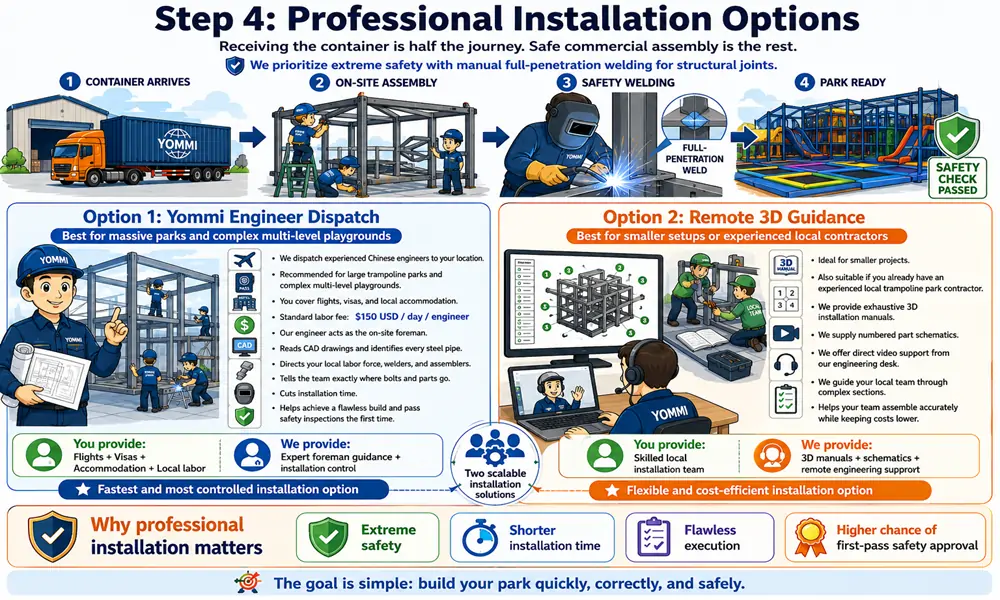
Receiving the container is half the journey. Commercial assembly is the rest. We prioritise extreme safety. We use manual full-penetration welding for our structural joints. To make sure your park is built flawlessly, I offer two scalable installation solutions.
The Yommi Engineer Dispatch. For massive trampoline parks or complex multi-level playgrounds, I recommend dispatching my experienced Chinese engineers to your location. You cover their flights. You pay for visas. You provide local accommodation. You pay a standard daily wage of $150 USD per engineer. That is just their labour fee. My expert acts as the foreman. He reads the CAD drawings. He identifies every single steel pipe. He directs your local labour force. He tells your local welders and assemblers exactly where to put the bolts. This cuts your installation time. It guarantees a rapid, perfectly executed installation. It passes safety inspections on the first try.
Remote 3D Guidance. For smaller setups. Or if you already have a highly experienced local [trampoline park contractor] on standby. My team provides exhaustive 3D installation manuals. We supply numbered part schematics. We set up direct video support from our engineering desk. We guide your local team through the complex sections.
Step 5: Securing Your Investment (Payment and QC)
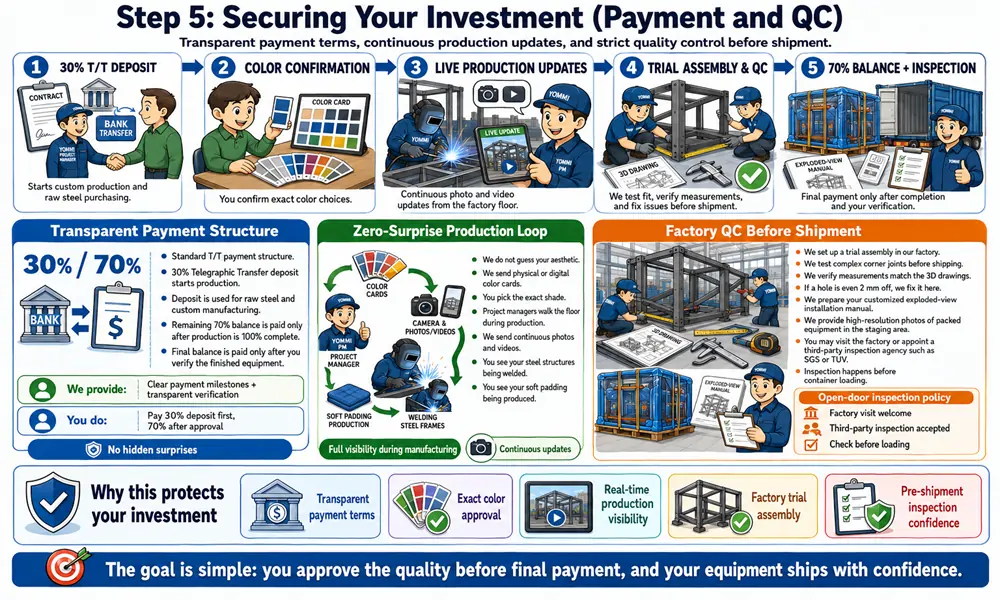
I built Yommi's reputation on absolute transparency. We use a standard T/T structure. We operate on a 30% Telegraphic Transfer deposit to initiate your custom production. That buys the raw steel. The remaining 70% balance is paid only after production is 100% complete and verified by you.
We use a Zero Surprise production loop. We do not guess your aesthetic. Once you place the deposit, we confirm your exact colour choices. We send you physical or digital colour cards. You pick the exact shade. Throughout manufacturing, my project managers walk the floor. They send you continuous photo and video updates. You watch your specific steel structures get welded. You see the soft padding being built on our floor.
We set up a trial assembly in our factory. We do not just ship loose pipes. We take the complex corner joints and build them on our floor. We verified that the measurements match the 3D drawings perfectly. If a hole is drilled two millimetres off, we fix it here. We do not let you discover a manufacturing error on your job site.
Before you pay the final balance, we prepare your customised exploded-view installation manual. You get high-resolution photos of your equipment packed in the staging area. I maintain an open-door policy. I welcome you to visit my factory. You can send a certified third-party inspection agency like SGS or TUV. They inspect the completed equipment before we load the container.
Step 6: Import Paperwork and Documentation
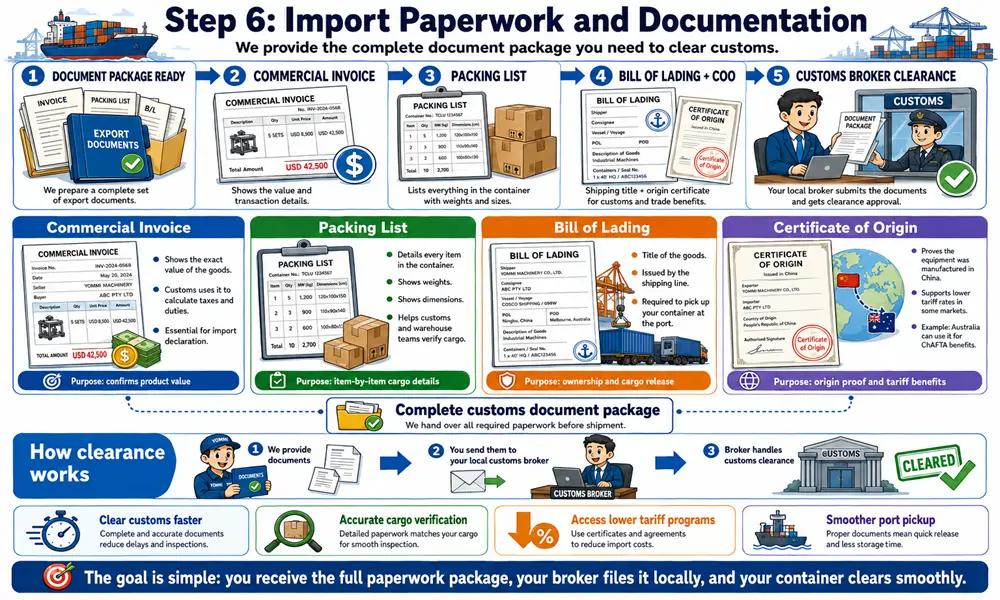
You need specific documents to clear customs. We hand over the complete package.
The Commercial Invoice. This shows the exact value of the goods. Customs uses it to figure out your taxes. The Packing List. These details every single item in the container. It shows the weights. It shows the dimensions. The Bill of Lading. This is the title of the goods. The shipping line issues it. You must have the Bill of Lading to pick up your container at the port. The Certificate of Origin. We provide this to prove the equipment was manufactured in China. It is how you get lower tariff rates in places like Australia under ChAFTA.
You hand these documents to your local customs broker. They handle the clearance.
Step 7: Certifications and Safety Standards
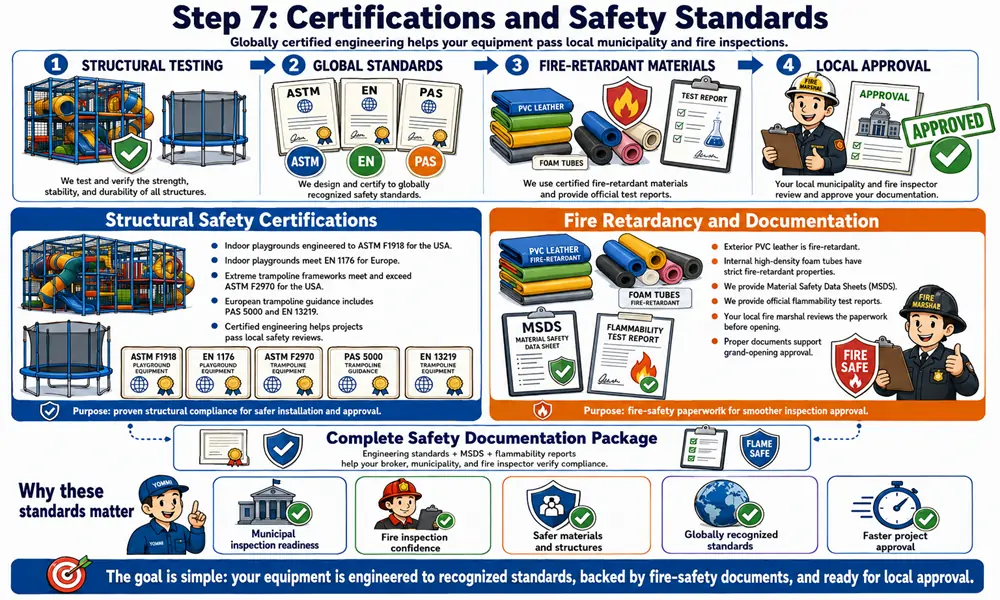
Your equipment is useless if it cannot pass your local municipality and fire inspections. When you source from my factory, you invest in globally certified engineering.
Look at structural safety. Our indoor playgrounds are engineered strictly according to ASTM F1918 for the USA. We meet EN 1176 for Europe. Our extreme trampoline frameworks meet and exceed ASTM F2970 for the USA. We hit PAS 5000 and EN 13219 guidelines for Europe.
Fire retardancy is a strict requirement. Every inch of our soft play materials is safe. The exterior PVC leather is fire-retardant. The internal high-density foam tubes are manufactured with strict fire-retardant properties. We provide you with the necessary Material Safety Data Sheets. The MSDS. We hand over the official flammability test reports. Your local fire marshal reviews the paperwork. They approve your grand opening.
Step 8: Production Timelines and Planning
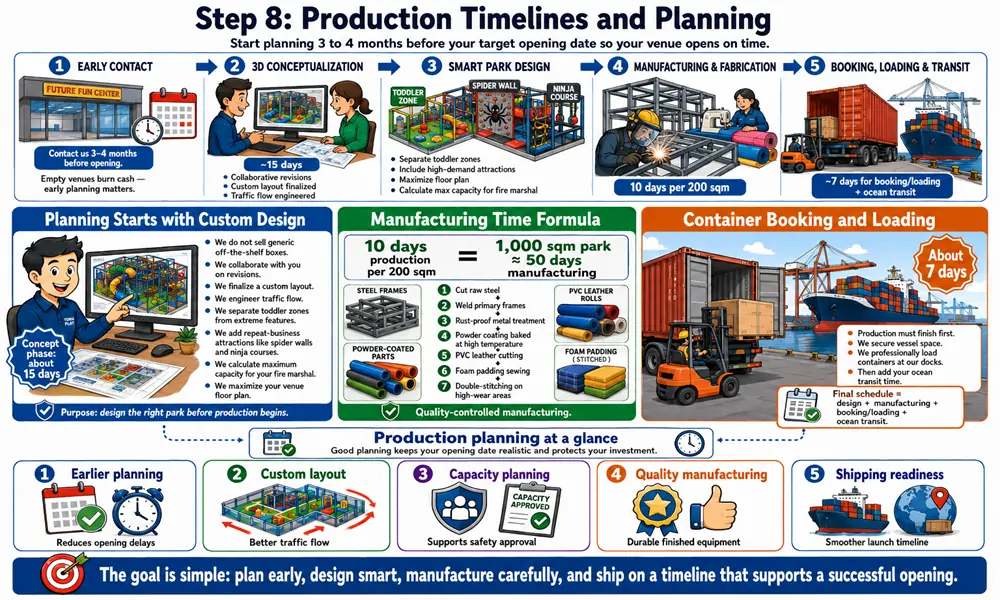
Empty commercial venues burn cash. Initiate contact with us at least 3 to 4 months before your target opening date. Allow for proper planning.
You might browse online for a generic kids jungle indoor playground for sale. We do not just sell off-the-shelf boxes. The 3D Conceptualisation phase takes about 15 days. My design team does collaborative revisions with you. We finalise a custom layout. We engineer the traffic flow. We separate the toddler zones from the extreme features. We make sure to include high-demand attractions like spider walls and complex ninja courses to drive repeat business. We calculate the maximum capacity for your fire marshal. We maximise your floor plan.
Manufacturing and Fabrication. My production managers use a simple estimation formula. We need 10 days of production per 200 square meters. You build a massive 1,000 sqm park. It requires approximately 50 days of dedicated quality-controlled manufacturing.
What happens during those 50 days? First, we cut the raw steel. We weld the primary frames. Next is rust-proofing. We treat the metal. Then, powder coating. We bake the paint onto the steel at high temperatures. It prevents chipping. While the steel cures, the sewing department cuts the PVC leather. They stitch the foam padding. We use double-stitching on high-wear areas.
Container Booking and Loading takes about 7 days. Once production finishes, we secure vessel space. We professionally load the containers at our docks. Then add your ocean transit time.
Step 9: Custom Fitting and Entrance Dimensions
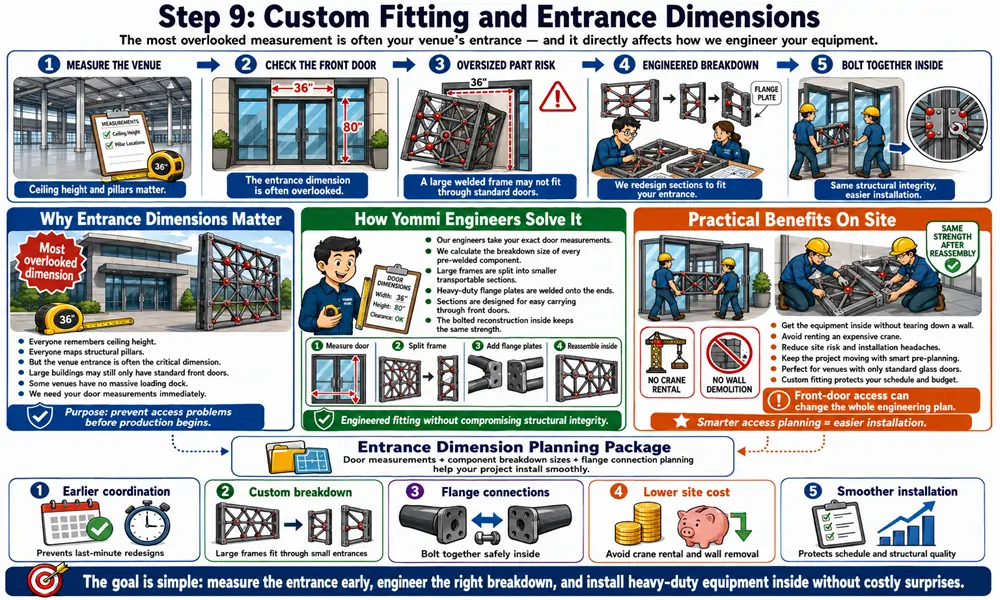
Everyone remembers to measure the ceiling height. Everyone maps out the structural pillars. The most critical dimension is often overlooked.
The venue entrance dimensions. Your front doors.
You rent a large building. It has high ceilings. But it only has standard glass front doors. It has no massive loading dock. I need to know this immediately. You cannot fit a massive pre-welded spider wall frame through a 36-inch door. My engineers take your door measurements. We calculate the breakdown size of every single pre-welded component. We split large frames into smaller sections. We weld heavy-duty flange plates onto the ends. You carry the pieces through your front door. You bolt the flange plates together inside. The structural integrity remains identical. You get the equipment inside without tearing down a wall. You avoid renting an expensive crane.
Step 10: Partnering with a China Sourcing Agent
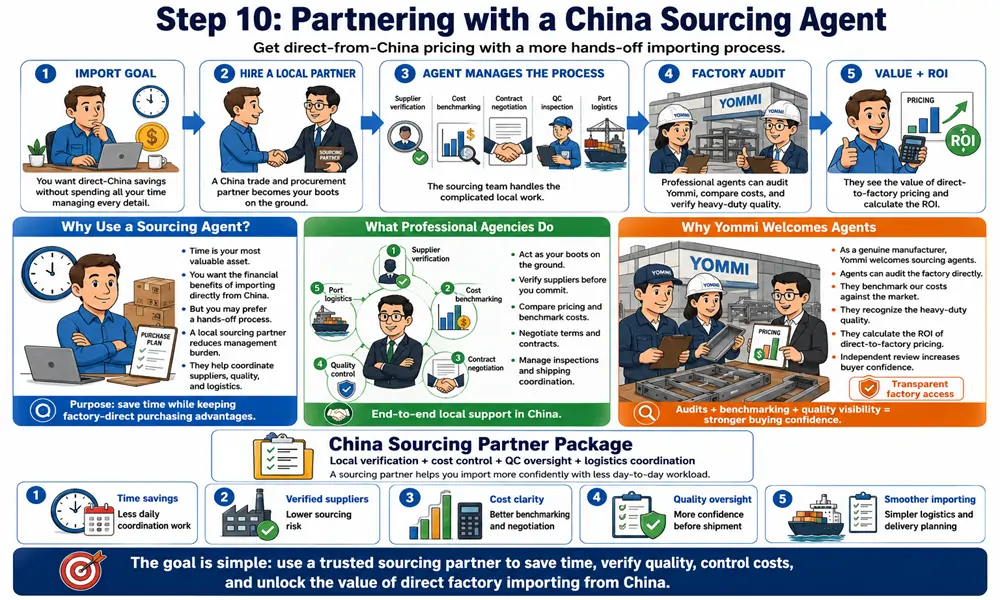
Time is your most valuable asset. You want the financial benefits of importing directly from China, but require a completely hands-off process. I recommend hiring a local China Trade and Procurement Partner.
Professional sourcing agencies act as your boots on the ground. Their directors oversee supplier verification. They run cost benchmarking. They handle contract negotiation. They manage quality control and port logistics. As a genuine manufacturer, I welcome sourcing agents to audit Yommi. They conduct their cost benchmarking. They recognise the massive value. They see the heavy-duty quality. They calculate the ROI of our direct-to-factory pricing.
Frequently Asked Questions
Q1: Do I need to hire a customs broker to import playground equipment? Yes. I highly recommend it. Unless you choose our DDP service, hiring a licensed local customs broker in your country ensures your shipment clears customs quickly. They handle all the complex paperwork for HS Code 95069990. They prevent expensive daily storage fees at your port.
Q2: What happens if a part is damaged during shipping or is missing? Thanks to our strict multi-layer packaging, this is extremely rare. If a component is damaged in transit, simply send my team a photo or video. We will immediately manufacture the replacement. We express ship it to you via DHL or FedEx to ensure your opening schedule is not delayed.
Q3: Can I mix indoor playground structures, trampolines, and arcade games in the same container? Absolutely. Many of our clients build Hybrid Family Entertainment Centres. My loading team is highly experienced in efficiently consolidating different types of commercial entertainment equipment. We pack it into the same 40HQ container to maximise your shipping value.
Q4: Do you send spare parts with the container? Yes. Playground parts wear out over time. Springs stretch. PVC gets scratched by zippers. We pack a dedicated box of free spare parts inside your container. We include extra springs. We provide extra foam tubes. We put in rolls of matching PVC leather. You can handle minor repairs immediately. You do not need to order basic maintenance parts from China right away.
Q5: Do you provide a warranty for international orders? Yes. I stand firmly behind our engineering at Yommi. We provide comprehensive commercial warranties on our steel structures. We cover jumping mats, springs, and soft padding. The specific warranty durations will be clearly detailed in your contract. It is based on the exact equipment you purchase.
Start Your Import Journey
Importing commercial entertainment equipment is a strict logistical process. Understand trade terms like CIF and FOB. Prepare the right HS Code. Partner with a transparent manufacturer. You cut out the massive middleman markups. You secure a significantly faster ROI.
You are ready to build your customised indoor playground or extreme trampoline park. Let my experts handle the heavy lifting. Contact the Yommi engineering team today. We will set up a free design consultation and give you a transparent freight estimate.