When investors begin to formulate initial plans for a commercial trampoline park, one of the first questions they typically ask is, “How much does a trampoline cost? While this is a logical starting point, evaluating a trampoline park's business plan solely based on the price of a single piece of equipment is insufficient. A commercial trampoline park is a complex project. It requires consideration of numerous aspects, including commercial real estate leasing, major structural modifications, international logistics, installation labor, and operating capital. If only the cost of the equipment is considered without taking other factors into account, your project is likely to face cash flow shortages before it even officially opens.
Based on extensive experience with commercial trampoline park cases, this article provides a transparent, professional, and objective analysis of the various costs involved in project construction. We will elaborate on the pricing logic per square meter and the hidden costs you must anticipate to ensure the project's success and profitability.
The Global Budget Allocation Model
A healthy and sustainable trampoline park budget structure usually looks like this: Equipment Procurement: 35%–45%, Rent & Deposit: 15%–25%, Fit-out/Renovation: 20%–30%, and Cash Reserve: 10%–20%. Simply put, equipment is ≈ 40%, renovation is ≈ 25%, rent is ≈ 20%, and cash ≈ 15%.
Based on my experience managing both successful and unsuccessful indoor trampoline parks, the foundation of a sustainable commercial trampoline park lies entirely in a balanced allocation of funds. A common mistake many new investors make is allocating up to 70% of their total budget to equipment, leaving them short-handed when faced with construction delays or approval issues. Industry-standard financial models stipulate specific structures to ensure stability. Your equipment purchases should account for 35% to 45% of the total budget. Rent and security deposits typically require 15% to 25%. Your facility renovations may require 20% to 30%. Finally, your cash reserves should be strictly controlled between 10% and 20%. Following an effective “45-20-20-15” principle ensures your project successfully navigates the initial phase and achieves appropriate scaling during the first year of operation.
Equipment Pricing Logic (Per Square Meter)
Generally, the industry quotes packaged prices per square meter. A key reality is that the client's final transaction average price is usually between $100 and $200 per square meter across the whole park.
To accurately answer how much the equipment costs, we must evaluate the space categorically. Commercial manufacturers price layouts based on the complexity and density of the attractions.
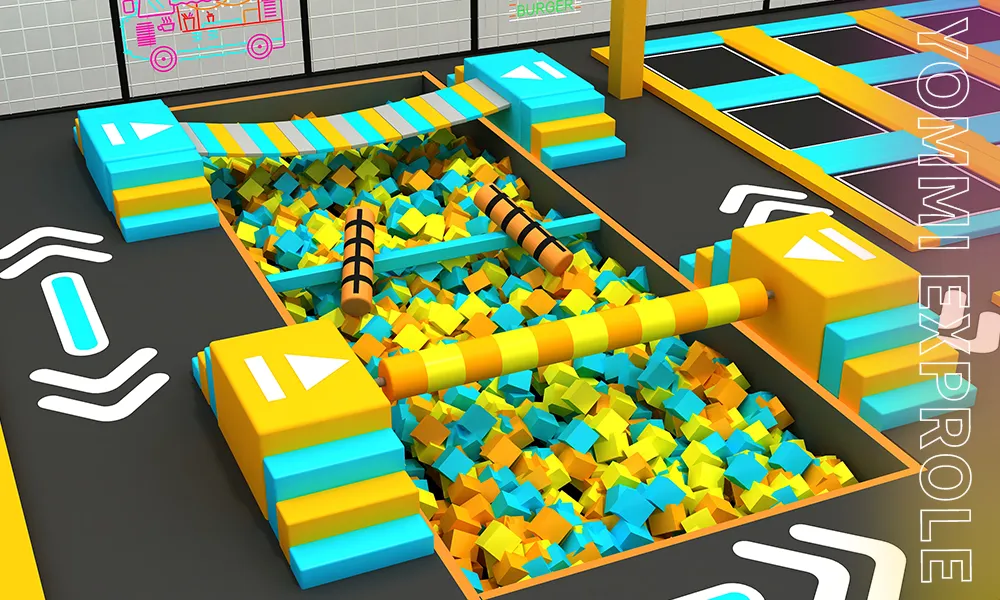
•The Basic Free Jump Area ($80–$150 / sqm): This includes standard flat jumping beds, basic foam pits, and safety padding. It consumes the most floor space at the lowest capital cost.
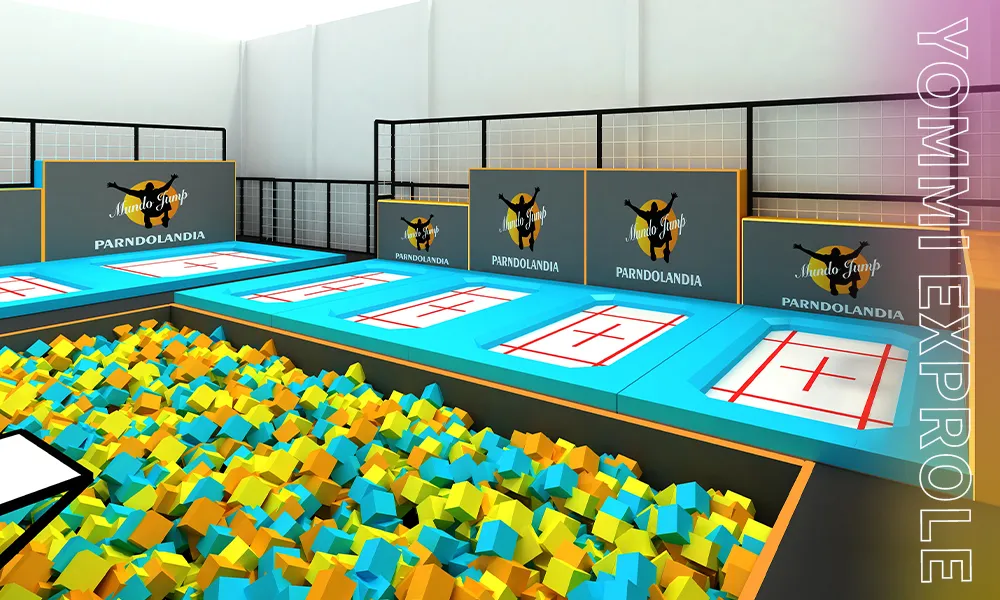
•The Comprehensive Project Area ($200–$500/sqm): This includes Ninja Warrior courses, climbing walls, donut slides, ziplines, and Battle Beams.
•The High-End / Competitive Area ($200–$500 / sqm): This includes professional, Olympic-grade trampolines and airbag drops.
A high-profit park is not solely composed of expensive, high-end equipment. Professional site designers will skillfully integrate these three aspects to control the overall budget, ultimately keeping the average cost per square meter between $100 and $200.
Hidden Cross-Border Logistics and Installation Costs
When importing commercial equipment, heavy galvanized steel structures and flexible equipment require significant transport space. The industry standard is a 40-foot high cube (40HQ) container. Depending on the destination country and global port conditions, ocean freight for one container typically ranges from $3,000 to $6,000. In addition, you must calculate local import duties, VAT, customs clearance fees, and inland transportation costs to your designated warehouse.
Meanwhile, professional installation is essential for safety and insurance compliance. If you hire an experienced Chinese engineering team from the factory, standard labor costs are $150 per person per day. The entire installation cycle depends entirely on the site size and facility complexity. You must also budget for the engineer's international visas, round-trip airfare, local hotel accommodations, and daily meals throughout the construction phase.
Facility Renovation and Fit-Out Costs
Facility upgrades, particularly fire safety improvements and party room construction, require 20% to 30% of your total budget as dedicated funding.
Vacant industrial warehouses or abandoned retail spaces are not automatically suitable for public gatherings. You must allocate a significant portion of your budget to making the building compliant with local business regulations and providing a comfortable environment for your guests. Fire safety is a necessity; you may need to rearrange ceiling sprinkler heads to accommodate the height of rides, add commercial emergency exits, and upgrade fire control panels. Finally, building birthday party rooms, café dining areas, and restrooms that meet the Americans with Disabilities Act (ADA) standards requires experienced contractors and high-quality building materials. These infrastructure upgrades are crucial for long-term operational success.
Securing the Operational Cash Flow Reserve
Opening is just the beginning of the business cycle. The local community needs time to recognize your brand, book birthday parties in advance, and develop a habit of regular weekend visits. Setting aside 10% to 20% of your total budget as working capital is a strict operational requirement. Based on my experience advising clients on operations, this amount should cover at least three months of fixed costs. This includes monthly commercial property rent, employee salaries, utilities, and local marketing campaign expenses. Without this buffer, operating a venue will put pressure on early ticket sales and severely limit your ability to make strategic operational adjustments in the first quarter.
The Source Factory Advantage vs. Local Traders
Purchasing directly from reputable manufacturers can save 20% to 40% on equipment costs, but remember that cheap does not equal good; you must pay attention to whether they have real-world case studies and compliance certifications.
Many investors naturally search for a local trampoline park equipment supplier, assuming it will result in better local service. The commercial reality is that middlemen usually add a markup of 20% to 50%. They do not handle production; they simply transfer orders and cannot offer deep structural customization for your building. By bypassing intermediaries and working directly with the factory, you can retain 20% to 40% of your funds for operations or cash flow. Our Yommi factory offers customized construction services, allowing for practical installation adjustments based on site conditions. We can also break down the equipment to ensure error-free installation. I always remind clients: cheap doesn't equal good. When purchasing equipment directly, your evaluation must focus entirely on the manufacturer's genuine compliance certifications (such as ASTM or EN standards) and their proven track record of successful installations.
The Operational Dangers of Bottom-Tier Pricing
If you push the equipment price below the industry floor, you will easily encounter three problems: jumping mat life is not long, springs break easily, and soft padding collapses.
When investors look to buy trampoline park equipment, the temptation to select the absolute cheapest quotation to save initial capital is exceptionally high. If a supplier quotes a price significantly below the industry average, they are physically altering the raw materials to maintain their profit margin. The hidden dangers of cheap equipment will quickly become apparent during operation. First, due to the lack of high tensile elasticity in low-grade bouncy surfaces, their lifespan will be very short. Second, inferior springs are prone to breakage under the impact of heavy adult users. Third, cheap padded panels will collapse after only a few months of intensive use. This not only seriously threatens customer safety but also increases maintenance and replacement costs and puts your liability insurance at risk.
ROI and Payback Period Realities
The payback period is typically 12 to 24 months. Return on investment (ROI) is determined by more than just equipment; location, pricing strategy, and the proportion of revenue from party venues also play a crucial role.
Based on data from established facilities, standard projects can recoup their entire investment within 12 to 18 months. For well-run venues in prime locations, the ROI can be as short as 6 to 10 months. Conversely, for venues with mediocre performance, the ROI can take 20 to 30 months.
The most important business lesson I share with clients is that commercial trampoline equipment is not the only factor determining ROI. Location accounts for at least 50% of a project's financial success. High visibility and a good match with your target audience drive daily foot traffic. Besides location, your pricing strategy and the proportion of revenue from group events also determine your profit margin. Focusing on high-margin birthday party events yields higher and faster returns compared to relying solely on hourly ticket sales.
Hardcore B2B FAQ: Investment and Cost Planning
Q: If I have a strict budget of $150,000 for equipment, how large a venue can I realistically fit out?
A: A $150,000 equipment budget can create a 1,000-square-meter high-quality indoor trampoline park.
Expert Insight: Using the realistic blended average of $150 per square meter, a $150,000 capital expenditure translates to roughly 1,000 square meters of active play area. This allows you to integrate a balanced mix of basic free jump zones alongside premium, high-ticket attractions like a Ninja Course or a Donut Slide. However, applying the 40-25-20-15 rule is crucial; if $150,000 represents your 40% equipment allocation, your total project capital requirement should be calculated around $375,000 to cover your rent, heavy renovations, and safe cash flow reserves.
Q: Are there specific strategies to lower the international shipping and freight costs when importing from a source factory?
A: The most effective strategy to lower freight costs is optimizing the structural design to maximize the internal packing density of the 40HQ container.
Expert Insight: While you can't control global port fees or international shipping costs, you can strictly control packaging efficiency. At professional factories like Yommi, engineers use specialized engineering software to precisely disassemble large equipment, ensuring a tight fit to the dimensions of a standard 40-foot high cube container. By maximizing the use of container space, we ensure each container can hold more equipment, effectively reducing shipping costs per square meter.
Q: Why do some local suppliers offer quotes that are 30% lower than established source factories?
A: Quotes falling 30% below established factory rates indicate severe compromises in steel gauge, foam density, and safety certifications.
Expert Insight: Galvanized steel pipes, flame-retardant PVC lining, and high-density EPE foam all have strict standard costs. As mentioned earlier, cheaper does not equal better. If the price is drastically reduced, the manufacturer may have used thinner steel pipes (which are prone to deformation), low-density lining (which ages quickly), and no third-party safety test reports. The initial savings will be completely offset by the maintenance and replacement costs and forced downtime losses in the first year.