
When investors begin planning an indoor playground, their initial focus often centers on the variety and aesthetic appeal of the equipment. However, the most critical question that must be answered first is this: what do you need to open an indoor playground that operates safely, efficiently, and generates a sustainable return on investment? The answer lies entirely in precise spatial planning and a logical layout. Selecting the right commercial building and intelligently allocating its space will directly impact the indoor playground's operational workflow, daily visitor capacity, and long-term profitability. The key to successful operation lies in optimizing the utilization of every single square meter of the venue.
Drawing upon fifteen years of extensive experience in the indoor playground industry, this guide provides the precise mathematical parameters, area ratios, and spatial requirements necessary to plan an efficient commercial venue. We will conduct an in-depth analysis of key metrics—such as total floor area, vertical levels, and visitor flow management—to ensure the success of your venue's design.
The Minimum Viable Space and the "Golden Ratio"
The very first step in site planning is determining the total square footage required for your specific business goals. Space requirements vary significantly depending on whether the indoor playground is your primary revenue generator or a supplementary attraction designed to support another business.
If your primary business is the play center itself, the minimum recommended space to maintain a competitive edge and adequate weekend capacity is between 200 and 400 square meters (approximately 2,200 to 4,300 square feet). To achieve an optimal balance of major attractions, comfortable seating, and profitable party facilities, a footprint of 500 to 800 square meters (5,400 to 8,600 square feet) is highly recommended by industry experts. For investors with robust budgets aiming to establish a landmark regional entertainment hub, securing a facility exceeding 800 to 1,200 square meters provides the scale necessary for massive, high-capacity attractions. It is worth noting that venues smaller than 200 square meters can still achieve sustainable profitability. However, these smaller footprints are best utilized as community-based locations or supplementary zones within existing cafes, restaurants, or retail environments where daily foot traffic is highly stable and consistent.
Once you secure the total footprint, you must divide the space using a proven operational formula. The industry-standard "golden ratio" for a healthy, profitable business model is allocating 65% to 75% of the total available space strictly to the play equipment, leaving 25% to 35% for non-play operational zones. To break this down into a highly detailed and actionable floor plan, a professional architectural layout typically adheres to these specific percentages:
Indoor Playground Equipment Area: 67% – 75%
Reception, Ticketing, and Shoe Cubbies: 5% – 10%
Cafe and Parent Seating Area: 10% – 15%
Private Birthday Party Rooms: 8% – 12%
Restrooms and Utility Storage: 5% – 8%
This exact proportional breakdown ensures that the venue maximizes active play capacity while providing enough support infrastructure to handle peak holiday and weekend crowds comfortably.
The Mathematics of Levels and Clear Height Requirements
When analyzing a potential commercial building, the vertical space is just as critical as the horizontal floor area. Commercial indoor play equipment is engineered using a multi-tiered level system. The industry default standard for a single-level height is 1.4 meters. This specific height allows children to navigate comfortably through the structure while remaining accessible for adult parents or staff members if assistance is required. Depending on your target age demographic and specific design goals, this level height can be customized by the factory to range anywhere between 1.2 meters and 1.8 meters per tier.
To determine if a building can legally and physically accommodate a specific structure, you must align the number of desired levels with the building's clear height. The clear height is the true distance from the concrete floor to the lowest hanging obstacle on the ceiling.
Two-Level Structure: Requires a building clear height of approximately 3.2 meters.
Three-Level Structure: Requires a building clear height of approximately 4.5 meters.
Four-Level Structure: Requires a building clear height of approximately 6.0 meters.
These benchmark dimensions not only include the actual dimensions of the steel structure framework, but also take into account the mandatory clearance height of the safety ceiling.
Top Ceiling Clearance and Safety Margins
For strict safety, the highest point of the play structure must never sit flush against the building's ceiling. You are required to maintain a safety buffer ranging from 0.3 to 1.0 meters directly above the top tier of the equipment. The absolute minimum allowable clearance is 0.3 to 0.5 meters. If the top level of your design includes climbing features, interactive elements, or sections where children can stand completely upright, this safety buffer must be expanded to 0.5 to 1.0 meters.
This vertical buffer serves three distinct and non-negotiable operational purposes:
•Physical Safety: It physically prevents active children from bumping their heads against the ceiling or attempting to climb out over the upper safety netting.
•Fire Code Compliance: It ensures that the building's commercial fire sprinkler systems have an unobstructed, legal spray radius to suppress any potential hazards.
•Facility Maintenance: It provides the necessary physical access space for maintenance personnel to inspect the upper framework, adjust lighting, and service building HVAC utilities.
Space Allocation for Premium Attractions
To increase ticket prices, enhance brand appeal, and drive social media marketing, many operators incorporate high-impact visual attractions. These features require significant dedicated space and must be planned carefully to avoid disrupting the main pedestrian traffic flow.
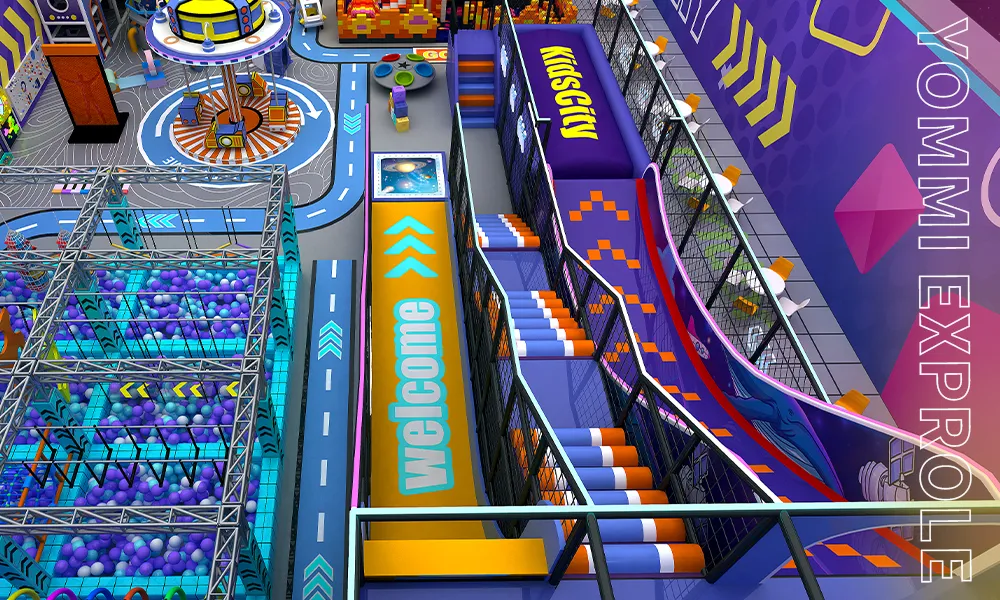
A highly popular premium attraction is the Donut Slide (also known as a Dry Snow Slide). A standard commercial Donut Slide installation typically spans 10 to 20 meters in length and at least 2 meters in width, though wider custom configurations for dual-racing lanes are common. The starting platform requires a vertical height of 4.2 to 8.0 meters. In total, you must dedicate 20 to 50 square meters of uninterrupted linear space just for this single attraction.
Another premium visual feature is the Volcano Climb. This acts as a massive visual anchor, usually placed in the center of the room. A standard Volcano Climb requires a large circular footprint with a diameter of 5 to 10 meters and a minimum vertical clearance of 4 to 6 meters.
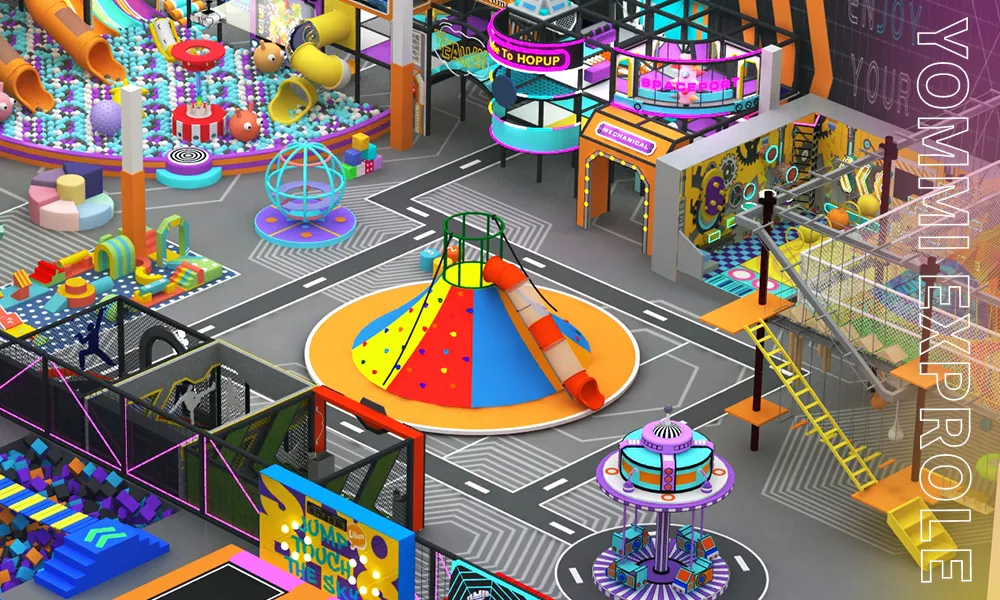
Because of the massive footprint these attractions demand, there is a strict spatial threshold for their implementation. If your overall facility is smaller than 500 square meters, installing a Volcano Climb is not recommended. It will consume too much valuable floor space, severely reducing the capacity of your main play frame. For venues under 500 square meters, spatial efficiency is best achieved by focusing on compact slide combinations and dense, multi-level obstacle courses. If your facility exceeds 800 square meters, you have the necessary footprint to deploy these large visual landmarks without compromising your general venue capacity.
Grid Systems and Managing Structural Columns
Very few commercial buildings feature a completely open, column-free floor plan. Most warehouses or retail spaces contain heavy structural support columns. Managing these columns correctly is a hallmark of professional architectural design. The structural framework of indoor playground equipment is typically built on a standardized galvanized steel grid, usually measuring 1.25 meters by 1.25 meters (approximately 4.1 feet by 4.1 feet). When a building column interrupts this grid, professional play equipment manufacturers employ two highly effective engineering methods to resolve the physical conflict.
The first method is the wrapping technique. The engineering team maps the exact location of the building column and designs the play structure to encompass it. The concrete or steel column is then heavily wrapped in thick, commercial-grade EPE foam padding and protective PVC leather, effectively transforming an architectural obstacle into a safe, integrated play feature within the structure.
The second method involves grid integration. The design software adjusts the standard 1.25-meter modules to create an "irregular grid" that seamlessly bypasses the column's exact coordinates, ensuring the structural integrity of the frame remains intact.
When executed correctly by experienced factory designers, structural columns do not result in wasted space. A professionally engineered layout can achieve a space utilization rate of over 95%, ensuring that every available square meter generates revenue.
Independent Planning for the Toddler Zone
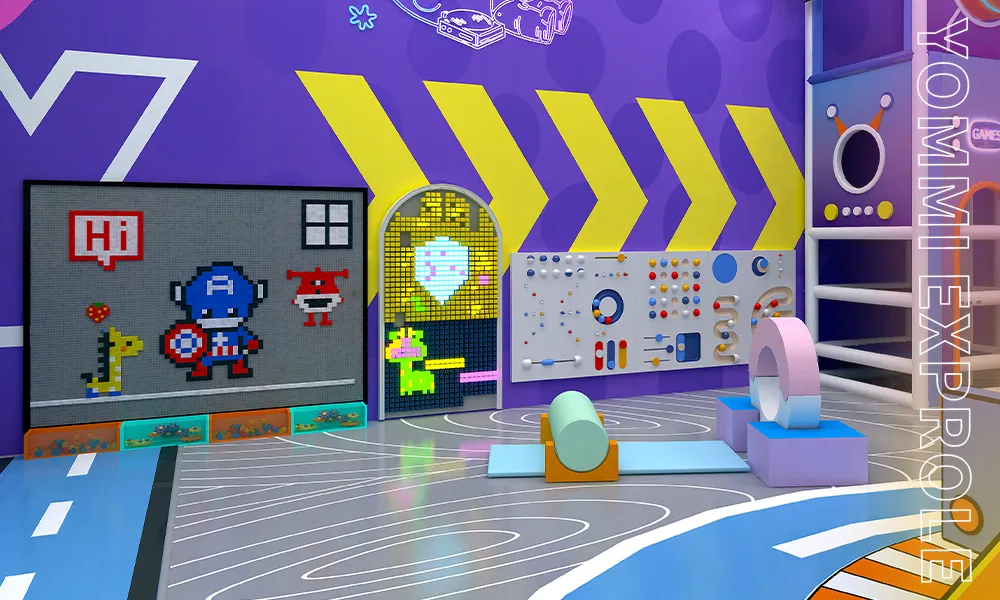
The Toddler Zone must be treated as an independent spatial entity during the initial planning phase. Following the golden ratio mentioned earlier, the Toddler Zone should consume 15% to 25% of the total active play area. Its physical placement within the building is crucial for safety and parental satisfaction. The zone must be situated far away from high-speed attractions, such as zip lines or the exit lanes of large slides, to prevent accidental collisions between fast-moving older children and slow-moving toddlers.
Strategically, the Toddler Zone should be placed immediately adjacent to the main cafe or parental seating area. This positioning provides parents with excellent, unobstructed visibility to monitor their youngest children while resting. To maintain safety protocols, the Toddler Zone must be physically isolated from the main play frame using low, padded barrier walls or soft fencing. This physical boundary prevents toddlers from wandering into the main structure and deters older, more active children from entering the designated low-impact area.
Maximizing Party Room Logistics and Sizing
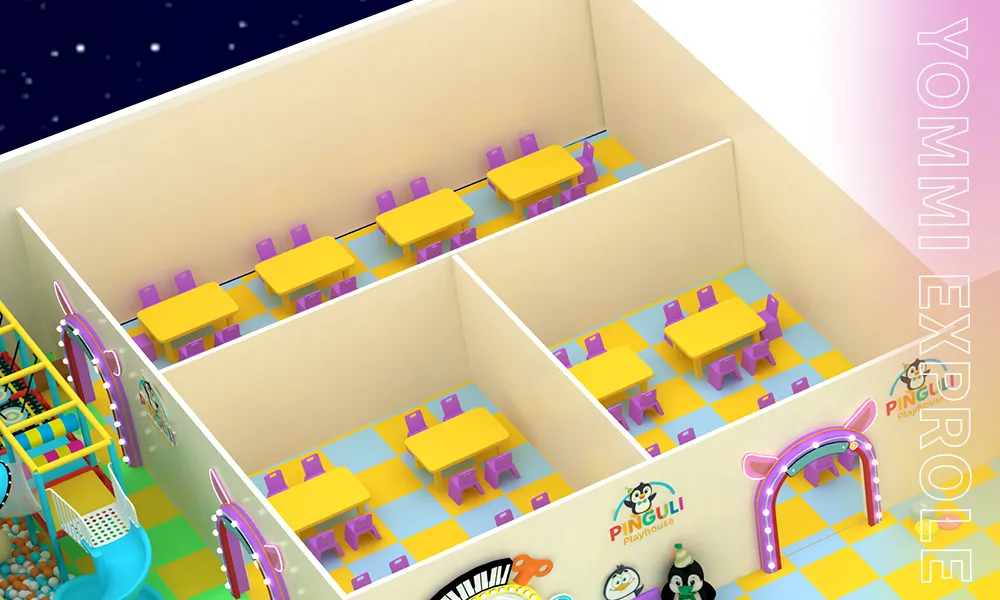
Birthday parties often yield the highest profit margins in a family entertainment center. The size, quantity, and location of your party rooms directly impact your weekend revenue ceiling and overall profitability. A standard party room designed to comfortably accommodate 15 to 30 guests should measure between 20 and 30 square meters. For a mid-sized facility ranging from 500 to 800 square meters, the optimal configuration is to build 2 to 4 dedicated party rooms.
The architectural placement of these rooms requires careful logistical planning. They should be positioned in proximity to the food and beverage preparation area. This minimizes the walking distance for staff delivering hot food and cakes, significantly improving operational efficiency during busy weekend shifts. At the same time, the party rooms must be situated slightly away from the heaviest traffic aisles to provide guests with a sense of exclusivity and acoustic privacy, without obstructing the main circulation routes of the venue.
Eliminating Bottlenecks at Entry and Exit Zones
The most common operational failure in new venues occurs right at the front door. Properly sizing the entry, ticketing, and transition zones is vital to prevent severe crowding that can frustrate customers before they even begin playing.
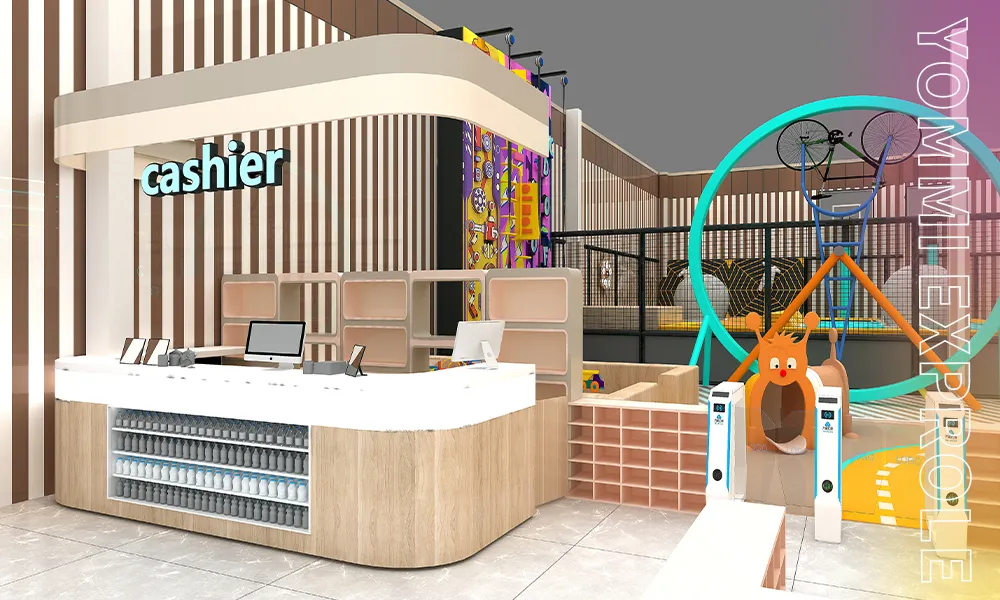
The reception and ticketing area must be spacious enough to handle multiple families filling out digital waivers, asking questions, and paying for admission simultaneously. The reception counter area should have a minimum width of 4 to 6 meters and a depth of 3 to 4 meters to allow organized lines to form without spilling outside the front door. Immediately following the reception is the transition zone, featuring shoe cubbies and locker storage. The mathematical rule for sizing this area is to calculate your absolute peak visitor capacity and multiply it by 1.2. This ensures you have adequate storage for overlapping shifts of guests arriving and departing simultaneously.
The core architectural principle for designing these transitional zones is flow separation. You must establish distinct, separate pathways for arriving guests and departing guests. Forcing existing customers to push past entering customers creates immediate congestion. Ensure that all main circulation aisles leading from the reception to the play areas maintain a minimum width of 1 to 2 meters. By strategically planning the dimensions of these critical bottleneck zones, you ensure a smooth, professional customer experience from the moment guests walk through your doors.
Hardcore B2B FAQ: Spatial Planning & Site Selection
Q: I have a 400-square-meter facility and want to install a Volcano Climb as the centerpiece. Is this a feasible layout strategy?
A: Yes, but it requires a customized, scaled-down design.
Expert Insight: A standard Volcano Climb requires a large circular footprint of 5 to 10 meters in diameter, which would consume a disproportionate amount of active floor space in a 400-square-meter venue and reduce your overall visitor capacity. However, professional manufacturers can engineer a customized, compact Volcano Climb specifically tailored for mid-sized footprints. This allows you to retain the strong visual anchor and marketing appeal of the attraction while preserving enough horizontal space for essential multi-level slide combinations and integrated obstacle courses. The key to maximizing ROI in a 400-square-meter space is structural customization rather than buying off-the-shelf equipment sizes.
Q: The commercial building I want to lease has structural columns every 5 meters. Will this ruin the layout of my indoor playground?
A: No, structural columns will not ruin the layout if handled by a professional manufacturer with custom engineering capabilities.
Expert Insight: While dense columns make planning more complex, professional engineers use two methods to solve this. First, we integrate the columns into the 1.25m x 1.25m structural grid by creating irregular grid modules. Second, we heavily wrap any exposed building columns in commercial-grade EPE padding and PVC, turning them into safe, interactive obstacles within the play frame. A properly engineered design can achieve over 95% space utilization, even in a building with heavy column density.
Q: How do I calculate the exact size needed for my shoe cubby and locker area to prevent weekend traffic jams?
A: The standard industry formula is to calculate your venue's peak visitor capacity and multiply it by 1.2.
Expert Insight: If your maximum legal capacity is 200 children, you need a minimum of 240 shoe cubbies. This 20% buffer is critical for managing shift overlaps. During busy weekend hours, a new wave of customers will arrive and need to store their shoes while the previous wave of customers is still inside the play area, preparing to leave. Additionally, your architectural layout must physically separate the entry flow from the exit flow, utilizing aisles that are at least 1 to 2 meters wide to prevent bottlenecks.


