
Listen to me very carefully. Most investors looking to open a trampoline park USA location focus entirely on the wrong things. They obsess over shiny 3D renderings. They look at the initial equipment quote, look at their bank account, and think they are ready to print money.
Then reality hits.
I have spent 15 years in the trenches of the B2B indoor amusement industry. As a source factory veteran, I have seen guys mortgage their homes, buy cheap equipment, and then go completely bankrupt before they even cut the grand opening ribbon. Why? Because the US market is a financial bloodbath if you are blind. It is the most profitable market in the world, but the building codes, fire inspections, and shipping logistics will eat you alive. You are not just buying steel and foam. You are navigating a minefield.
I am going to walk you through exactly what it takes to survive and dominate this market. I will use the hard data, the failed leases, and the blood lessons I deal with every single day. If you want to protect your money, read every single word.
1. The 1.5x Cash Rule: The Hidden Financial Trap
Many US clients come to me asking for a quote. I give them the price. They wired the deposit. They think the hard part is over. They are dead wrong.
Equipment is just the beginning. I had a client from New York. He ordered a massive setup. He had just enough cash to cover the gear. Shortly after production finished, US-China trade friction spiked. Ocean freight rates exploded. Customs tariffs shifted overnight. He did not have the cash buffer to pay the sudden surge in shipping costs.
His custom-built park sat in my factory for six months. We had to charge him storage fees to keep his gear safe. Worse, his landlord in New York demanded rent every single month for an empty concrete box. His entire business plan was delayed by half a year because he lacked a cash buffer.
Do not make this mistake. For a standard 20,000-square-foot location, the equipment will run you between $200,000 and $240,000. That is only 60% to 70% of your total project cost. My rule is simple: You must have 1.5 times the equipment cost sitting in cash before you sign a contract. You need that extra money for ocean freight fluctuations, tariffs, local US contractor fees, and city permits. If your bank account hits zero at the 90% completion mark, you lose everything.
2. The 18-Foot Death Trap: Why Ceiling Height Dictates Survival
Location dictates your survival. The vertical space of your building dictates your profitability and your legal liability.
A guy from Missouri sent me his lease agreement and floor plan. He wanted a layout fast. I checked the specs. His ceiling was exactly 15 feet high. He thought it was perfectly fine. He never factored in the local fire code. US fire regulations require an 18-inch clearance for overhead fire sprinklers.
That left him with 13.5 feet of usable height. I told him flat out: "Sir, you cannot build a park here. It is a death trap."
Think about the physics. If a grown adult bounces on a high-performance commercial trampoline, they are going to launch into the air. With a 13.5-foot clearance, their head will smash directly into the steel sprinkler system. A flooded building ruins your gear. A broken neck is a massive lawsuit that ends your life and your business. We demand an absolute minimum clear height of 18 feet for US locations. If you want high-ticket attractions like zip lines or devil slides, you need even more. I forced that client to abandon his lease and find a taller building. We saved his business before it even started.
3. Beating the Fire Marshall: ASTM Standards and Material Reality
The US has the strictest safety and fire regulations on the planet. If you buy cheap equipment from a shady broker to save a few bucks, the local Fire Marshall will lock your doors.
We build our parks with a paranoia for safety. We comply with ASTM F2970 standards. We meet NFPA requirements. We even pass California's insane TB 117-2013 flammability laws. How? By refusing to use cheap materials. We use heavy-duty, flame-retardant PVC for our padding. We use high-density foam blocks with a minimum density rating of 40. We use galvanized steel pipes with a thickness between 1.8mm and 2.5mm.
I have seen investors buy cheap, thin-walled Chinese steel and standard foam. The US inspectors walk in, run a flammability test on the padding, check the structural integrity of the frames, and deny the occupancy permit. The investor is left with a warehouse full of illegal garbage that they cannot legally let children play on. Do not play games with US inspectors. Buy source factory-grade. Pass the inspection on day one.
4. Slashing Outrageous US Insurance Premiums
Commercial liability insurance in the US will bleed your cash flow dry. It is a massive, relentless fixed cost. If you buy weak gear, your accident rate goes up, your claims go up, and your premiums skyrocket until you are forced to shut down.
As a serious trampoline park manufacturer (Yommi), we attack your insurance costs directly at the factory floor. We over-engineer everything. We use thicker padding overlaps so feet do not slip between springs. We weave tighter, high-tension safety nets. We use premium springs that do not snap under heavy loads.
Our equipment carries ASTM and EN1176 certifications. When you sit down with an insurance underwriter, you do not just ask for a policy. You drop our spec sheets on the table. You prove to them that the park is built like a tank. When a kid inevitably trips over their own feet, you have the documentation to prove the equipment is flawless. This reduces your risk profile. It gives you leverage to negotiate lower premiums.
5. The 50/50 Floor Plan Rule: Why "Jump-Only" Parks Are Dead
Traditional "jump-only" parks are dead. If you just put 15,000 square feet of flat trampolines in a room, you will go out of business within two years. Kids get bored. Parents stop paying.
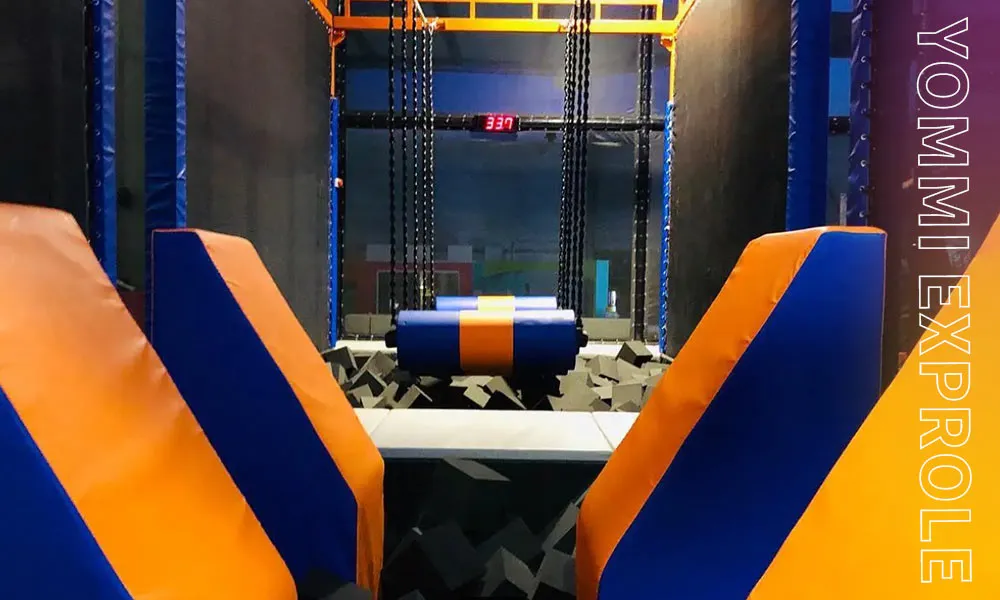
Look at our recent US order data. The highest revenue generators are not trampolines. They are Ninja Warrior Courses, interactive Tag Arenas, Devil's Slides, and high-wire Zip Lines. These are the attractions that drive aggressive repeat business.
When my team designs your layout, we enforce the 50/50 rule. We allocate 50% to 60% of your usable space for traditional jump zones to handle high capacity. We dedicate the remaining space exclusively to these high-retention, modern attractions. You are not selling a place to jump. You are selling an extreme indoor sports experience. That is how you charge premium ticket prices.
6. Navigating the Trade War and Ocean Freight
Let us be honest about geopolitics. US-China trade friction is real. Tariffs fluctuate. Ocean freight rates can swing wildly based on port congestion and global events.
I cannot magically make US tariffs disappear. But I can control the timing. We monitor shipping lanes and freight costs daily. When your production is nearing completion, we actively track the rate changes. We push you to arrange your logistics, clear customs, and book your containers at the exact right moment to avoid sudden spikes in shipping costs. In this industry, hesitation costs thousands of dollars. We keep you moving.
7. The Installation Nightmare: Do Not Trust Local US Contractors
US labor costs are astronomical. When the shipping containers finally arrive at your warehouse, you will be tempted to hire a local American construction crew to bolt the steel together.
Do not do it. Local contractors know how to frame houses and pour concrete. They do not know the exact tension requirements for commercial jumping mats. They do not understand the intricate lacing of safety nets. They make mistakes. They work slowly. You end up paying them $100 an hour just to stand around reading our instruction manuals.
We solve this. We send our own factory engineers directly to your site. We handle their visas and paperwork. You simply pay for their flights, hotel, daily food, and a flat base salary. Our guys build these parks professionally. They work fast, they do not cut corners, and they ensure every single bolt meets ASTM compliance. It is drastically cheaper and infinitely safer than hiring a random local crew.
8. The Los Angeles Mall Trap: Zoning and Foot Traffic
Zoning approvals in the US can drag on for six to eight months. You need to start your permit process the second we verify your floor plan. But where do you build?
You need a location surrounded by young families with massive parking availability. A client in Los Angeles brought me a location inside a busy shopping mall. High population density. Great demographics. On paper, it looked like a goldmine. I looked at the mall's internal traffic flow and told him to halt everything.
His unit was on the highest floor of the mall, shoved into the furthest edge, completely disconnected from the only ground-level parking lot. Think about your customer. Parents carrying bags and dragging three kids are not going to hike across a massive mall and ride three escalators to reach your park. They will go to your competitor, who has a ground-floor entrance with parking 20 feet from the door. I forced him to relocate to a lower level. We secured his foot traffic and saved his revenue stream.
9. War Tactics: Beating Franchises Like SkyZone
A client in Florida called me in a panic. He just leased a building right down the street from a massive SkyZone franchise. He asked me how an independent park could possibly survive against a corporate giant.
I gave him two operational directives. First, stop fighting them on ticket sales. Change your business model. Do not just sell hourly jump passes. Push massive group events, corporate team building, and aggressive membership programs to lock in recurring revenue.
Second, we changed his floor plan to offer what SkyZone did not. We designed a dedicated, high-end cafe area. We built a massive pay-to-play arcade zone. We installed premium, private party rooms. He stopped selling jump tickets. He started selling complete Saturday afternoon experiences. Parents sat in the cafe, kids played in the arcade, and he generated three different streams of income from a single customer. He ate their market share because his park was simply a better business.
10. The Arizona Warehouse Disaster: A Warning
Let me end with a warning. You must pay attention to the building details, or you will lose everything.
An investor from Arizona came to me. He already owned one successful park. He was arrogant. He found a massive, cheap warehouse for location number two. He rushed me to draft a 3D layout immediately so he could sign the lease that afternoon. I stopped him and demanded the architectural blueprints. I reviewed them, and it was a disaster waiting to happen.
First, the building had no pre-installed fire sprinkler system. Retrofitting a massive warehouse with commercial sprinklers in the US costs an absolute fortune. Second, the entire building only had one emergency exit. Putting 300 kids in a room with one door is illegal and guarantees a deadly stampede in an emergency.
I laid the facts out. He froze. He realized he was hours away from signing a multi-year lease on a building he legally could not operate in. He backed out of the deal. We saved him hundreds of thousands of dollars.
Do not rush. Do your math. Partner with a factory that acts like a ruthless business partner, not a cash register.
Executive FAQ: Handling Objections
Q: Can I open a US park with just enough cash to cover the equipment and the building lease?
No. You will run out of money, and your park will fail before it opens.
My Experience: A New York client had exact cash for the gear. US-China tariffs and ocean freight skyrocketed overnight. He couldn't pay the shipping. His gear sat in my factory for 6 months, racking up storage fees, while his landlord charged him rent for an empty building. Always hold 1.5x the equipment cost in cash.
Q: My building has a 15-foot ceiling. Is that high enough if I only install basic trampolines?
Absolutely not. You will violate US fire codes and create a lethal hazard.
My Experience: A Missouri client tried this. He forgot that US fire codes require an 18-inch clearance for overhead sprinklers. That leaves 13.5 feet. An adult bouncing will smash their head into the steel pipes. You need an absolute minimum of 18 feet of clear height.
Q: Can I save money by using cheaper foam and thinner steel pipes?
No. The US Fire Marshall will fail your inspection and lock your doors permanently.
My Experience: The US strictly enforces ASTM and California TB 117-2013 flammability laws. We use expensive flame-retardant PVC, density-40 foam, and 1.8mm-2.5mm galvanized steel. Cheaper Chinese materials fail US fire tests. Your park will never legally open.
Q: Should I hire a local American contractor to install the park?
Only if they specialize specifically in indoor amusement parks, which is extremely rare. Otherwise, you are throwing money in the trash.
My Experience: US labor is too expensive. Local crews build houses; they don't know the exact tension specs of our gear. We dispatch our own factory engineers to the US. You pay for flights and basic salary. They build it faster, cheaper, and perfectly to the ASTM code.
Q: Can an independent park really compete against massive franchises like SkyZone?
Yes. But you must diversify your floor plan and revenue streams.
My Experience: A Florida client was terrified of a nearby SkyZone. We dedicated only 50% of his space to jumping. We filled the rest with Ninja Courses, arcades, and VIP party rooms. He beat them by selling memberships and birthday packages, not just jump tickets.


