Please listen to me carefully. The most expensive mistake you can make when opening an indoor trampoline park is signing a commercial lease before a professional factory team has analyzed the site. Investors often look up at the ceiling when they walk into an industrial warehouse, feel it looks high, and then jump right into signing a multi-year commercial lease. When our factory team gets the CAD drawings of the site weeks later, we often find that the actual usable height is woefully inadequate, and there are so many structural columns that the site may not be able to accommodate high-end, high-margin equipment.
Understanding the rigors of trampoline park construction isn’t just about finding a big site; If your building doesn't meet basic physical requirements, you won't attract the teen crowd. You will be forced to operate a low-end facility and also be responsible for the monthly rent. As a playground equipment manufacturer with rich experience and a global reputation, I suggest that if you want to survive and develop in the local market, successfully pass municipal safety inspections, and occupy a dominant position, you must strictly follow the factory-level site selection indicators detailed below.
The Physics of the Clear Height: The Minimum Baseline
For a standard commercial jump area to legally operate, the absolute minimum vertical space required is 4.5 to 5 meters. Here is the exact, unyielding mathematical breakdown directly from our engineering floor:
The Structural Base Frame (1.0m – 1.2m): A heavy-duty trampoline commercial frame and the necessary ground clearance required for the spring tension to operate consume at least 1.0 to 1.2 meters directly off the concrete floor.
Human Kinetic Jump Height (1.5m – 3.0m+): You must calculate the apex of the user. An average adult jumping casually will reach 1.5 to 2.0 meters in the air. A physically fit teenager pushing the limits of the mat will hit 2.5 meters. In extreme scenarios where athletic users are performing flips, they can easily exceed 3 meters of vertical kinetic lift.
The Safety Clearance Buffer (0.2m – 0.5m): You must legally and physically maintain a strict safety buffer between the jumper's maximum theoretical apex and the ceiling. This 0.2 to 0.5-meter buffer is mandatory to prevent catastrophic impacts that would result in immediate facility closure and massive liability lawsuits.
When you add the base frame (1.2m) + an aggressive kinetic jump (2.8m) + the safety buffer (0.5m), you immediately hit 4.5 meters just for basic, flat, standard jumping. If your building is shorter than this, you cannot legally or safely operate a standard commercial park. Your insurance underwriters will deny your coverage instantly.
The High-Performance Zone: The 7-Meter Rule
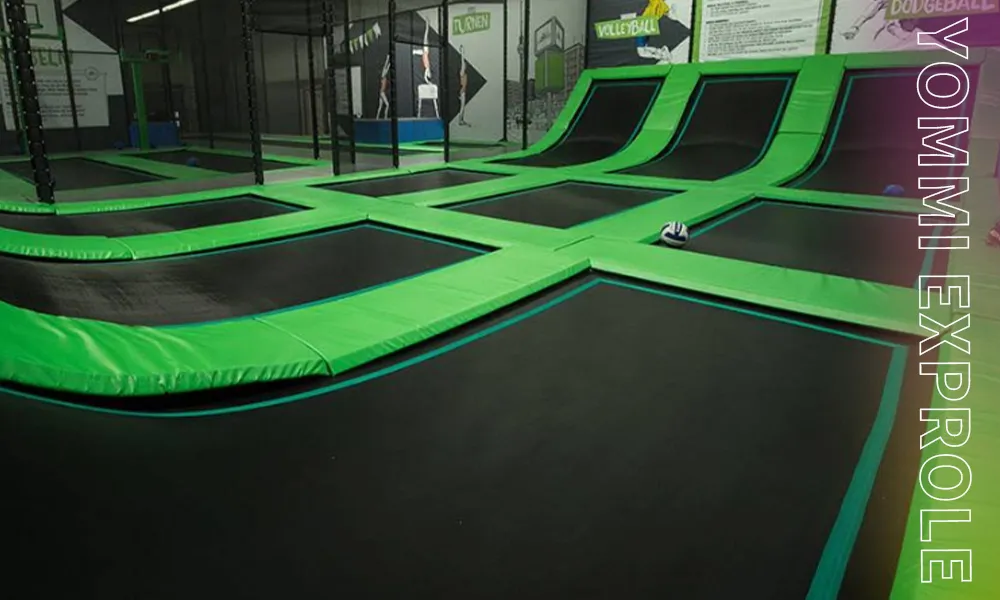
The teens and young adults of 2026—the group with the highest disposable income and the highest frequency of social media sharing—are looking for the ultimate thrill. What they are looking forward to is Olympic-level professional trampoline, vertical wall running, extreme ninja warrior track, and a giant air cushion jumping platform. These premium, high-profit attractions simply cannot fit in a standard 5-meter building. The physics of these features propel users much higher into the air. For any High-Performance Zone, the absolute mandatory clear height is 6.5 meters minimum, and our factory engineering team strongly recommends 7.0 meters or higher.
The "Clear Height" Deception: The 99% Mistake
Clients constantly measure from the concrete floor to the literal metal roof deck. That measurement is completely useless and highly dangerous. In commercial amusement engineering, we do not care about the roof. We only care about the "Lowest Obstacle Point."
There are four critical obstacles that clients blindly ignore when touring a warehouse:
Fire Sprinkler Systems: The mandatory water pipes and sprinkler heads that hang down from the ceiling.
Massive HVAC Ducts: Commercial air conditioning systems rely on huge, suspended metal ducts that can drop a full meter below the roofline.
Horizontal Steel Support Beams: The structural trusses that hold the building together.
Industrial Lighting Fixtures: Large, hanging warehouse lights.
Let me give you an example that actually happened in my career. I have a North American client who is ready to sign a long-term lease contract. He assured me, "The height is 6.5 meters, absolutely perfect." Before he signed, I asked him to take an original picture from inside the warehouse for me to confirm. However, the photos show that the 6.5 meters is measured to the highest point of the roof. At a height of 4.8 meters from the ground, a huge horizontal steel beam spans the entire site. The 6.5-meter-high building, he said, is completely unsuitable for professional trampolines. The measurement must be based on the lowest obstacle.
The Column Minefield and Custom Engineering
Old industrial warehouses, retail spaces, and abandoned supermarkets are often filled with dense structural columns. When many investors see this situation, they will think that the density of columns is too high and is completely unsuitable for transformation into a continuous trampoline park. The reality is: excessive column density can make space layout difficult. If the posts are too closely spaced, the flow of the space will be disrupted, making it impossible to arrange a large, continuous jumping bed or a full-size competitive dodgeball court. This will limit the usable space of the venue and seriously reduce the utilization rate of the venue.
However, as a true source factory, we focus on overcoming this difficulty. We provide deeply customized venue designs. If you have columns, we will specifically design the structural frame so that it neatly wraps around the columns. What’s more, all posts located in or near active play areas must be wrapped with thick wainscoting. This is a necessary security requirement. We transform architectural barriers into safe and secure components of the park. Don't let your local merchants tell you it's impossible; the source factory can create a solution for you.
Monetizing the Vertical Space (The ROI Maximizer)
The cost of renting a warehouse with a clear height of 7 to 8 meters will be relatively high. Commercial rent may become your project's largest operating expense. So if you just put a regular trampoline on the first floor, you’re not actually maximizing the use of your vertical space. To maximize your ROI, you must make the most of your vertical space. Since the floor area is fixed, you have to grow upwards. We specialize in designing indoor parks to include multi-story, high-altitude programs:
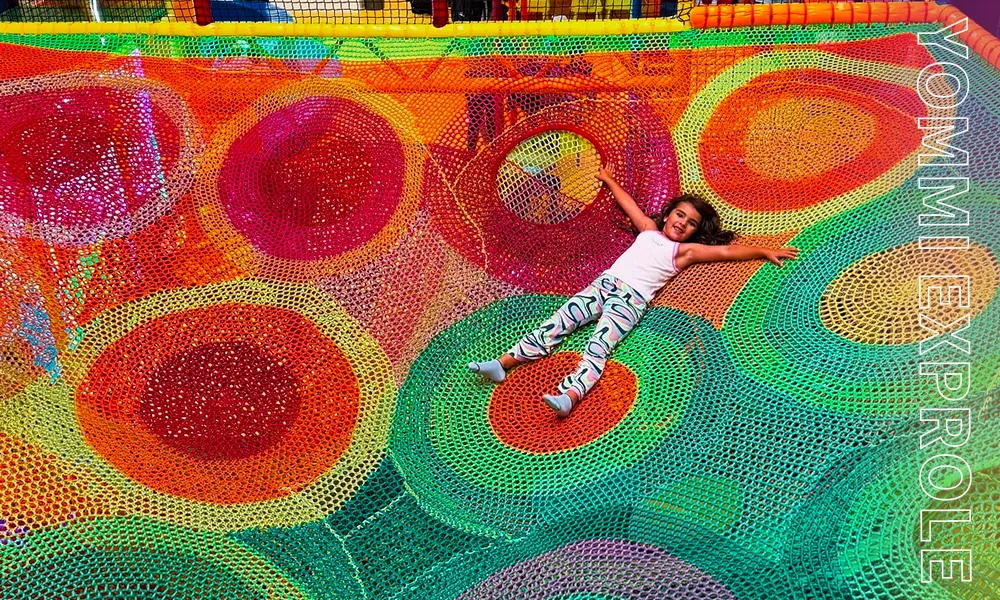
Suspended Rainbow Nets: Utilizing the upper canopy for safe, fully enclosed exploration networks.
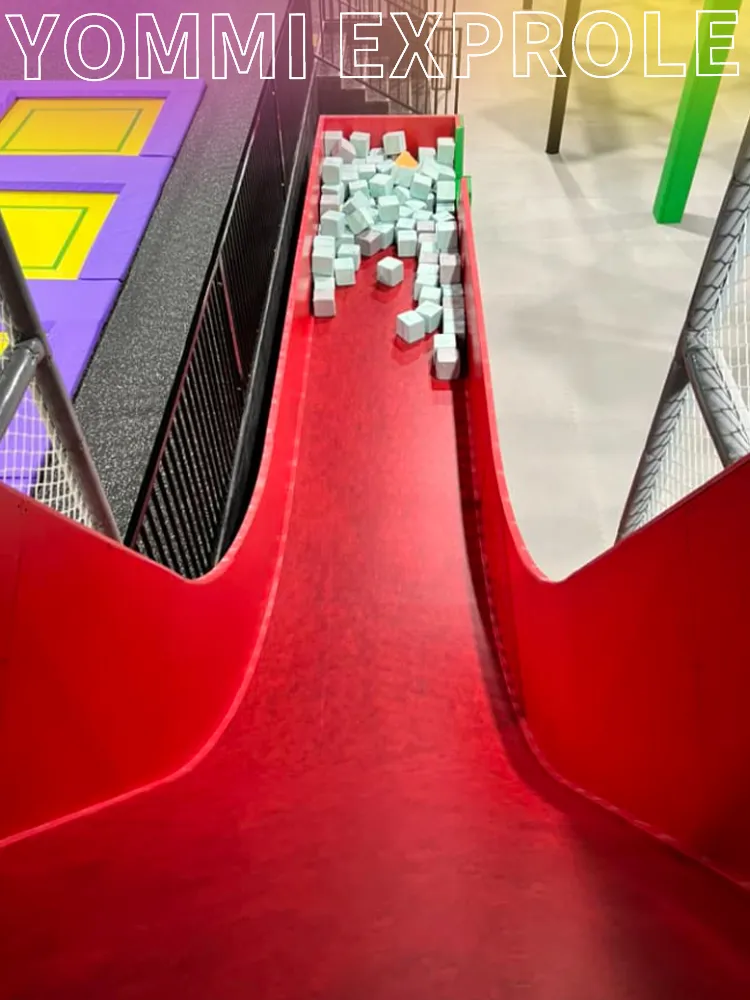
Devil Slides: Dropping from a 4-meter high platform to generate massive thrills and visual centerpieces.
Elevated Ninja Courses: Stacking attractions on top of each other to increase user capacity.
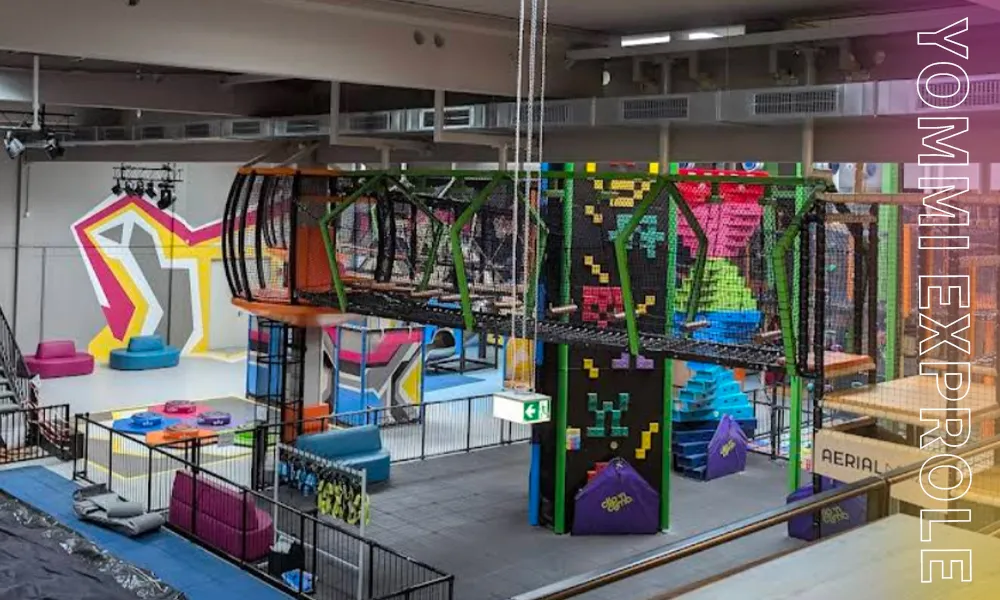
The underlying business logic is simple: By fully utilizing the vertical space, you can double the physical capacity of the building, allowing you to sell more tickets per hour.
Logistics, Roll-Up Doors, and The Yommi Play Advantage
Investors are so deeply focused on the inside of the building that they completely forget how the equipment actually gets inside. Before signing a rental contract, you must actually measure the dimensions of the equipment door that will be brought into the venue. Our factory's standard recommendations are: the width of your factory's receiving door should be ≥3.5 to 4 meters, and the height should be ≥4.2 to 4.5 meters. If your door size is much smaller than this, moving a large wooden slide box into the venue will become a more difficult affair.
But working with a professional, top-tier factory can change the rules of the game. Regular manufacturers like Yommi Play use advanced engineering breakdown processes. Once you place your order, you simply provide the exact dimensions of your building's door. Our engineering department uses specialized software to meticulously break down large rides, ensuring each custom-sized component will fit smoothly through your designated doorways. This guarantees flawless logistics, without the need for on-site cutting or welding, and ensures a smooth installation process. Of course, it should also be noted that large fiberglass slides must be packed in wooden boxes. This cannot be broken down and has practical requirements for the size of the door.
The Skylight Sabotage: UV Degradation
Many old warehouses have huge skylights on their roofs to bring in natural light. Maybe you will find it beautiful from an aesthetic point of view. But from a commercial and operational perspective, this will incur a maintenance expense. Direct sunlight is the enemy of commercial indoor trampoline parks. Intense UV radiation can damage the jumping surface. Over time, continued UV exposure can cause the bungee surface to lose its high stretch elasticity and become brittle. This will incur a maintenance fee to replace the jumping surface. Secondly, direct sunlight in summer can cause the heat load on the air conditioning system to soar. Just trying to cool down consumes a large portion of operating capital. This does not include localized areas of overheating on the mat that customers would refuse to use due to discomfort. We strongly recommend that all customers install heavy shading structures, UV protective films, or complete blackout treatments on their skylights before the equipment arrives.
The Pre-Lease Factory Audit: Your Ultimate Safety Net
It is best not to directly sign a lease agreement without having the site analyzed by our factory team. Unlike middlemen who start peddling generic equipment manuals after you blindly rent a property, real manufacturers will serve as your technical engineering advisors before you invest your money. If you send us original architectural CAD drawings before signing your lease agreement, our engineering team will review them. We'll find some hidden construction flaws:
The True Net Height Check: We will find the low-hanging beams and HVAC ducts you missed.
Column Density Analysis: We will warn you if the structural pillars are too dense to build a profitable layout.
Evacuation Flow Validation: We will calculate if the entrance and exit placements mathematically violate local crowd evacuation physics, which would cause you to instantly fail your municipal fire inspection.
Hardcore B2B FAQ
Q: Can I just rent a standard 5-meter building and still install a professional Wall Run and Air Bag drop to attract teenagers?
No. Professional and extreme attractions physically demand a minimum of 6.5 to 7 meters of clear vertical space to operate legally and safely.
My Experience: If you were trying to put a professional trampoline into a 5-meter-tall building, it could create a safety hazard. An able-bodied adult can easily jump over 3 meters while bouncing on an Olympic-level trampoline. Coupled with the 1.2-meter-high base, their heads almost touch the ceiling. This makes it easy for the insurance company to terminate your insurance. Professional trampoline areas require higher ceilings, both from a legal and physical perspective.
Q: The commercial real estate agent insists the ceiling is 7 meters high, but there are large AC ducts hanging down. Should I accept the 7-meter measurement for my layout?
Absolutely not. You must only calculate the "Lowest Obstacle Point" to determine your true usable height for equipment design.
My Experience: 99% of amateur clients make this exact mistake. They measure to the roof deck and completely ignore the structural obstacles. If the roof is 7 meters, but massive HVAC ducts, lighting trusses, and fire sprinklers drop down to 5.5 meters, your functional clear height is exactly 5.5 meters. If you order equipment designed for a 7-meter building, the installation team will hit the ducts. You will then be forced to halt installation and pay local contractors tens of thousands of dollars to modify the steel frame on-site or reroute the building's HVAC system.
Q: My chosen warehouse has a very heavy column density. Does this mean I cannot open a profitable trampoline park?
Not necessarily, but it requires deep factory-level custom engineering and strict commercial safety padding.
My Experience: Dense columns are a real pain in the ass because they disrupt the layout of large dodgeball courts and continuous free jumping areas. However, a professional steel structure factory can custom-design the underlying steel structure so that it cleverly bypasses the columns. The absolute bottom line here is safety: all columns must be tightly wrapped with thick wainscoting. When we designed the layout, we ensured that these padded columns blended in with the overall aesthetic of the park.