I have been manufacturing and exporting commercial indoor playground and trampoline park equipment for over 10 years. Every day, ambitious investors bring me thousand-square-meter floor plans, and their very first question is always the exact same: Is a trampoline park profitable?
When you search online for trampoline park ROI, you will see countless exaggerated advertisements. But as one of the industry's leading trampoline play equipment manufacturers, I never use unrealistic dreams to close a deal. A trampoline park is a heavy commercial investment. It requires significantly more capital, higher ceiling clearances, and stricter safety compliance than a standard soft play center. Today, I am going to use real financial data from hundreds of large-scale trampoline parks in Western markets to break down the exact setup costs, the hidden operational expenses, and the actual timeframe it takes to get your money back. We will strip away the hype and look at the raw numbers.
1. The Real Setup Costs: Equipment is Only Half the Battle
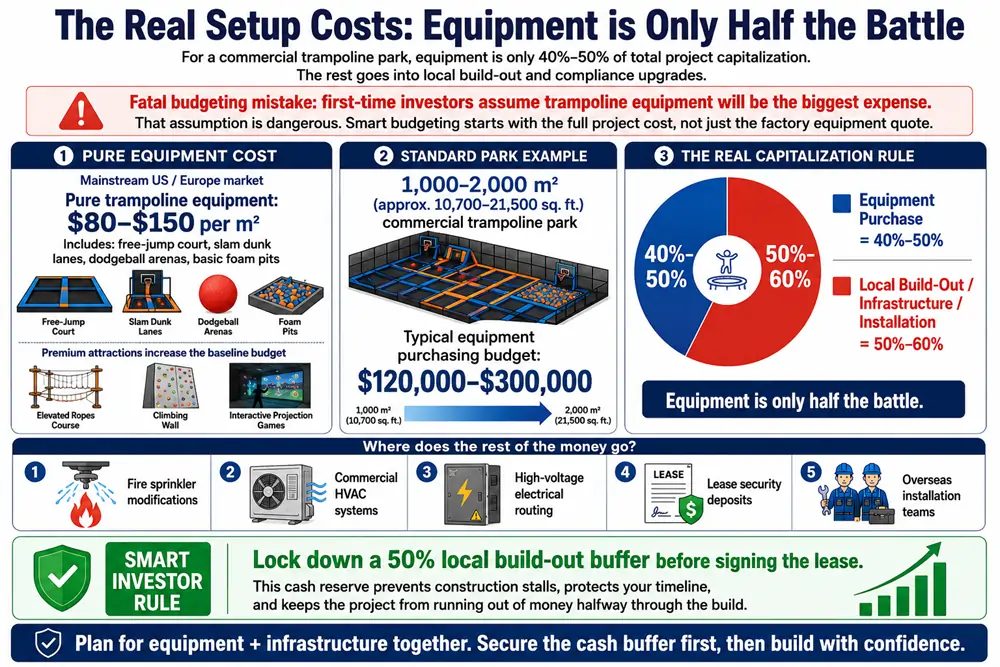
Many first-time investors make a fatal budgeting error. They assume their largest expense will be purchasing the physical trampoline beds from the factory. This is a highly dangerous financial assumption. Based on current mainstream configurations in the US and European markets, pure trampoline equipment—which includes the main free-jump court, slam dunk lanes, dodgeball arenas, and basic foam pits—typically costs between $80 and $150 per square meter. If you plan to add premium, high-value attractions like elevated ropes courses, indoor rock climbing walls, or interactive projection games, your baseline equipment budget will naturally increase.
Let us look at a standard 1,000 to 2,000 square meter (approx. 10,700 to 21,500 sq. ft.) commercial trampoline park. Your pure equipment purchasing budget will fall anywhere between $120,000 and $300,000, depending on your exact footprint and attraction density. However, you must engrave this financial rule into your business plan: Your pure equipment purchase will only account for 40% to 50% of your total project capitalization.
Where does the rest of your money go? It goes into massive local infrastructure upgrades. A trampoline park requires specialized fire sprinkler modifications to meet the local fire marshal's clearance heights. You need heavy-duty commercial HVAC systems to keep thousands of jumping customers cool. You need high-voltage electrical routing, massive commercial lease security deposits, and a significant budget for overseas installation teams. Smart investors lock down this 50% "local build-out buffer" before they ever sign a lease, ensuring they never run out of cash halfway through construction.
2. The Real Gross Revenue: The Massive Gap Between Average and Elite
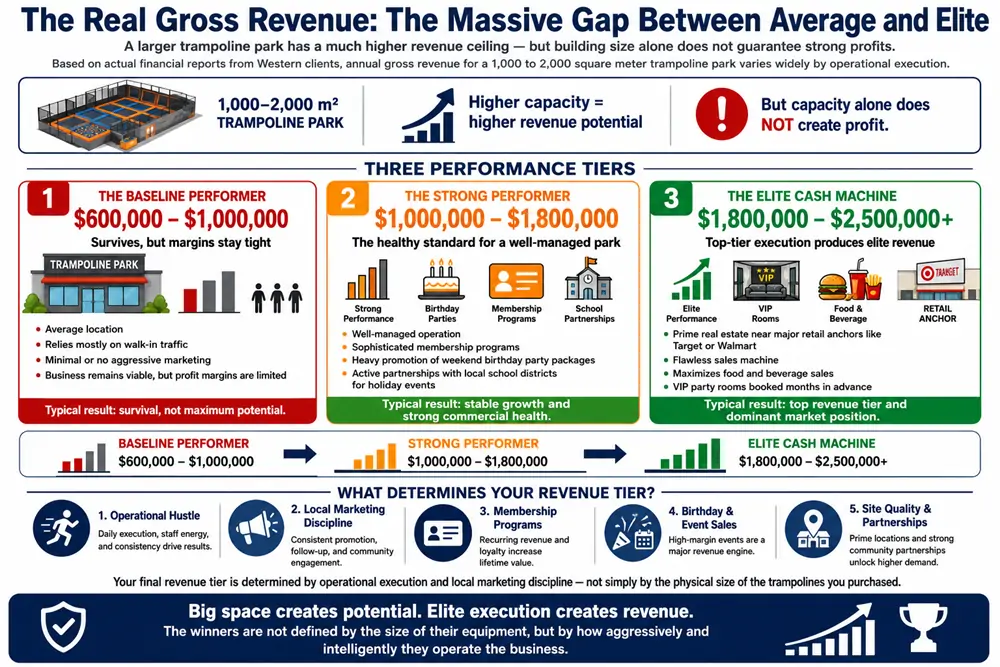
Because a 1,000 to 2,000 square meter trampoline park has a much larger maximum capacity than a standard indoor playground, its revenue ceiling is substantially higher. But having a massive building does not automatically guarantee massive profits. Based on the actual financial reports from our Western clients, annual gross revenue varies wildly based on operational execution. We categorize parks into three distinct performance tiers:
• The Baseline Performer ($600,000 to $1,000,000): If your venue is in an average location and you rely strictly on organic, walk-in foot traffic without aggressive marketing, this is where you will land. You will survive, but your margins will be tight.
• The Strong Performer ($1,000,000 to $1,800,000): This is the healthy standard for a well-managed park. These operators run sophisticated membership programs, heavily market their weekend birthday party packages, and actively partner with local school districts for holiday events.
• The Elite Cash Machine ($1,800,000 to $2,500,000+): These are the apex predators of the industry. They secure prime real estate next to massive retail anchors (like Target or Walmart). They operate a flawless sales machine, maximizing food and beverage sales and booking their VIP party rooms months in advance.
Your final revenue tier is determined by your operational hustle and local marketing discipline, not by the physical size of the trampolines you purchased.
3. Foot Traffic & Ticket Pricing: The Extreme Weekday vs. Weekend Divide
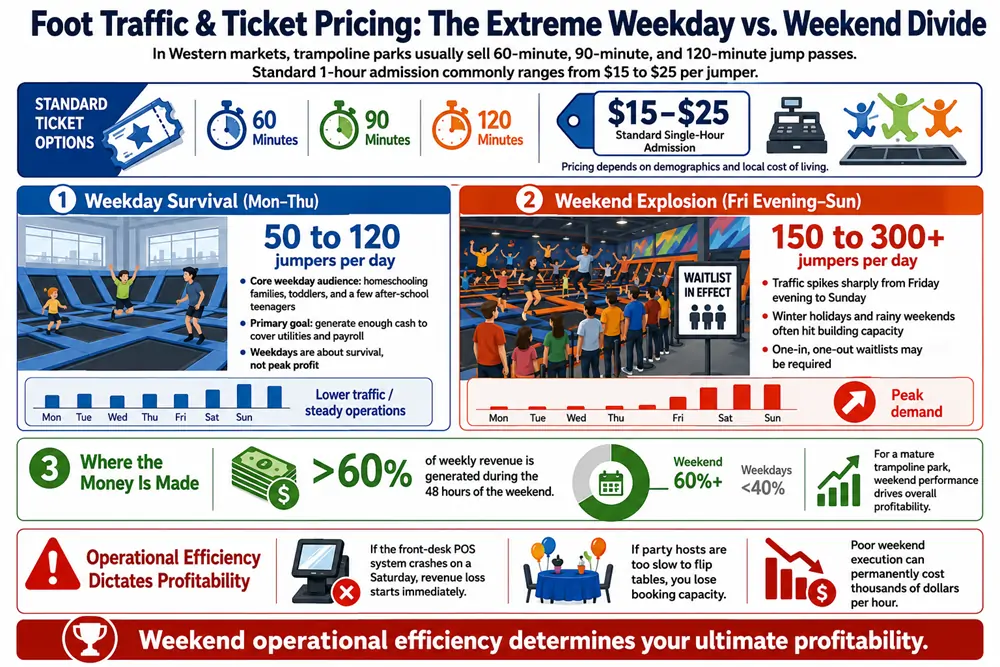
In Western markets, trampoline parks charge by the hour. The standard business model relies on selling 60-minute, 90-minute, or 120-minute jump passes. Depending on your local demographics and city cost-of-living, standard single-hour admission usually ranges from $15 to $25 per jumper. To accurately calculate if is a trampoline park profitable, you must understand the extreme polarization of weekly foot traffic:
• The Weekday Survival (Monday to Thursday): Your primary demographic will be homeschooling families, toddlers, and a few after-school teenagers. Seeing 50 to 120 jumpers per day is standard. Your primary goal from Monday to Thursday is simply to generate enough cash to cover that day's utility bills and payroll.
• The Weekend Explosion (Friday Evening to Sunday): This is the battlefield. Traffic will violently spike to 150 to 300+ jumpers per day. During winter holidays or rainy weekends, you will likely hit building capacity and be forced to implement a one-in, one-out waitlist.
For a mature trampoline park, over 60% of the entire week's revenue is generated during the 48 hours of the weekend. If your front desk point-of-sale system crashes, or your party hosts are too slow to flip tables on a Saturday afternoon, you are permanently losing thousands of dollars an hour. Weekend operational efficiency dictates your ultimate profitability.
4. The Golden Revenue Breakdown: The Hidden Fortune in Grip Socks
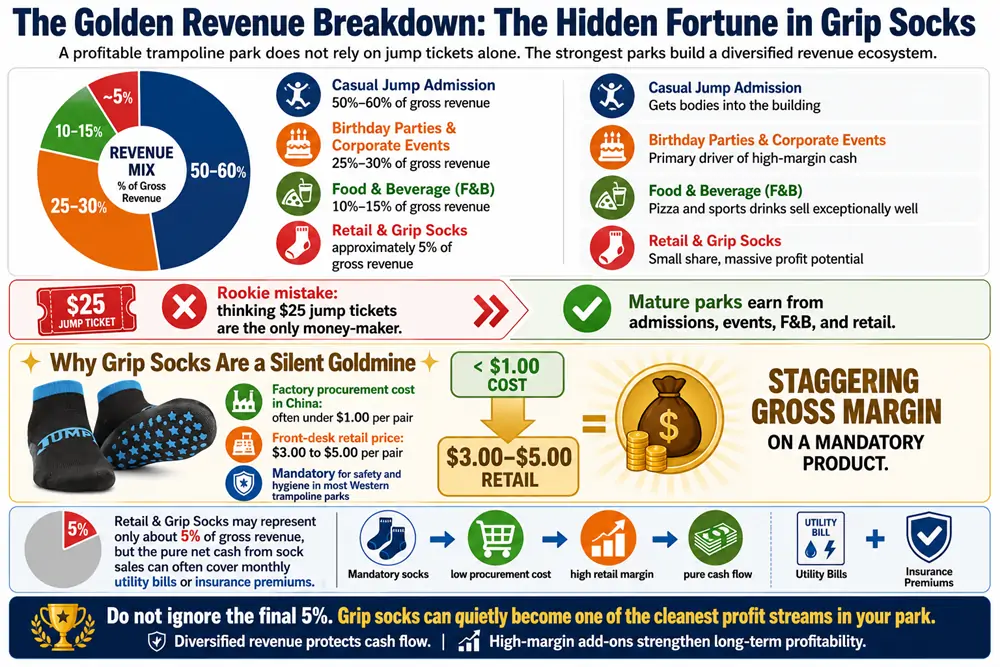
A common rookie mistake is assuming that selling $25 jump tickets is the only way to make money. A mature trampoline park builds a highly diversified revenue ecosystem. Here is the standard revenue breakdown of a highly profitable park:
• Casual Jump Admission: 50% to 60% of gross revenue. This gets bodies into the building.
• Birthday Parties & Corporate Events: 25% to 30% of gross revenue. This is your primary driver of high-margin cash.
• Food & Beverage (F&B): 10% to 15% of gross revenue. High-energy jumping makes customers thirsty and hungry. Pizza and sports drinks sell exceptionally well.
• Retail & Grip Socks: Approximately 5% of gross revenue.
I must draw your attention to that final 5%. For safety and hygiene reasons, almost every Western trampoline park legally requires jumpers to wear custom silicone-bottom grip socks. Trampoline Grip Socks are a silent goldmine. The factory procurement cost in China is incredibly low (often under $1.00 per pair), but the retail price at your front desk is strictly set at $3.00 to $5.00 per pair. The gross margin on a pair of mandatory socks is staggering. While it may only represent 5% of your gross revenue, the pure net cash generated by sock sales is often enough to entirely cover your monthly utility bills or insurance premiums.
5. The Ultimate Profit Killers: High Rent and Expensive Insurance
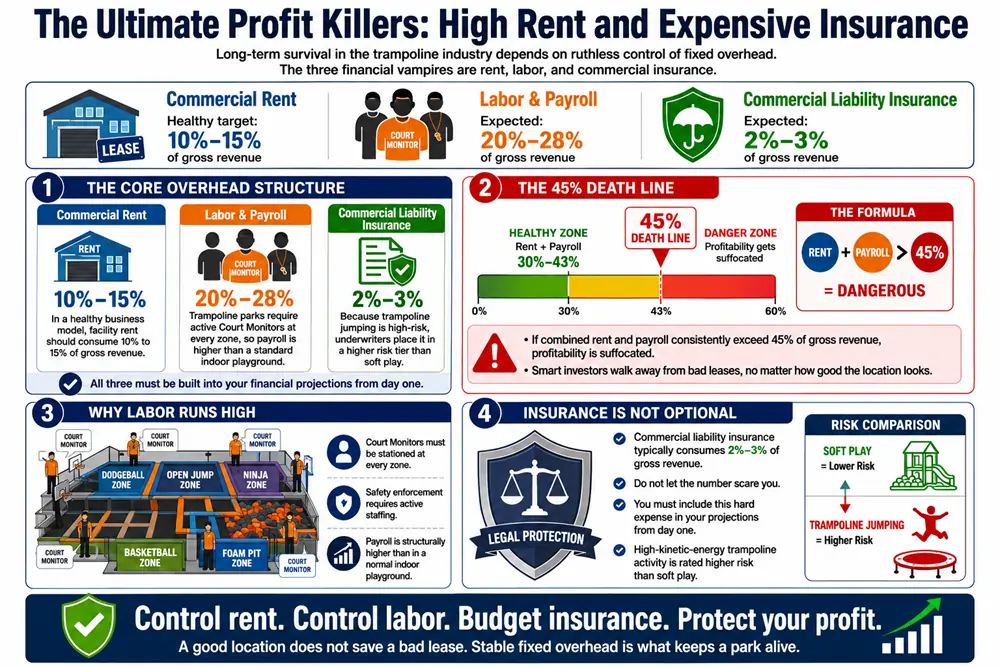
The key to long-term survival in the trampoline industry is ruthlessly controlling your fixed overhead. There are three financial vampires you must manage: rent, labor, and commercial insurance.
• Commercial Rent: In a healthy business model, your facility rent should consume 10% to 15% of your gross revenue.
• Labor & Payroll: Because trampoline parks require active Court Monitors stationed at every zone to enforce safety rules, your payroll is higher than a standard indoor playground. Expect labor to consume 20% to 28% of your gross revenue.
The 45% Death Line: If your combined rent and payroll consistently exceed 45% of your gross revenue, your profitability will be suffocated. Smart investors walk away from bad leases, no matter how good the location looks.
Furthermore, you must face the reality of Commercial Liability Insurance. Because trampoline jumping is a dynamic, high-kinetic-energy activity, underwriters assess it at a higher risk tier than soft play. You can expect your commercial liability insurance to consume 2% to 3% of your gross revenue. Do not let this number scare you, but you absolutely must build this hard expense into your financial projections from day one.
6. Hidden Maintenance & Wear: Trampolines are Consumables
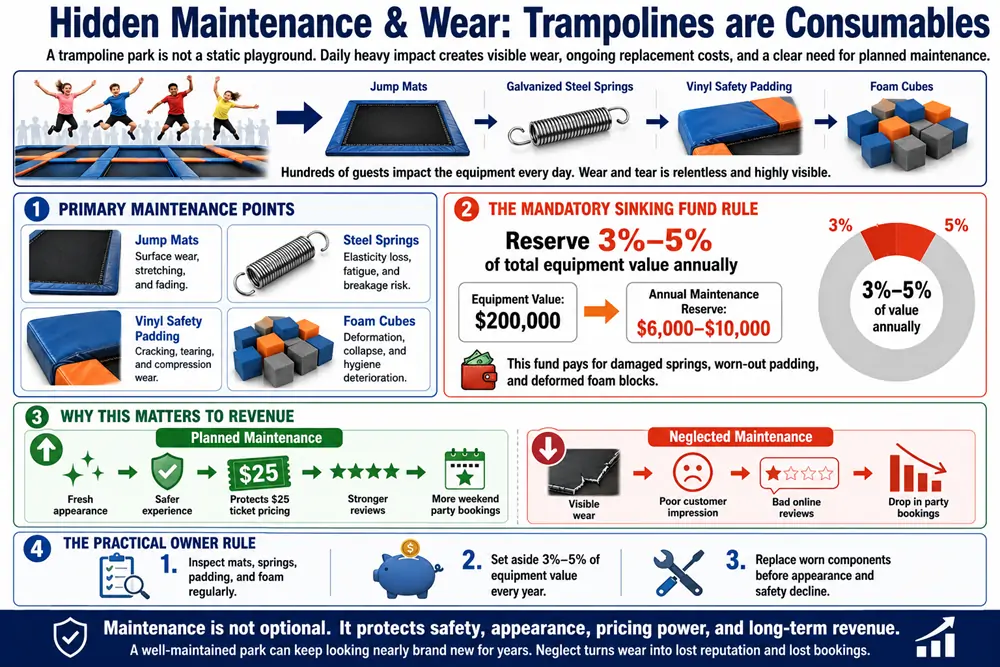
Unlike static steel playground structures, a trampoline park is a highly active physical consumable. You have hundreds of people violently impacting the equipment every single day. The wear and tear is relentless and highly visible.
Your primary maintenance points will be the jump mats, the galvanized steel springs, the vinyl safety padding covering the frames, and the foam cubes in the stunt pits. From a strict financial planning perspective, I give all my clients a mandatory rule: You must establish a sinking fund and reserve 3% to 5% of your total equipment value annually for maintenance and component replacement. If you've purchased $200,000 worth of equipment, it's best to set aside $6,000 to $10,000 to replace damaged springs, worn-out padding, and deformed foam blocks. This investment will keep your playground looking brand new for three years. This is absolutely essential for charging a $25 ticket price. Neglecting maintenance will not only lead to poor online reviews but also a significant drop in weekend party bookings.
7. The Real Net Profit Margin and ROI Timeframe
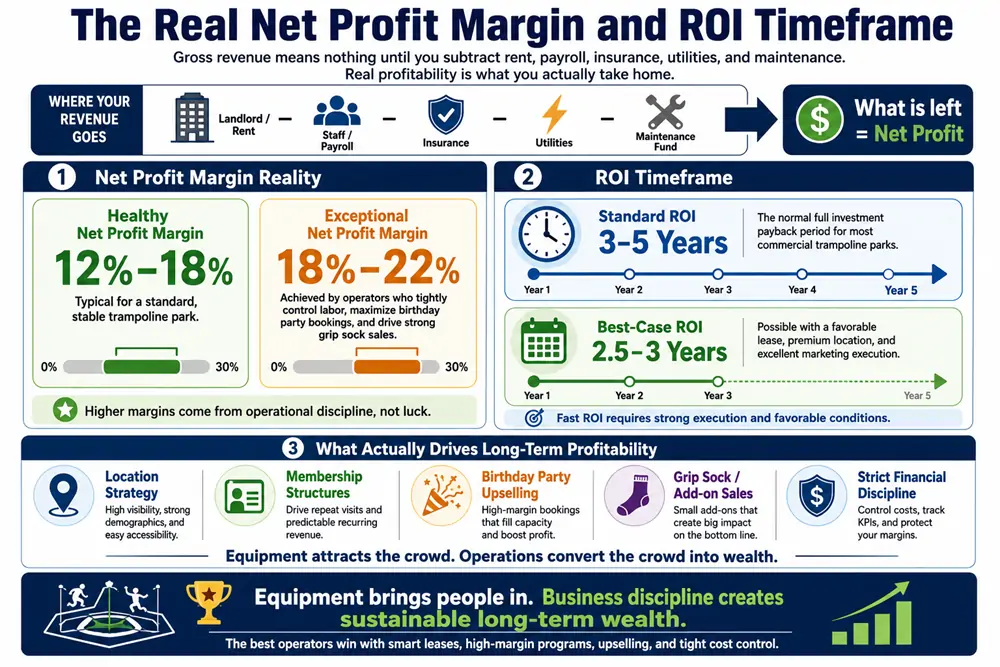
Let us strip away the gross revenue and calculate the actual cash you get to take home. After you have paid your landlord, your massive staff, your insurance premiums, your utility bills, and your maintenance fund, what is left?
• A Healthy Net Profit Margin: For a standard, stable trampoline park, the net margin sits between 12% and 18%.
• An Exceptional Net Profit Margin: Operators who ruthlessly control their labor schedule, max out their birthday party calendar, and drive heavy grip sock sales can push their net margin to 18% to 22%.
What about the Return on Investment (ROI) timeframe?
For the vast majority of normal commercial trampoline parks, full investment payback takes 3 to 5 years. If you secure a highly favorable lease in a premium location and execute your marketing perfectly, it is possible to compress that ROI timeframe to 2.5 to 3 years.
The ultimate profitability of a trampoline park is never decided by the equipment alone. The equipment simply attracts the crowd. Your location strategy, your membership structures, your birthday party upselling, and your strict financial discipline are what actually convert that crowd into sustainable, long-term wealth.
Sales-Expert FAQ: Resolving Your Investment Doubts
Q: I heard that commercial liability insurance for trampoline parks is outrageously expensive. Will this eat all my profits and make the business unviable?
Insurance is a significant line item, but it will not destroy your profit; rather, it is the necessary moat that protects your million-dollar asset. My Experience: Many clients ask me if a trampoline park is profitable while hyper-focusing on the insurance fear. In reality, your premium generally sits at 2% to 3% of your gross revenue. If you generate $1,000,000 a year, your insurance is roughly $20,000 to $30,000. If you properly execute the mandatory sale of Trampoline Grip Socks and optimize your high-margin F&B (food and beverage) counter, the pure profit generated from those two minor secondary revenue streams alone will easily cover your entire annual insurance premium. Never walk away from a 15% net margin business just because you are intimidated by a 3% operational expense.
Q: Because the initial startup capital is so high, can I buy the absolute cheapest trampolines from a discount online supplier to cut my hardware costs and speed up my ROI?
This is absolute commercial suicide; the extreme maintenance costs and severe safety liabilities of cheap equipment will permanently destroy your park. My Experience: A trampoline park absorbs the kinetic impact of thousands of heavy landings every day. If you try to save $30,000 by buying cheap, unverified equipment, within six months your springs will snap, your jump mats will tear, and your thin safety padding will compress to the steel frame. Your annual maintenance budget will skyrocket from 3% to 15%. Worse, if a customer fractures an ankle due to failing hardware, your insurance premiums will double instantly, and your local reputation will collapse. As premier trampoline play equipment manufacturers, we know that buying heavy-duty, certified equipment upfront is the only reliable way to protect your future cash flow.
Q: I only have a 1,000-square-meter space and a limited budget. Should I just build a basic open-jump trampoline zone, or stretch my budget to add a Ninja Course and interactive games?
If you want to survive the competition and justify a $25 ticket price, you must upgrade from basic trampolines to customized indoor trampoline park equipment that includes high-value attractions like Ninja Courses. My Experience: A basic open-jump trampoline zone was highly profitable ten years ago, but today's Western consumers demand more. If you only install basic mats, your venue will lack a unique selling proposition. High-value customized indoor trampoline park equipment—which perfectly integrates climbing walls, interactive projection games, and challenging obstacle courses into your specific floor plan—not only creates a massive visual impact but specifically attracts teenagers, a highly lucrative demographic. Diversifying your attractions is the absolute strongest weapon you have to drive up the average ticket size and guarantee your weekend party rooms stay fully booked.