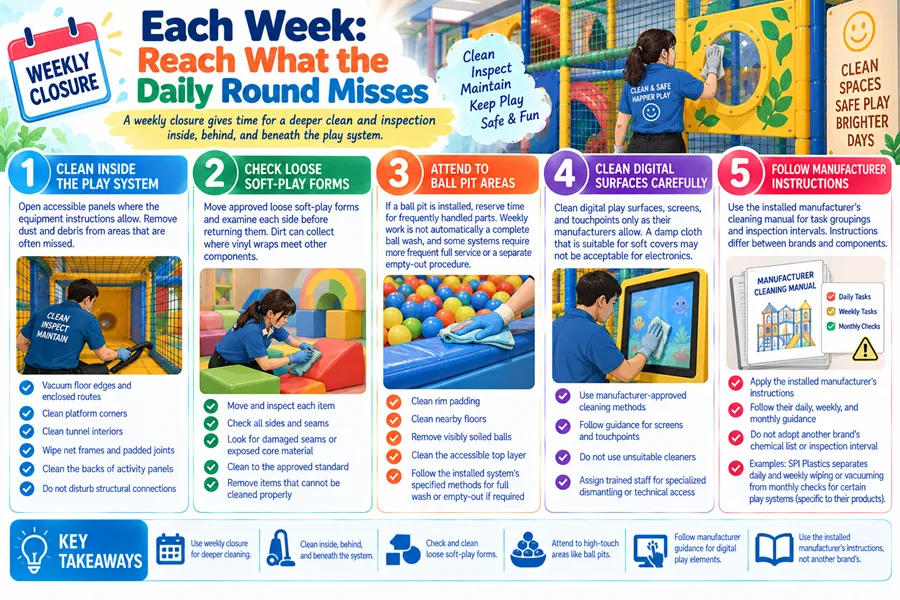
A Calendar Is the Starting Point, Not the Answer
How often are indoor playgrounds cleaned? A practical starting schedule handles spills and obvious contamination immediately, cleans heavily touched areas throughout use and at the end of each day, reaches less accessible features each week, and reserves longer closures for deeper work each month. The exact frequency for a ball pit, fabric element, or trampoline bed depends on its manufacturer, use, and the facility's requirements.
That distinction matters. A playground can look tidy at closing while its tunnel seams, pit base, or removable toys still need attention. Conversely, spraying every structure between every visitor group may be unworkable and incompatible with some materials. The useful question is which task must happen before the next child uses a surface, which can wait until closing, and which requires taking an entire zone out of service.
This article offers an operating framework for commercial indoor playgrounds. It does not replace product care instructions or local policies for schools, daycare facilities, healthcare settings, or other regulated uses. Write the final schedule for the actual equipment and visitors, then give staff the time and tools to perform it.
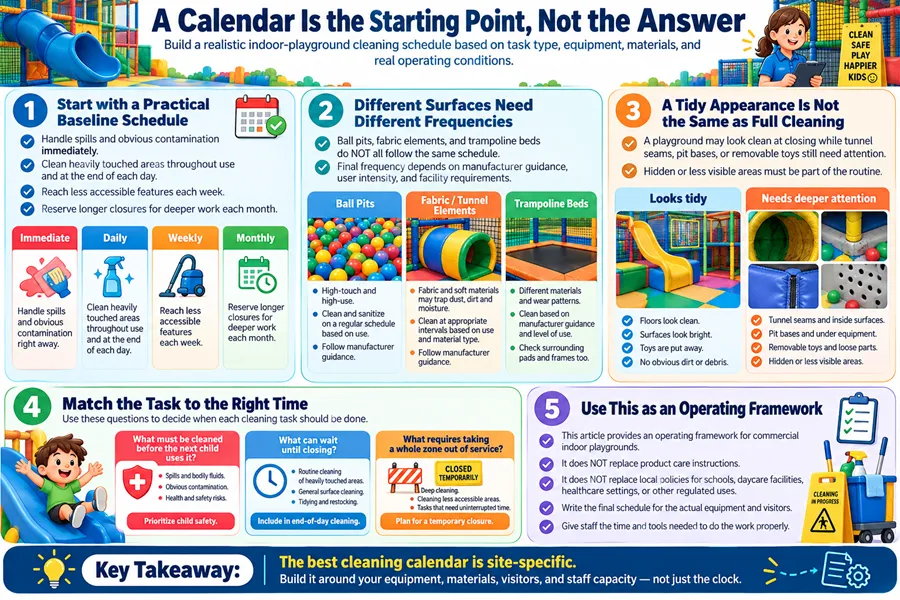
During Open Hours: Act on Contamination, Not the Clock
A daily checklist does not justify leaving a spill in place until evening. Remove visible dirt, food, and litter when found. Clean a contaminated touchpoint before returning it to use. If vomit, blood, or another body fluid is involved, close the affected zone and follow the facility's incident procedure, including the appropriate protection, cleaning, and disinfection process.
Move soiled loose items out of play and keep them separate from cleaned stock. A basket of used role-play pieces should not be tipped back into circulation because the daily cleaning shift has not begun. Likewise, a visibly dirty slide landing or entry gate calls for a response during operating hours.
High traffic may justify additional touchpoint rounds. Assign a person and a practical interval based on observed visitor turnover rather than relying on an unstaffed instruction to “clean frequently.” Front-desk handles, gate latches, handrails, toddler-level panels, and shared objects tend to collect repeated contact. Check whether extra rounds can be completed without working among moving children.
Cleaning, sanitizing, and disinfecting have different meanings. The US Environmental Protection Agency distinguishes physical removal of soil from the chemical processes used to reduce or kill germs. Clean first when a disinfectant is needed, use a product appropriate for the surface, and follow its label for wet contact time and any rinse or drying requirement. More chemical does not turn an incompatible method into a safer one.
If a play area shares space with dining, account for food and drink routes, crumbs, and service-related spills. The restaurant kids play area guide explores that adjacency; an operator should translate it into a site-specific response schedule rather than apply a restaurant rule to every indoor playground.
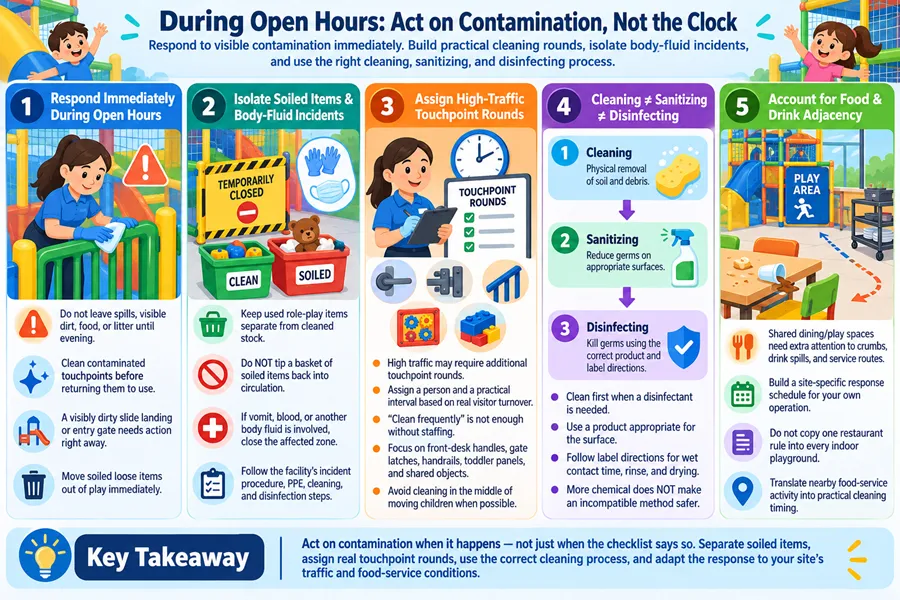
Each Day: Clean the Surfaces Children Reach Repeatedly
Before opening, walk the play floor and identify any leftover soil, moisture, odors, or closures. Staff should also flag torn covers, loose parts, and exposed foam. The cleaning checklist can capture these observations, but a maintenance issue needs its own corrective action and reopening decision.
During normal daily care, focus on entry points, handrails, climbing holds where accessible, tunnel entrances, soft-play shapes, slide sides and exits, interactive panels, toddler activities, and nearby floor areas. Include any movable equipment used that day. Work from cleaner zones toward dirtier ones and change cloths or cleaning tools according to the facility's procedure to avoid spreading soil.
At closing, allow enough time to clean surfaces that were difficult to reach while children were playing. Check under portable elements and at the edge of fixed equipment. Clean safety padding and the surrounding floor using methods appropriate to their covers and flooring materials. A damp wiping method suitable for one vinyl surface may damage an uncoated foam part, screen, or fabric.
The baseline for daily work is not necessarily daily disinfection of everything. For example, CDC guidance for community facilities calls for regular cleaning of high-touch surfaces and disinfection where people have clearly been ill. Facilities serving children may have different policies for mouthed toys or other shared items. Use the applicable setting rules and the actual product instructions.
One question should close each shift: what is ready for the next opening? Note completed work, unresolved contamination, and zones that remain unavailable. If a staff member cannot safely reach a feature, add a scheduled closure rather than recording it as cleaned.
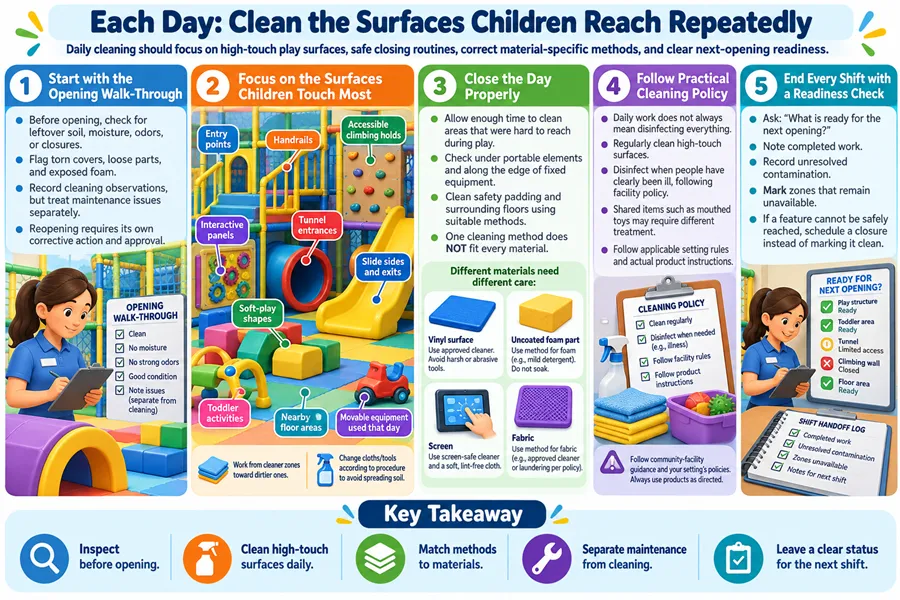
Each Week: Reach What the Daily Round Misses
A weekly closure creates time to work inside, behind, and beneath the play system. Open accessible panels where the equipment instructions permit it. Vacuum dust and debris from floor edges and enclosed routes. Clean reachable platform corners, tunnel interiors, net frames, padded joints, and the backs of activity panels without disturbing structural connections.
Move approved loose soft-play forms and examine each side before returning them. Check covers for damaged seams or exposed core material. Dirt may collect where vinyl wraps meet other components; an apparently intact top face does not reveal the whole condition of a block. Remove an item that cannot be cleaned to the approved standard.
Reserve time for frequently handled parts of a ball pit, if one is installed: rim padding, nearby floors, visibly soiled balls, and the accessible top layer. This weekly work is not automatically a complete ball wash. Some installed systems require more frequent full service; others have a separate empty-out procedure. Follow their specified methods.
Clean digital play surfaces, screens, and touchpoints only as their manufacturers allow. A damp cloth appropriate for a soft cover may not be acceptable for electronics. Put cleaners and inspection staff in charge of different tasks where specialized dismantling or technical access is required.
A manufacturer's cleaning manual can give useful task groupings: SPI Plastics, for example, separates daily and weekly wiping or vacuuming from monthly checks for certain play systems. Its directions are specific to its components. Apply the installed manufacturer's instructions rather than adopting another brand's chemical list or inspection interval wholesale.
Each Month: Schedule the Jobs That Need a Closed Zone
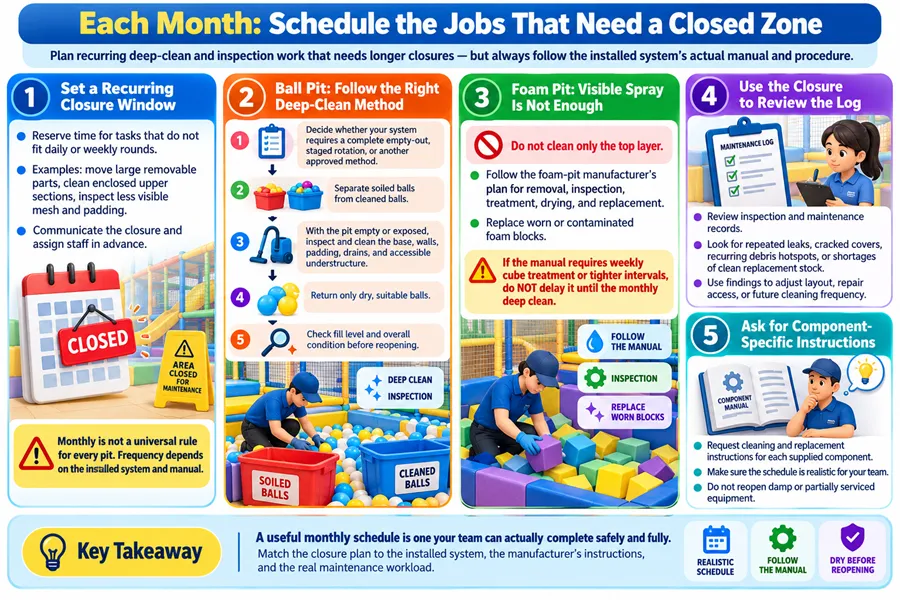
Set a recurring window for tasks that cannot fit into short daily or weekly rounds. These may include moving large removable components, cleaning enclosed upper sections, examining less visible mesh and padding, and washing or removing the contents of a pit. A calendar reservation helps allocate staff and communicate a closure; it is not a universal rule that every pit needs service only once a month.
For a ball pit, determine whether the installed washing system, ball material, and facility procedure call for a complete empty-out, staged rotation, or another approved method. Separate soiled balls from cleaned ones. With the pit empty or exposed as specified, inspect and clean the base, walls, padding, and any drain or accessible understructure. Return only dry, suitable balls after checking the required fill level and overall condition.
For a foam pit, a light spray over the visible cubes cannot clean the lower layers. Follow the foam-pit manufacturer's plan for removal, inspection, treatment, drying, and replacement of worn or contaminated blocks. Some manufacturers specify weekly cube treatment or other tighter intervals. A monthly deep-clean column should therefore never postpone a more frequent task in the installed manual.
Use the extended closure to revisit the inspection and maintenance log. Identify repeated leaks, cracked covers, debris collecting in the same location, or a shortage of clean replacement stock. These findings may require changes in layout, repair access, or the frequency of future rounds.
Operators who buy indoor play place equipment should request component-specific cleaning and replacement instructions with the supplied system. The useful schedule is one the team can actually complete without reopening damp or partially serviced equipment.
Ball Pits, Toddler Zones, and Trampolines Need Separate Timetables
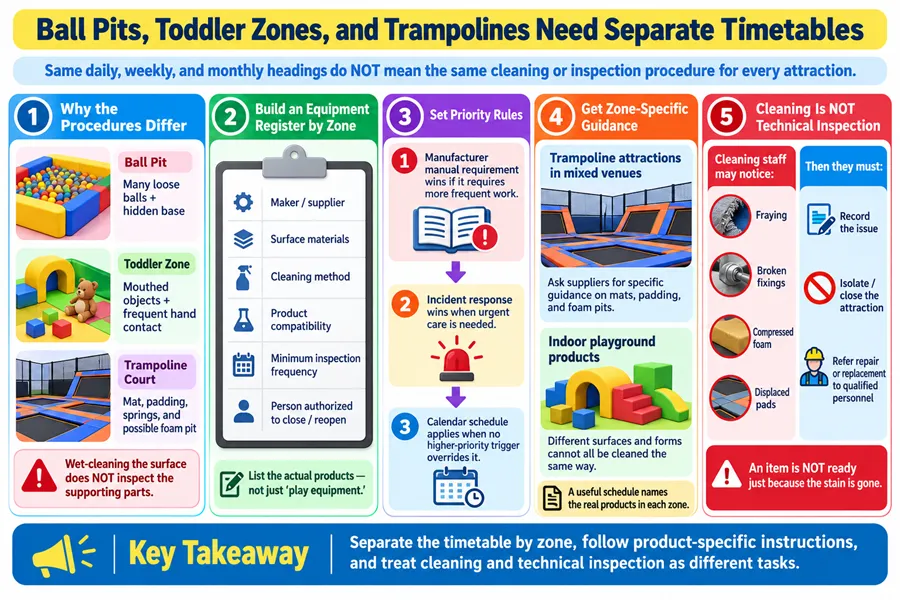
The same daily, weekly, and monthly headings do not mean every attraction receives the same procedure. A ball pit contains many individually handled pieces and a hidden base. A toddler area may have objects that are mouthed and require handling after individual use. A trampoline court has a jumping mat, padding, springs, and possibly a foam pit; wet-cleaning the surface does not inspect the supporting parts.
Build an equipment register by zone. Include the maker, surface materials, cleaning method, product compatibility, minimum inspection frequency, and the person authorized to close and reopen the attraction. Where the manufacturer's manual requires more frequent work than the proposed calendar, the equipment requirement wins. Where an incident demands immediate care, the incident response wins.
Ask indoor trampoline park suppliers for the specific mat, padding, and foam-pit guidance when trampoline attractions are part of a mixed venue. The commercial indoor playground equipment range also includes surfaces and forms that cannot all be cleaned by the same method. A useful schedule lists the actual products, rather than calling everything “play equipment.”
Do not confuse cleaning with technical inspection. Staff may notice fraying, broken fixings, compressed foam, or displaced pads while they clean. They should record and isolate the issue, then direct repairs and replacement to personnel qualified under the equipment instructions. An item is not ready merely because the stain is gone.
Decide When the Schedule Must Become More Frequent
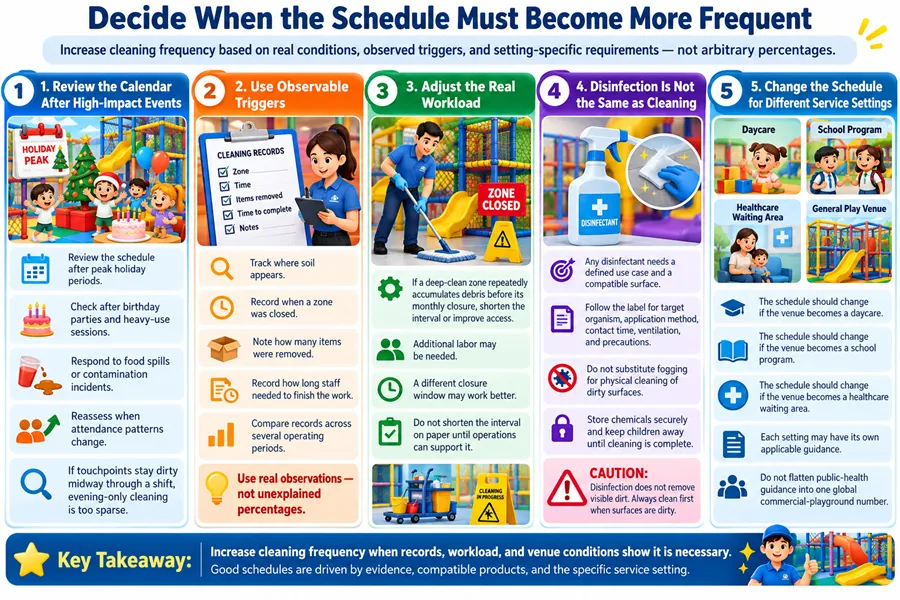
Review the calendar after peak holiday periods, birthday-party sessions, food spills, contamination incidents, or changes in attendance. If touchpoints are repeatedly dirty midway through a shift, an evening-only round is too sparse. If a deep-clean zone repeatedly accumulates debris before its monthly closure, adjust the interval or improve access.
Use observable triggers rather than unexplained percentages. Track where soil appears, when a zone was closed, how many items were removed, and how long staff needed to finish the work. Compare the records across several operating periods. Additional labor or a different closure window may be necessary before shortening the interval on paper.
Any disinfectant needs a use case and a compatible surface. Follow the label's stated organism, application method, contact time, ventilation and any precautions relevant to children's areas. Do not substitute fogging for physical cleaning of dirty surfaces. Keep chemicals securely stored and children away until the cleaning process is complete.
This schedule should change if the venue becomes a daycare, school program, healthcare waiting area, or other service with its own applicable guidance. Public-health advice for those settings informs their operating procedures; it should not be flattened into one global commercial-playground number.
Turn the Calendar into a Signed Operating Record
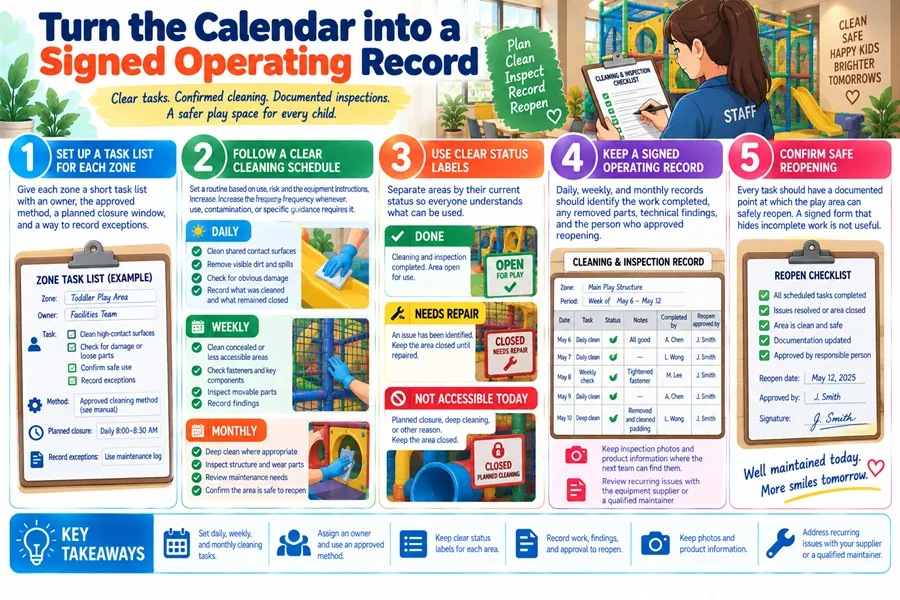
Give each zone a short task list with an owner, the approved method, a planned closure window, and a way to record exceptions. Daily records should show who cleaned high-contact areas and what remained closed. Weekly and monthly records should identify deeper tasks, removed parts, technical findings, and the person who approved reopening.
Separate “done,” “needs repair,” and “not accessible today.” A signed form that hides incomplete work is not useful. Keep inspection photos or product information where the next team can find them, and review recurring issues with the equipment supplier or a qualified maintainer.
So, how often should an indoor playground be cleaned? Set a daily baseline for shared contact surfaces, weekly access to concealed or movable areas, and planned monthly deep work where appropriate. Then move faster whenever use, contamination, or the specific equipment instructions require it. The schedule succeeds when every task has an owner and a documented point at which the play area can safely reopen.
FAQ
Should an indoor playground be cleaned every day?
Yes, a commercial venue should plan daily cleaning of surfaces children repeatedly touch, as well as floors and nearby areas that become dirty during use. Remove obvious spills or contamination immediately rather than saving them for the closing round. The exact products and techniques depend on surface materials, manufacturer instructions, and the facility's operating requirements. A daily routine should include a walk-through and a record of items left closed for repair. Daily cleaning does not mean every ball, foam block, or enclosed platform receives a complete deep-clean every evening.
Does an indoor playground need disinfecting after every group?
No single rule applies to every commercial play surface or group. First identify whether the setting has stricter requirements, whether an item is mouthed, and whether a child has been ill or a body-fluid incident occurred. Clean visible soil promptly. If disinfection is required, use a compatible product according to its label, including the wet contact time and any rinse or drying step. Do not spray a dirty structure and call it disinfected. Set a group-turnover procedure only where the venue's users, equipment, and staff can support it.
How often should ball pit balls be washed?
The interval depends on the pit's manufacturer, ball material, traffic, washing method, and contamination history. Check and remove obviously dirty or damaged balls during normal operations. Schedule enough closure time to wash or rotate balls through an approved process and reach the pit base; a monthly window may be a planning starting point, not a universal requirement. If the installed manual or local setting calls for a shorter interval, follow it. Keep used and cleaned balls separate, allow them to dry as directed, and document when the pit was returned to use.
What belongs on a weekly indoor playground cleaning list?
Weekly work should reach parts the daily round cannot cover well: tunnel interiors, platform corners, the backs of panels, accessible lower areas, and all sides of removable soft-play pieces. Clean with material-compatible methods and note damaged covers or inaccessible areas. Inspect the edges of ball pits and other frequently handled attraction surfaces. Any task that requires dismantling, electrical access, or repair should follow the equipment manual and be assigned to qualified personnel. The weekly list should complement daily touchpoint cleaning, not defer visible soil until the next scheduled closure.
What should a monthly deep-clean include?
Plan a longer closure for the zones and components specified by each equipment supplier. Depending on the venue, this may include pit contents and bases, enclosed upper sections, movable pieces, and concealed areas that cannot be reached during ordinary operation. Review inspection logs and deal with recurring defects before reopening. Do not assume all ball pits and foam pits share one monthly interval: some products require more frequent emptying or treatment. Record what was removed, cleaned, replaced, or left out of service, and confirm that every returned component is dry and suitable for use.