Start With Two Different Maintenance Jobs
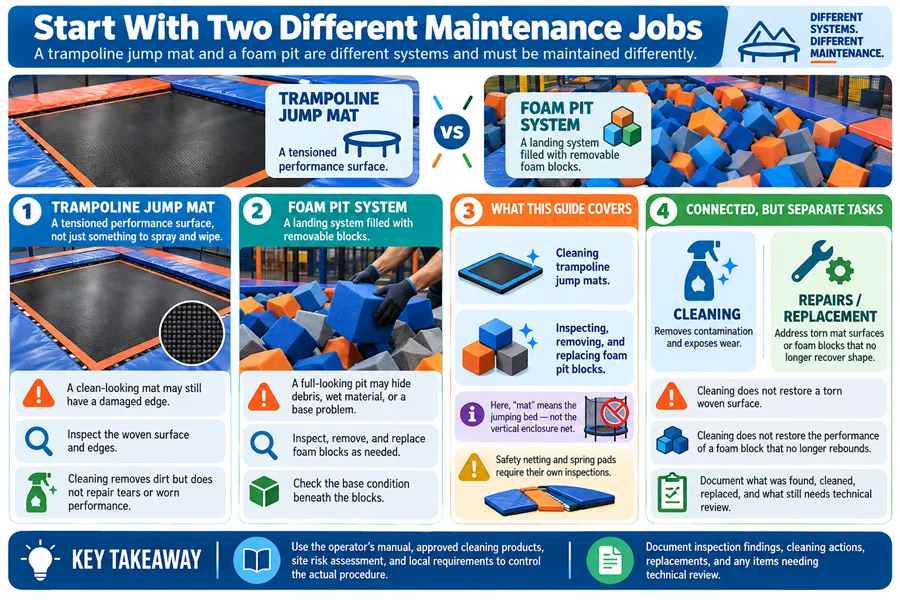
Knowing how to clean trampoline park equipment starts with a simple distinction: the jumping mat is a tensioned performance surface, while the foam pit is a landing system filled with removable blocks. Neither can be maintained by spraying the visible surface and moving on. A clean-looking mat may have a damaged edge. A full-looking foam pit may hide debris, wet material, or a problem at the base.
This guide concentrates on cleaning trampoline jump mats and inspecting, removing, and replacing foam pit blocks. Here, “mat” means the jumping bed, not a vertical enclosure net; safety netting and the pads over springs require their own inspections. The operator's equipment manual, approved cleaning products, site risk assessment, and applicable local requirements control the actual procedure.
Treat cleaning and repairs as connected but separate tasks. Cleaning removes contamination and exposes wear. It does not restore a torn woven surface or the performance of a block that no longer recovers its shape. Document what the team found, what it cleaned, what it replaced, and what still needs technical review.
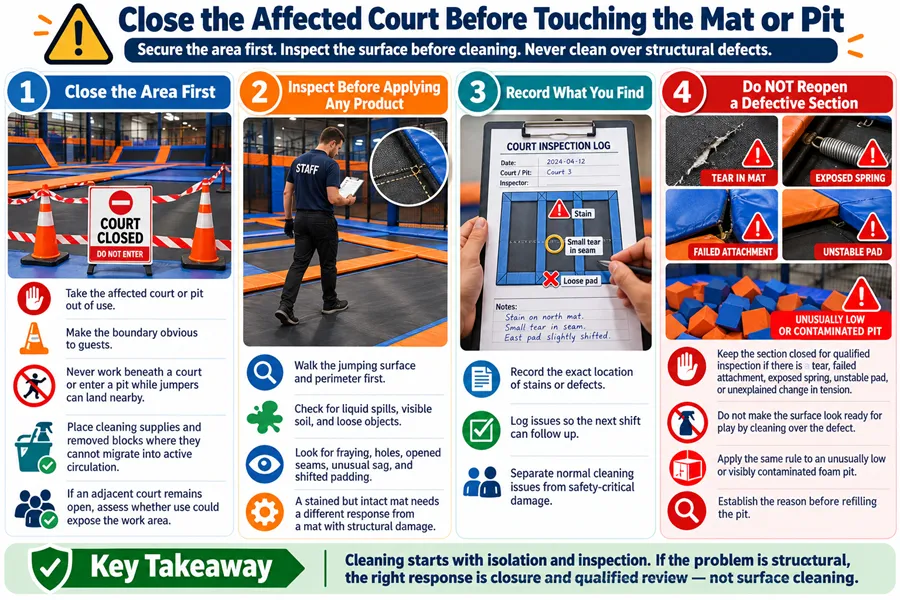
Close the Affected Court Before Touching the Mat or Pit
Take the affected court or pit out of use and make the boundary obvious to guests. A cleaner should not work beneath a court or enter a pit while jumpers can land nearby. Place cleaning supplies and removed blocks where they cannot migrate into active circulation. If an adjacent court remains open, the operator should assess whether its use could expose the work area.
Walk the jumping surface and its perimeter before applying any product. Look for liquid spills, visible soil, loose objects, fraying, holes, opened seams, unusual sag, and places where padding has moved away from the frame or spring line. A stained but intact mat needs a different response from a mat with structural damage. Record the location of either condition so a later shift can follow it up.
If there is a tear, failed attachment, exposed spring, unstable pad, or unexplained change in tension, keep that section closed for qualified inspection. Do not make the surface look ready for play by cleaning over the defect. The same approach applies to an unusually low or visibly contaminated foam pit: establish the reason before refilling it.
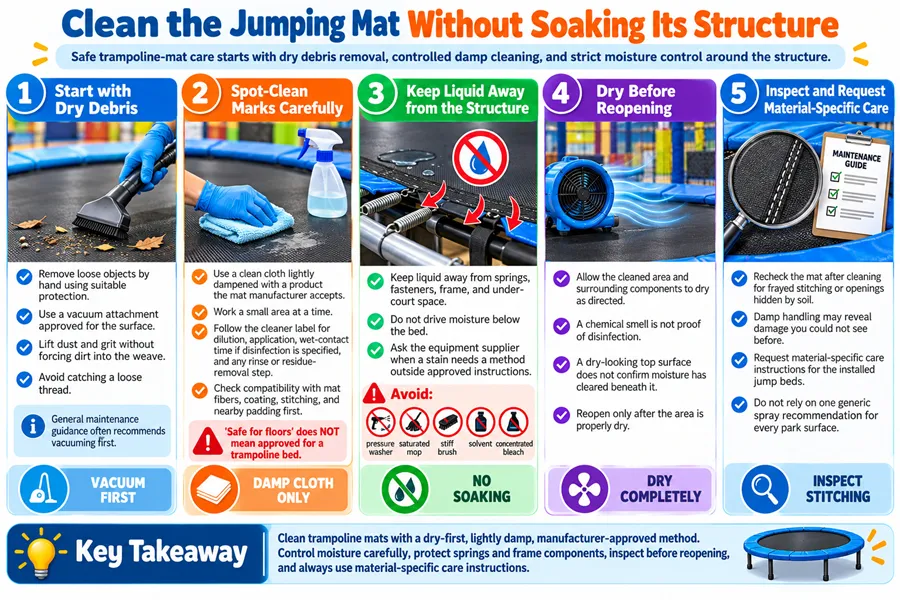
Clean the Jumping Mat Without Soaking Its Structure
Start with dry debris. Remove loose objects by hand using suitable protection, then use a vacuum attachment approved for the surface to lift dust and grit. Avoid forcing dirt into the weave or catching a loose thread. Akrobat's park-maintenance guidance describes vacuuming and cleaning jumping mats with a damp cloth; that is a useful general approach, subject to the actual mat maker's instructions.
For marks that remain, use a clean cloth lightly dampened with a product that the mat manufacturer accepts. Work a small area at a time. Follow the cleaner's label for dilution, application, required wet contact time if disinfection is specified, and any rinse or residue-removal step. Check compatibility with the mat fibers, coating, stitching, and nearby padding first. “Safe for floors” does not mean approved for a trampoline bed.
Keep liquid away from the springs, fasteners, frame and under-court space. Do not assume a pressure washer, saturated mop, stiff brush, solvent, or concentrated bleach is suitable. Such methods can drive moisture below the bed or affect materials and connections. Ask the equipment supplier when a particular stain requires a method outside the approved instructions.
Allow the cleaned area and surrounding components to dry as directed before reopening. A chemical smell is not proof of disinfection, and a dry-looking top surface does not confirm that moisture has cleared beneath it. Check the mat again after cleaning: damp handling and a closer view can reveal frayed stitching or an opening that was hidden by soil.
Operators comparing park equipment manufacturers should request material-specific care instructions for the installed jump beds, not a single generic spray recommendation for every surface in the park.
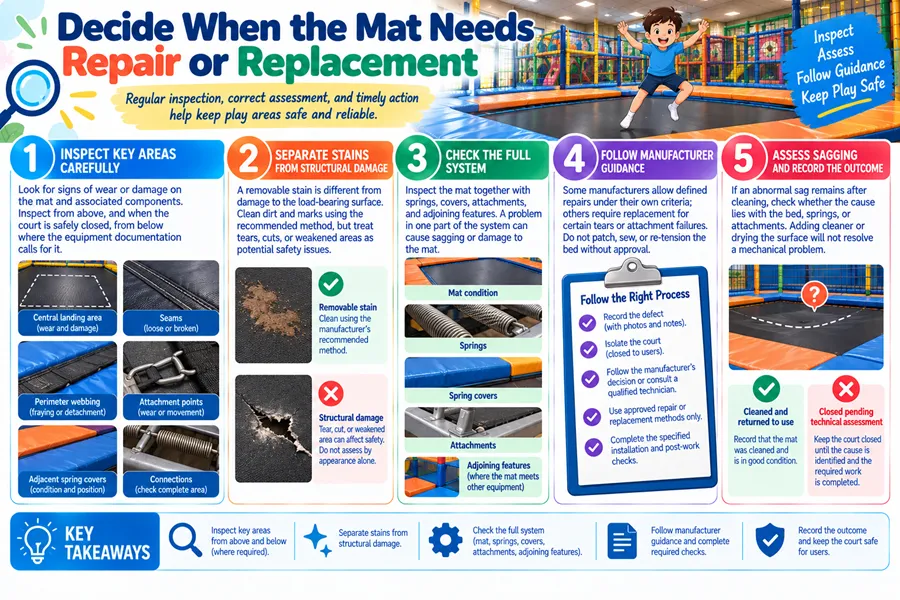
Decide When the Mat Needs Repair or Replacement
Separate a removable stain from a damaged load-bearing surface. Inspect the central landing area, seams, perimeter webbing, attachment points, and any location where the bed meets an adjoining feature. Look from above and, when the court is safely closed, from below where the equipment documentation calls for it. Inspect adjacent spring covers and connections rather than assessing the fabric in isolation.
Some manufacturers allow defined repairs under their own criteria; others require replacement for certain tears or attachment failures. Do not choose a patch, sew a seam, or re-tension the bed on the basis of appearance alone. Record the defect, isolate the court, and follow the manufacturer or a qualified technician's decision. A repaired or replaced mat also needs the specified installation and post-work checks.
If an abnormal sag remains after cleaning, ask whether the cause lies with the bed, springs, or attachments. Adding cleaner or drying the surface will not resolve a mechanical problem. The inspection record should distinguish “cleaned and returned to use” from “closed pending technical assessment.”
Empty the Foam Pit Before Judging Its Condition
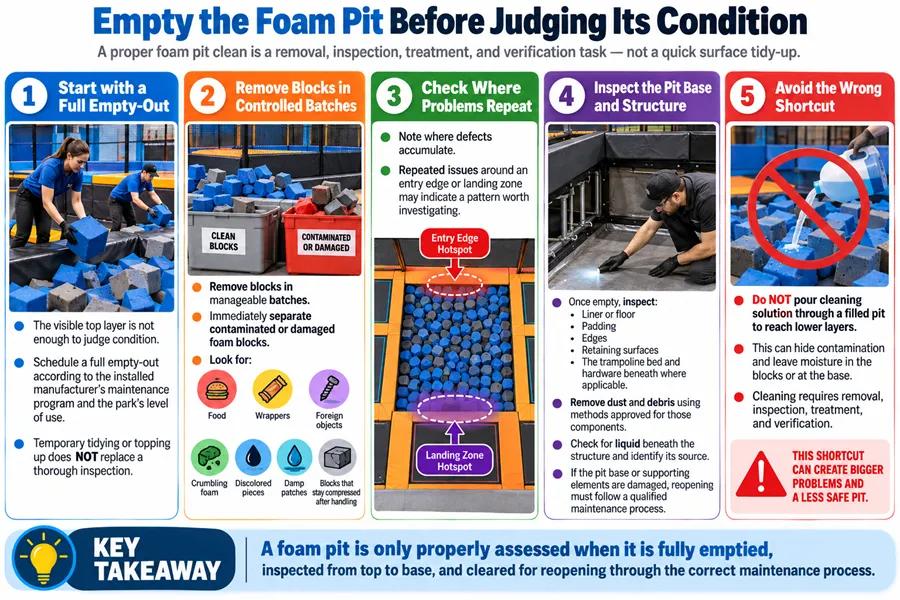
A foam pit requires access to material below the visible top layer. Schedule a full empty-out according to the installed manufacturer's maintenance program and the park's level of use. Temporary tidying or topping up does not replace a thorough inspection. Akrobat's guidance describes removing all foam blocks first so the pit base can be cleaned and checked.
Create a clean staging area and remove the blocks in manageable batches. Keep obviously contaminated or damaged pieces separate immediately. Look for food, wrappers, foreign objects, crumbling foam, discolored pieces, damp patches, and blocks that remain compressed after handling. Note where defects accumulate; repeated problems around an entry edge or landing zone may indicate a pattern worth investigating.
With the pit emptied, inspect the liner or floor, padding, edges, retaining surfaces, and the trampoline bed and hardware beneath where applicable. Remove dust and debris with methods approved for those components. Check for liquid beneath the structure and identify its source. If the pit base or supporting elements are damaged, the decision to reopen belongs to the qualified maintenance process, not to the person restocking cubes.
Do not pour cleaning solution through a filled pit in an attempt to reach the lower layers. That hides contamination and may leave moisture in the blocks or at the base. Cleaning a pit is a removal, inspection, treatment, and verification task.
Sort, Clean, and Replace Individual Foam Blocks
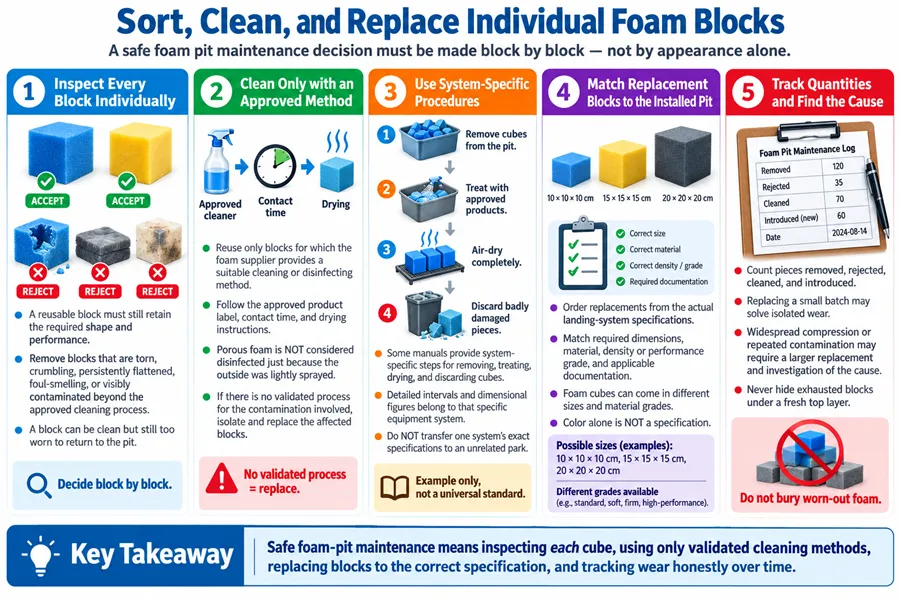
Make the decision block by block. A sound block should retain the shape and other characteristics specified for the installed pit. Remove pieces that are torn, crumbling, persistently flattened, foul-smelling, visibly contaminated beyond the approved cleaning process, or otherwise rejected by the manufacturer's criteria. A block can be clean yet too worn to put back.
Only reuse pieces for which the foam supplier provides a suitable cleaning or disinfecting method. Follow the approved product label, contact time, and drying instructions. Porous foam should not be declared disinfected merely because its exterior received a light mist. If there is no validated process for the type of contamination involved, isolate and replace the affected blocks according to the park's procedure.
Fun Spot Manufacturing's foam-pit manual is an example of a system-specific approach: it calls for removing cubes, treating them with approved products, allowing them to air-dry, and discarding badly damaged or soiled pieces. Its detailed intervals and dimensional figures belong to that equipment. They are not specifications to transfer to an unrelated park.
Order replacements from the specifications for the installed landing system. Match the block's required dimensions, material, density or performance grade, and applicable material documentation with the supplier's approval. Color alone is not a specification. The trampoline foam pit blocks product page shows that foam cubes are offered in different sizes and material grades; the correct option must be selected for the actual pit.
Count the pieces removed, rejected, cleaned, and introduced. A replacement batch can solve isolated wear, but widespread compression or repeated contamination may call for a larger replacement and investigation of the underlying cause. Do not hide exhausted blocks under a layer of new ones.
Refill the Pit and Check the Landing System
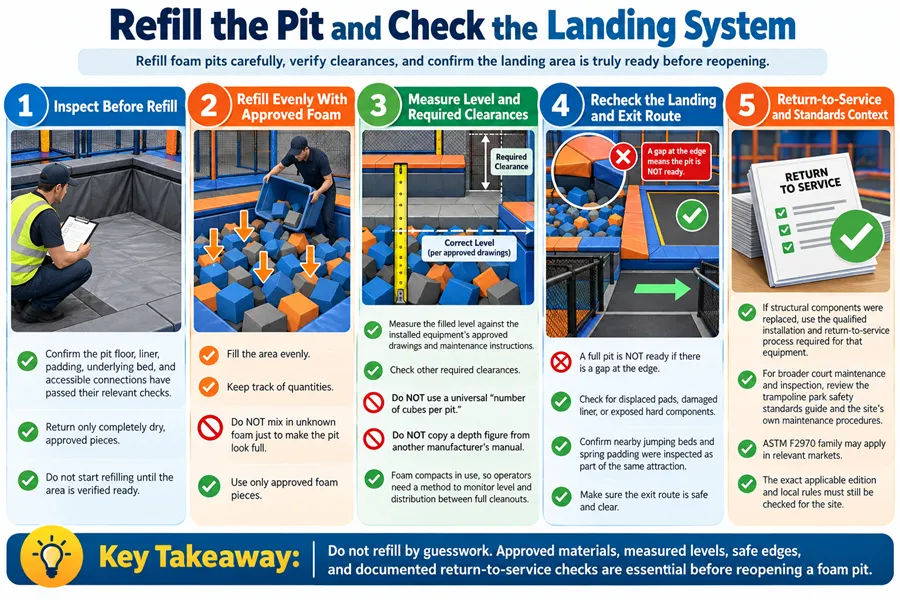
Before adding blocks, confirm that the pit floor, liner, padding, underlying bed, and accessible connections have passed their relevant checks. Return only completely dry, approved pieces and fill the area evenly. Keep track of quantities and avoid mixing in unknown foam simply to make the pit look full.
Measure the filled level and other required clearances against the installed equipment's approved drawings and maintenance instructions. Do not use a universal “number of cubes per pit” or copy a depth figure from another manufacturer's manual. Foam compacts in use, so the operator also needs a method for monitoring level and distribution between full cleanouts.
Recheck the landing and exit route. A full pit with a gap at the edge, displaced pad, damaged liner, or exposed hard component is not ready. Confirm nearby jumping beds and spring padding have been inspected as part of the same attraction. If the work involved replacing structural components, use the qualified installation and return-to-service process required for that equipment.
For the broader scope of court maintenance and inspection, YOMMI PLAY's trampoline park safety standards guide discusses the equipment and operational context. The ASTM F2970 family addresses institutional trampoline courts in markets where it is relevant, but the exact applicable edition and local rules still need to be checked for the site.
Keep a Cleaning Record That Makes Defects Actionable
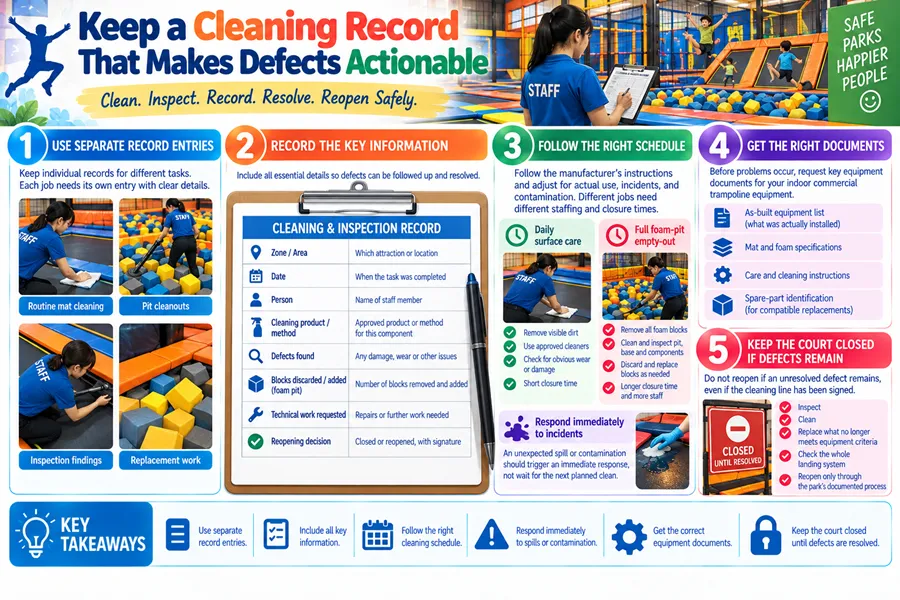
Use separate entries for routine mat cleaning, pit cleanouts, inspection findings, and replacement work. Record the zone, date, person completing the task, cleaning product or method approved for that component, defects found, blocks discarded and added, technical work requested, and reopening decision. Keep a court closed when an unresolved defect remains, even if the cleaning line has been signed.
The schedule should follow the installed manufacturer's instructions and respond to use, incidents, and contamination. Daily surface care and a full foam-pit empty-out are different jobs with different staffing and closure times. An unexpected spill should trigger an immediate response rather than waiting for the next planned deep clean.
For indoor commercial trampoline equipment, request the as-built equipment list, mat and foam specifications, care instructions, and spare-part identification before staff have to solve a failure during trading hours. Those documents help a manager purchase compatible parts and tell the cleaning team where its work stops and qualified repair begins.
The practical endpoint is a signed decision about the attraction, not a photograph of a spotless mat or a freshly filled pit. Inspect, clean, replace what no longer meets the equipment criteria, check the whole landing system, and reopen only through the park's documented process.
FAQ
Q: What is the correct way to clean a trampoline park jumping mat?
A: Close the affected court and inspect the jumping bed before cleaning it. Remove loose debris with an approved vacuum attachment or other method specified by the mat maker. Wipe remaining marks with a lightly dampened, non-abrasive cloth and a compatible cleaning product, following its label and the equipment instructions. Avoid soaking the bed or driving liquid toward springs and the frame. Allow the required drying time, then inspect seams, webbing, and attachments again. A tear, loose connection, or unusual sag needs technical assessment; cleaning alone cannot make a damaged mat ready for use.
Q: Can a trampoline jumping mat be pressure washed or sprayed with bleach?
A: Do not assume either method is suitable. Pressure washing can force water into the weave and beneath the jumping bed, where springs, fasteners, and other components may be affected. A concentrated chemical can also be incompatible with fibers, coatings, stitching, or nearby padding. Check the mat manufacturer's approved products and methods alongside the cleaner's label. If a contamination event requires disinfection, the product must be suitable for the actual surface and used according to its instructions. Keep the court closed until cleaning and drying are complete and the equipment passes inspection.
Q: Which foam pit blocks should be replaced instead of cleaned?
A: Remove blocks that are torn, crumbling, persistently compressed, unusually stained, foul-smelling, or contaminated beyond the foam supplier's approved cleaning process. Check the installed manufacturer's rejection criteria because material construction and use differ between pits. A light surface spray does not establish that a porous block is suitable for reuse. Segregate questionable pieces while emptying the pit, and record what was discarded. Replacement blocks should match the installed system's approved dimensions, material, performance grade, and relevant documentation; selecting a similar color or size by eye is insufficient.
Q: How often should a trampoline park empty and clean a foam pit?
A: Follow the installed manufacturer's maintenance schedule and adjust the operating plan for usage and contamination events. Surface-level tidying and a complete empty-out serve different purposes. A thorough cleanout removes blocks so staff can inspect the lower layers, clean the pit base, identify damaged cubes, and check accessible supporting components. Some manufacturers publish specific intervals for their equipment; those figures should not become universal rules for other installations. Record when the pit was emptied, what defects were found, which blocks were replaced, and who authorized its return to use.
Q: What must be checked before reopening after foam block replacement?
A: Confirm the pit base, liner, edges, padding, and accessible underlying components passed their required inspections. Return only approved, fully dry foam blocks, distribute them evenly, and verify fill level and clearances against the installed equipment's documents. Check the surrounding jumping mat, spring covers, approach, and exit route for new or unresolved hazards. Reconcile removed and replacement stock in the maintenance record. If a bed, spring, attachment, or other structural component was repaired, follow the equipment's qualified return-to-service process. A visually full pit is not, by itself, evidence of readiness.