Start With the Visits a Thousand Cards Could Create
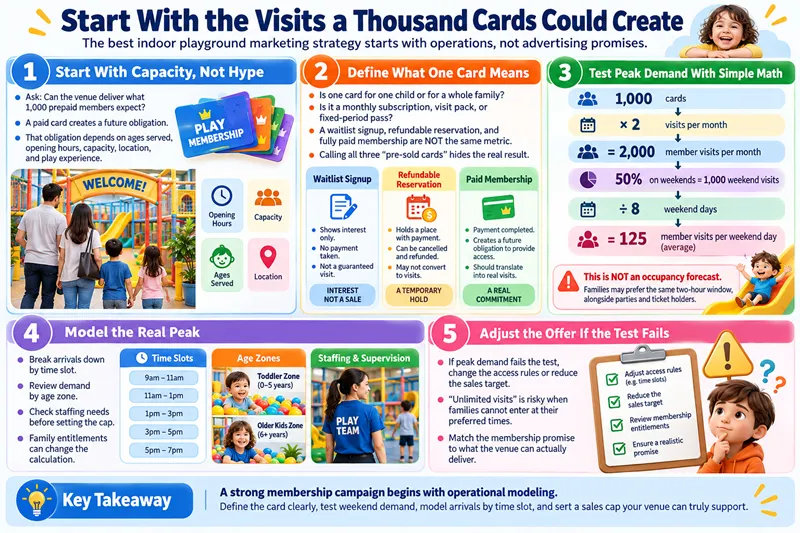
The most useful indoor playground marketing strategies begin with a question advertising cannot answer: can the venue deliver what 1,000 prepaid members expect? That is a planning target, not a campaign promise. Each paid card creates a future obligation shaped by the venue's ages, hours, capacity, location, indoor playground equipment and play experience.
Define one card: one child or a family? Monthly subscription, visit pack, or fixed-period pass? A free waitlist signup, refundable reservation, and fully paid membership are different metrics. Calling all three “pre-sold cards” hides the result.
Test peak demand. In a hypothetical month, 1,000 cards each generate two visits, half on weekends across eight weekend days. That means 125 member visits per weekend day on average. It is not an occupancy forecast: families may prefer the same two-hour window, alongside parties and ticket holders. Family entitlements can change the calculation.
Model arrivals by time slot, age zone, and staffing before setting the cap. If peak demand fails the test, change the access rules or sales target. “Unlimited visits” is risky when families cannot enter at their preferred times.
Write the Offer Before Buying Attention
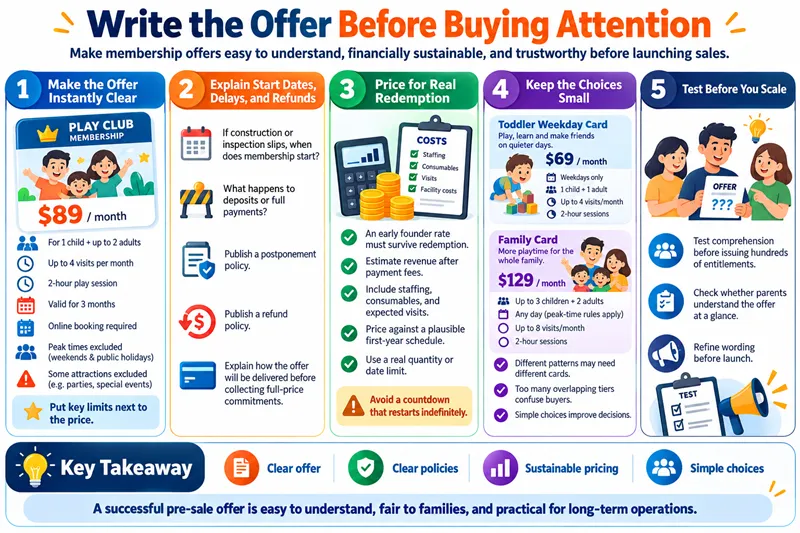
Parents should understand the card at a glance. State price, eligible users, visit frequency, session length, validity, booking rules, peak restrictions, and exclusions. Clarify charges for socks, adults, parties, or special attractions. Put key limits next to the price.
If construction or inspection slips, when does the membership clock start? What happens to deposits or full payments? Publish a postponement and refund policy that fits local rules and your payment system. Explain how the offer will be delivered before collecting full-price commitments.
An early founder rate must survive redemption. Estimate its contribution after payment fees, staffing, consumables, and expected visits. Price against a plausible first-year schedule, then choose a genuine quantity or date limit. Avoid a countdown that restarts indefinitely.
Keep choices small. A toddler weekday card and a broader family card may suit different patterns; overlapping tiers confuse buyers. Test comprehension before issuing hundreds of entitlements.
Help Families Picture a Visit to an Unfinished Playground
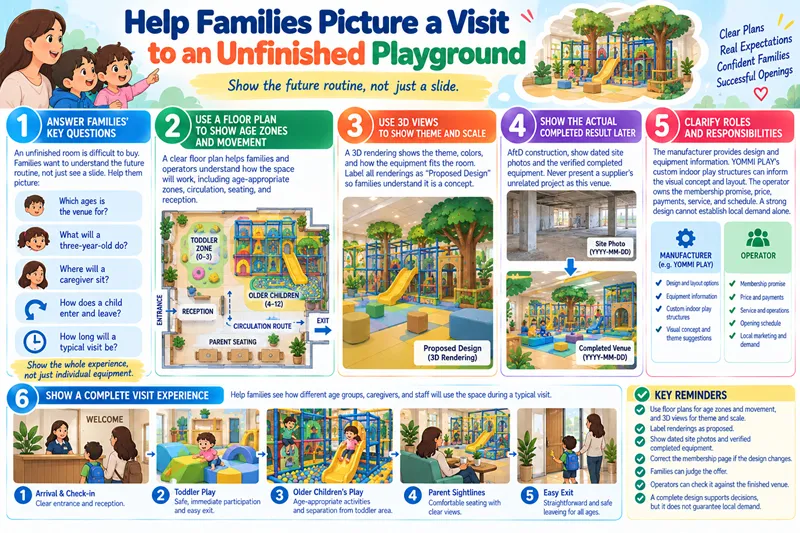
An unfinished room is difficult to buy. Which ages is the venue for? What will a three-year-old do? Where will a caregiver sit? How does a child enter and leave? Families need to picture a future routine, not just a slide.
Use a floor plan for age zones and movement, and a 3D view for theme and scale. Label renderings as proposed. Later show dated site photos and verified completed equipment. Never present a supplier's unrelated project as this venue. Correct the membership page if the design changes.
The manufacturer provides design and equipment information. YOMMI PLAY's custom indoor play structures can inform the visual concept and layout. The operator owns the membership promise, price, payments, service, and schedule. A strong design cannot establish local demand alone.
Show toddler separation, older children's play, parent sightlines, reception, and a realistic visit length. Families can judge the offer; operators can check it against the finished venue.
Build a Waitlist of Nearby Families, Not Anonymous Followers
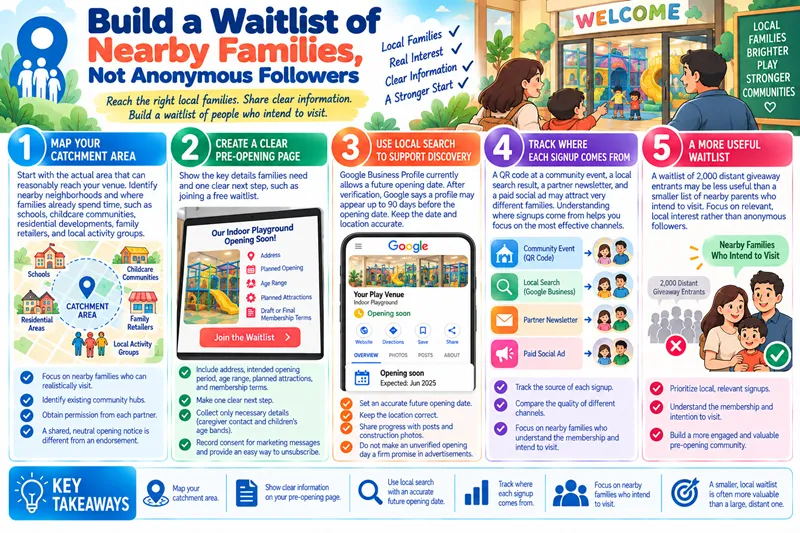
Start with the actual catchment area. Map the neighborhoods that can reasonably reach the venue, then note where families already spend time: nearby schools, childcare communities, residential developments, family retailers, and local activity groups. Permission from each partner matters. A school sharing a neutral opening notice is different from an invented endorsement.
The pre-opening landing page should show the address, intended opening period, age range, planned attractions, draft or final membership terms, and one clear next step. Initially that step may be joining a free waitlist. Collect only the details needed to follow up, such as a caregiver's contact information and children's age bands. Record consent for marketing messages and offer a way to unsubscribe under the rules that apply locally. Do not import parent-group contact lists without permission.
Local search can support discovery before the doors open. Google Business Profile currently allows a future opening date; after verification, Google says a profile may appear up to 90 days before the opening date. Keep the date and location accurate. Posts and construction photos can show progress, but an unverified opening day should not become a firm promise in an advertisement.
Track where each signup came from. A QR code at a permitted community event, a local search result, a partner newsletter, and a paid social ad may attract very different families. A waitlist of 2,000 distant giveaway entrants may be less useful than a smaller list of nearby parents who understand the membership and intend to visit.
Give Each Channel a Specific Job
Search pages and maps answer “where is it and when will it open?” Short videos answer “what will my child do there?” A local parent group can answer “is this suitable for our age range?” A preview session answers “does the real space match the promise?” Use the channel for its strongest question instead of posting the same discount graphic everywhere.
Partner with relevant local organizations only when the audience fit is real. A family retailer may share an opening notice. A childcare group may want weekday availability. A residential community may prefer a scheduled preview. Give each partner accurate copy and a trackable destination; do not imply the partner has tested or approved an unfinished playground. Small local creators can document a genuine preview after it is safe and authorized, with any required sponsorship disclosure.
Paid advertising should first test messages and geography on a limited budget. Compare qualified signups and paid purchases, not impressions alone. If a click reaches a page without prices, visit rules, or location, increasing the budget will not solve the underlying question. Retargeting and contact channels must follow the applicable consent and platform requirements.
Some venues also combine jumping attractions with soft play. Discussions with trampoline arena manufacturers can clarify equipment scope and installation timing, but the operator should sell only attractions actually included in the approved venue plan. Listings for soft play equipment for sale can help compare concepts; a product photo is not evidence that a local family will buy a membership. Keep the campaign grounded in the specific venue and offer.
Turn a Waitlist Into a Paid Founder Release
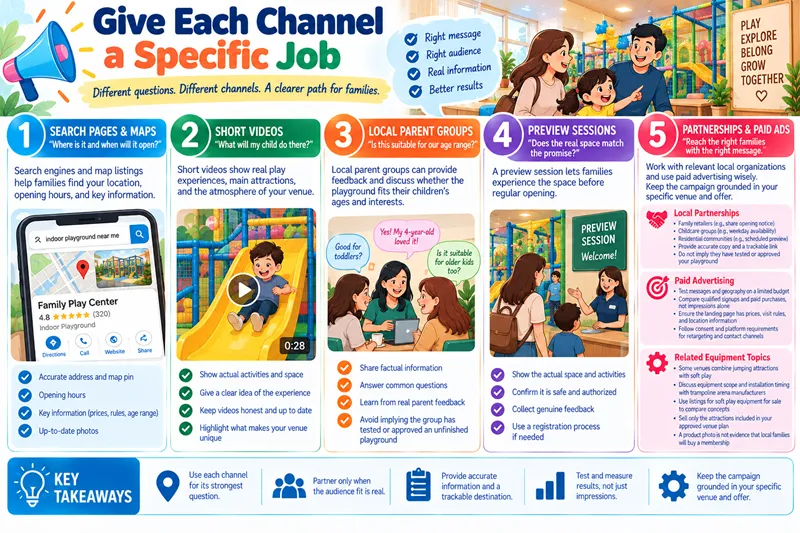
A free signup is an invitation to explain the offer, not permission to label the person a member. Send a short sequence that answers one objection at a time: the planned layout and ages, the membership terms, progress toward opening, how bookings will work, and the date when paid sales begin. Ask which question remains unanswered. Use that feedback to fix the page before expanding the audience.
Open paid sales only when the price, entitlement, payment confirmation, delayed-opening treatment, and support contact are ready. A real founder allocation can give the first buyers a defined benefit, such as a fixed price for a stated period or priority access to a limited preview. State the actual quantity and eligibility. When it sells out, stop calling the next release the same limited offer unless its terms truly match.
Consider a controlled preview for a small group of local families once the venue is ready for guests and the required checks are complete. Let staff rehearse check-in, footwear rules, supervision, cleaning between sessions, and the booking system. Collect honest feedback and correct problems before the main opening. A preview can build trust; it should not be used to conceal an unfinished or unavailable attraction.
Once a customer pays, send a receipt and a plain-language summary of benefits immediately. Keep a record of the child's or family's eligibility as appropriate, the activation rule, and any reservation made.
Use a Twelve-Week Runway as a Working Schedule
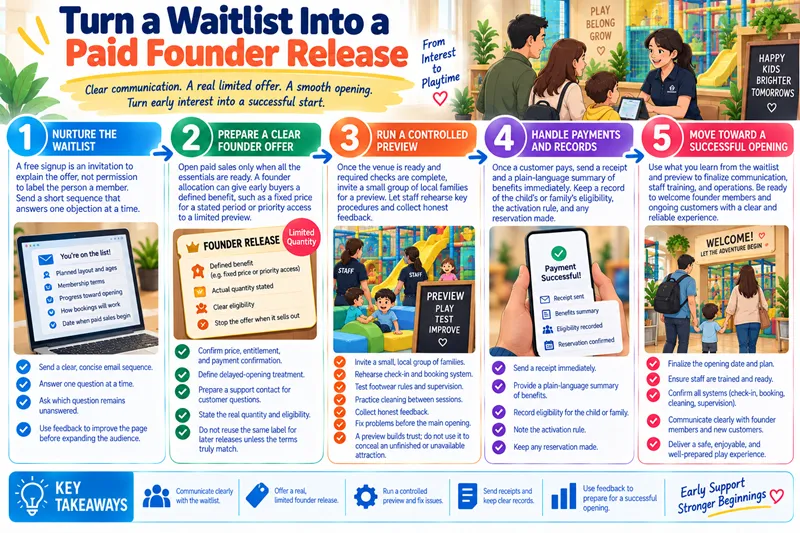
Twelve weeks is an illustrative planning window, not a required duration. Work backward from a realistic opening range and make each phase conditional on the build. In weeks 12 through 9, test the card economics, site capacity, and landing-page questions. Begin local partner conversations and collect a permission-based waitlist. Do not advertise a final opening day before the project can support it.
In weeks 8 through 5, publish accurate design views and construction updates, check which neighborhoods produce qualified leads, and interview families who do not sign up. Resolve questions about toddler access, weekend booking, and the founder price.
In weeks 4 through 2, if the venue and policies are sufficiently defined, release the paid offer to the waitlist and selected local channels. Review net paid cards daily, check support requests, and slow or pause sales if a capacity or opening-date assumption fails. In the final week, focus on confirmation, booking instructions, staff training, and the first-visit experience rather than a last-minute volume push.
YOMMI's guide to starting an indoor playground business covers broader venue preparation. This pre-sale schedule addresses one narrower decision: what to communicate, sell, and verify before the first admission. A shipping or installation milestone should trigger a campaign update, not an automatic claim that the venue is ready to open.
Report Net Paid Cards and the Cost of Each One
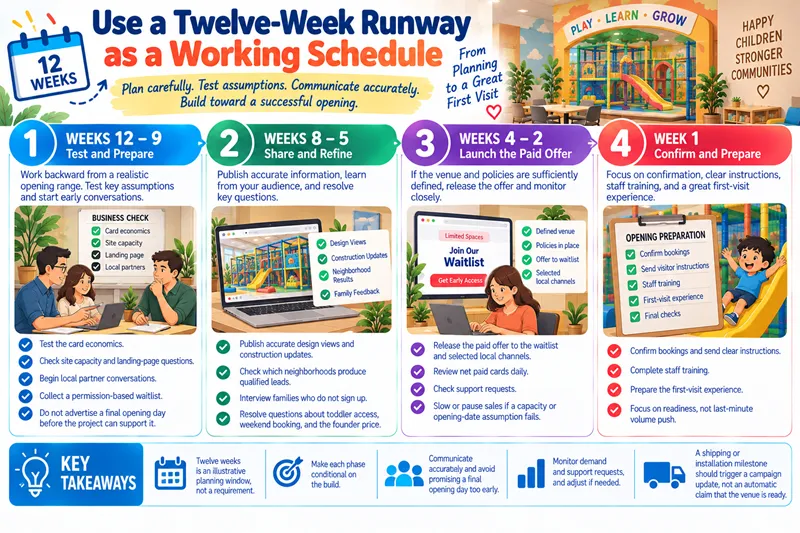
Use a simple dashboard with unique local leads, permission status, offer-page visits, checkout starts, gross paid cards, refunds, chargebacks, net active cards, and spend by channel. Reconcile the payment system with the membership database. Counting screenshots of “interested” comments or deposits as full memberships makes the 1,000-card goal meaningless.
The arithmetic should be transparent. If the campaign actually converts 20% of qualified leads to fully paid cards, reaching 1,000 gross sales would require 5,000 qualified leads before refunds. That 20% is an example for planning, not an industry benchmark. At 10%, the same target would need 10,000 leads. Test the real rate in your market, then recalculate the required reach and spending. A twelve-week average of about 84 net sales per week is a pacing check, not a prediction that every week performs equally.
Review why families leave the checkout. A price objection calls for a value or package review; an unclear opening date calls for a better schedule and refund explanation; a weekend booking objection calls for capacity planning. More ad spend does not repair those issues. Track the cost per net member and expected service obligation alongside cash received.
If the offer produces 300 appropriate prepaid families rather than 1,000, that may be a more usable opening base for a compact venue. The point is to learn whether demand and operations fit each other, not to claim a round number regardless of the evidence.
Make the First Visit Match the Pre-Sale Promise
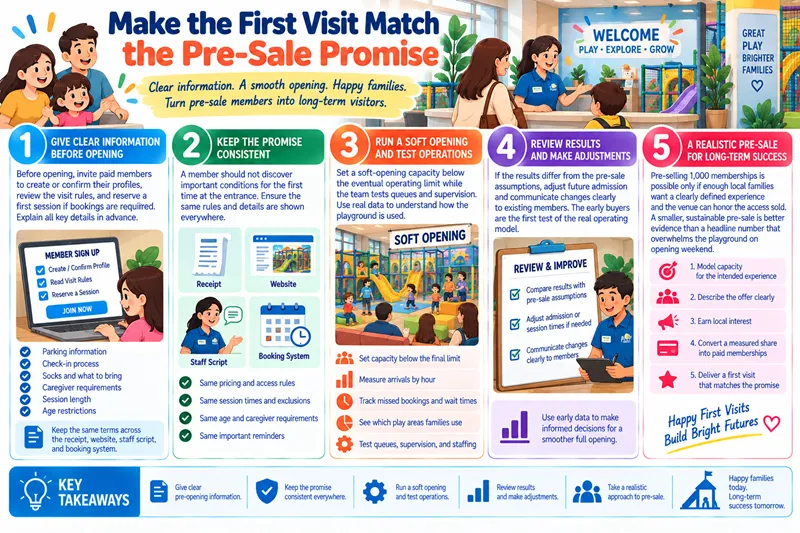
Before opening, invite paid members to create or confirm their profiles, review the visit rules, and reserve a first session if bookings are required. Explain parking, check-in, socks, caregiver requirements, session length, and any age restrictions. Keep the same terms across the receipt, website, staff script, and booking system. A member should not discover a weekend exclusion for the first time at the entrance.
Set a soft-opening capacity below the eventual operating limit while the team tests queues and supervision. Measure arrivals by hour, missed bookings, wait times, and the play areas families actually use. If the results differ from the pre-sale assumptions, adjust future admission and communicate changes clearly to existing members. The early buyers are the first test of the real operating model.
Pre-selling 1,000 memberships is possible only if enough local families want a clearly defined experience and the venue can honor the access sold. The practical sequence is to model capacity, describe the offer, earn local interest, convert a measured share into paid cards, and deliver a first visit that matches the promise. A smaller, sustainable pre-sale is better evidence than a headline number that overwhelms the playground on opening weekend.
FAQ
How early should an indoor playground start selling memberships?
Build awareness and a permission-based waitlist as soon as the location and concept are reliable enough to explain. Start taking payment only when the membership terms, price, opening assumptions, refund treatment, payment system, and customer support process are ready. A twelve-week marketing runway is a planning example, not a required schedule for every project. Construction, inspections, and staffing may change the launch date. It is better to collect interested families without charging them than to promise access the venue cannot provide. Keep each published opening estimate current as the build progresses.
How many leads are needed to pre-sell 1,000 membership cards?
There is no universal conversion rate. Divide the desired paid-card total by the measured share of qualified leads who buy. At a hypothetical 20% lead-to-paid rate, 1,000 gross sales require 5,000 qualified leads; at 10%, they require 10,000. Refunds and failed payments mean the number needed for 1,000 net active cards may be higher. Count unique nearby families who understand the offer, not all video views or contest entries. Test a small campaign first, calculate your own conversion rate, and update the forecast by channel and week.
Should founder memberships offer unlimited visits?
Only if the venue can consistently deliver that entitlement under realistic peak demand. Model how many member households may arrive in each time slot, how long they stay, and how many ordinary tickets or parties share the space. If capacity is tight, define a visit allowance, booking rule, weekday benefit, or peak-time restriction clearly before purchase. “Unlimited” with hidden blackout dates is likely to frustrate families. The offer should match the actual age zones, staffing, opening hours, and admission process. A simple, usable card is more valuable than an exciting promise that the entrance team must later deny.
Can 3D renderings be used to sell cards before installation?
Yes, as illustrations of a proposed venue, provided they are labeled accurately and updated when the design changes. A rendering helps parents understand theme, age zones, and approximate play flow. It does not prove that equipment has been installed, inspected, or opened. Pair it with the actual address, planned schedule, membership terms, and later dated construction photographs. Avoid implying that a supplier's other project is your finished space. If a promoted attraction is removed or delayed, tell existing buyers and revise the offer before taking more payments. Trust is part of the pre-sale product.
What if a playground cannot responsibly support 1,000 members?
Set a lower cap or redesign the entitlement before launching the paid campaign. A compact venue with concentrated weekend demand may struggle even if the total number of monthly visits looks manageable. Consider timed bookings, off-peak benefits, a limited number of family cards, or a smaller first release. Calculate the effect on staff, parties, ordinary admission, and the experience of existing members. Do not assume all members will arrive evenly. A target is useful only when it helps the operator make decisions; fewer cards with reliable access can support a stronger opening than a crowded, disappointing first month.