Stop believing those nonsensical online claims that opening an indoor playground in the UK is a shortcut to high-return, low-cost profits. That's not true. Operating an indoor playground in the UK is a demanding task requiring significant investment and strict adherence to regulations. You're facing Europe's stringent security screening system. If you buy cheap play area equipment for sale from a random trader and think you can simply open your doors, you will face financial ruin. The local council will shut you down, the insurance companies will refuse your application, and your investment will ultimately vanish on British soil.
I've been working in the indoor playground industry for a decade. I know why some playgrounds fail pre-opening audits and how to design a playground that can easily generate profits even on rainy days. If you want your UK playground project to truly survive and dominate the local market, you must strictly adhere to the following factory-level realities and precise data metrics. This isn't just theory; it's the blueprint we use to help our clients achieve sustained profitability.
The EN 1176 Red Line and The RoSPA Reality
In the UK, the absolute bottom line for safety and the law is the EN 1176 and EN 1177 standards. The fact is, if your equipment doesn't have certification proving its compliance with EN 1176, your pre-opening inspection will fail. If you fail the inspection, you will receive a mandatory rectification notice. In this industry, "rectification" usually means completely demolishing non-compliant structures and rebuilding from scratch. Serious violations will be immediately reported to local government agencies and insurance companies. In the UK, if you cannot obtain public liability insurance, you are operating illegally. Your doors will be permanently closed.
Now, let me expose a massive industry lie. No factory in the world can guarantee you a "100% RoSPA pass" just by handing you a printed certificate. Why? Because the final pass depends heavily on three unpredictable on-site factors:
The actual installation quality executed by the fitters.
The exact dimensional constraints of your venue.
The real-world physical deviations between the design software and the concrete floor.
However, a legitimate, standard-compliant factory mitigates this risk completely. We design the entire structural logic strictly according to EN 1176 from day one. We provide the mandatory TÜV or SGS test reports. If you buy from a regular factory with true EN 1176 credentials and execute the installation properly, you will pass this critical test. We provide the foundation; you secure the victory.
The Insurance Interrogation
UK Public Liability Insurance premiums are aggressive, and underwriters are looking for any single reason to deny your coverage. They do not just casually glance at your EN 1176 certificate and sign a policy. They heavily interrogate your operational and structural design. Before they insure your business, the insurance inspectors will rigorously check the following critical metrics:
•Maximum Free Fall Height: Is every single drop point strictly within the legal EN limits, backed by appropriate EN 1177 impact-absorbing flooring?
•Anti-Head Entrapment (Netting Hole Size): Are the mesh sizes on your safety nets specifically calculated and tightly woven so a child's head cannot possibly get stuck?
•CCTV Blind Spots: Do your security cameras cover every single square inch of the play frame? If a parent makes a false liability claim, you need absolute video proof to defend your business.
•Maintenance and RAMS: They will demand a look at your Risk Assessment and Method Statement (RAMS) and a rigid, documented daily maintenance record system.
If your equipment design fails even one of these points, you are uninsurable.
The 200-Day Rain Advantage: Toddler & SEN Zoning
It rains about 180 to 200 days a year in the UK. This weather can actually be your biggest business advantage – provided your site is well-planned and designed. Some amateurs just build a giant climbing frame for an 8-year-old and then wonder why their park is deserted on weekday mornings. To lock in stable weekday revenue while older kids are at school, you must follow this exact zoning ratio:
•The Toddler Zone (20%–30% of Total Area): I suggest you allocate about one-third of your playground area to toddlers. Toddlers are your primary source of income. If the toddler area is safe, clean, and separated from the more crowded children's areas, mothers will bring their toddlers to play every week.

•The SEN Zone (5%–10% of Total Area): Do not ignore Special Educational Needs (SEN). The UK market highly values inclusivity. By dedicating a specific percentage of your space to low-stimulation sensory rooms or inclusive play areas, you open massive revenue streams. This specific zoning brings in lucrative local school partnerships, government-funded group projects, and generates an incredibly high repurchase rate. Parents of SEN children are fiercely loyal to venues that respect their needs.
The 500㎡ Profit Blueprint: F&B and Party Rooms
British parents do not just drop their kids off to play; they come for the "social and consumption scene." If you treat your venue merely as a playground and ignore the adults, you are leaving your highest profit margins on the table. Let’s look at the strict financial blueprint for a standard 500-square-meter (approx. 5,300 sq.ft) UK venue. To maximise your Return on Investment (ROI), your space must be divided like this:
•The Cafe & Catering Area (15%–20% of Area): You must allocate up to 100 square meters strictly for high-quality seating and a premium cafe. British parents will stay for three hours if the coffee is good and the seating is comfortable. This zone alone must generate 30%+ of your total revenue.
•Premium Party Rooms (10%–15% of Area): Birthday parties are the absolute highest profit module in the building. Dedicate 50 to 75 square meters to highly themed party rooms. This relatively small space will generate 40%+ of your total revenue. You are selling a complete, stress-free social package to parents, allowing you to charge massive premium rates.
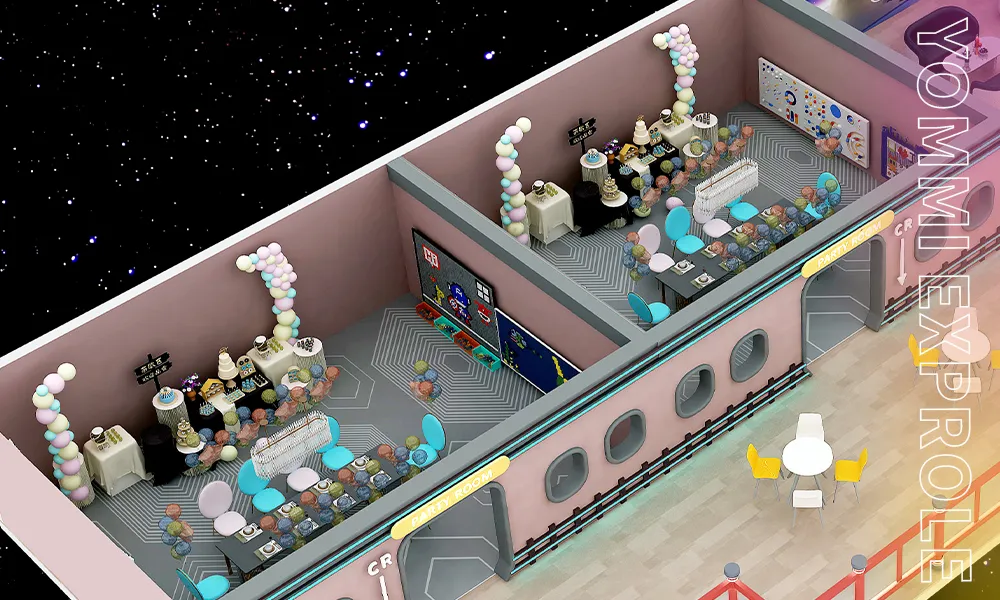
The play equipment is the magnet, but the cafe and the party rooms are your actual cash registers.
Defeating British Humidity: The Steel and Foam Reality
The UK climate is notoriously damp, humid, and wet. In the winter, if your warehouse heating drops overnight, heavy condensation builds up rapidly inside the building. If you buy cheap equipment from an unqualified supplier, the untreated steel pipes will rapidly rust from the inside out within months, leading to a catastrophic drop in structural strength. The cheap, unsealed foam will absorb the ambient moisture, grow mould, and ruin your venue's reputation.
As a premium source factory, we engineer our materials specifically to defeat this environment. We execute a rigorous double-treatment process on our main structures: Hot-dip galvanising combined with heavy powder coating. Furthermore, we utilise highly waterproof PVC leather and employ completely sealed structural designs to ensure moisture never penetrates the internal high-density foam. Your equipment must be chemically designed to outlast the British weather.
Installation and The Final Sign-Off
You cannot just hire a couple of local labourers to bolt your commercial frame together. In the UK, you need a professional Sign-off Certificate to legally open your doors and validate your insurance policy. Typically, this is handled by an independent UK inspector or a certified local engineer. If you use our factory installation team, our seasoned engineers can sign off on the assembly, verifying it strictly aligns with the EN 1176 standards we designed it for. However, you must understand the legal protocol: even if our factory engineers assemble it flawlessly, the structure still ultimately requires a local British inspector to review the site and sign the final approval document. We provide the complete technical dossier to ensure that the local inspector signs the paper without hesitation.
Slaughtering UK Middlemen: The Source Factory Advantage
There are dozens of "UK Play Equipment Manufacturers" ranking on Google. Let me expose the truth: the vast majority are just local trading companies. They buy from source factories in China, slap a British brand name on it, and mark up the price exponentially. Why should you bypass these local traders and partner directly with our experienced source factory? As a globally recognised indoor playground manufacturer, we offer four lethal advantages:
•Massive Cost Reduction: By cutting out the British middleman, you immediately save 30% to 50% on your equipment capital expenditure. That is cash you can keep in your bank for operational marketing and rent.
•Deep Customisation: Local UK traders generally offer the same generic, cookie-cutter themes to everyone because they buy in bulk. We are the factory. We provide deep, bespoke customisation so your brand visually dominates the local competition.
•True EN 1176 Mastery: Many British traders just read the sales brochures. We actually engineer the steel. We have a fundamentally deeper, technical understanding of EN 1176 compliance than the middlemen who just flip boxes.
•End-to-End Operational Support: We provide comprehensive support across the entire project lifecycle: Concept Design → Strict Compliance Engineering → Installation Guidance → Final Acceptance and Inspection Preparation.
If you want to conquer the UK indoor play market, you must control your costs and guarantee your compliance. Stop overpaying local traders. Partner with the factory that actually builds the foundation of your success.
Hardcore B2B FAQ
Q: Will your factory's EN 1176 certificate automatically guarantee that I pass the UK RoSPA or independent safety inspection?
No. No factory can guarantee a 100% pass automatically, because the final approval depends heavily on on-site execution.
My Experience: Factory certificates prove the engineering design is sound. However, the final acceptance result depends entirely on the installation quality, site dimensions, and any deviations that may exist on-site. I've seen customers purchase certified equipment but have it hastily installed by unprofessional local installers, resulting in failed acceptance. Reliable factories will provide drawings conforming to EN 1176 and TÜV/SGS reports as a benchmark, but you must ensure the installation perfectly matches the drawings for final acceptance.
Q: Can I save space by making the cafe smaller and fitting in a larger play structure to attract more children?
No. If you shrink your cafe area, you will destroy your most reliable and highest-margin daily revenue stream.
My Experience: Many amateurs assume that giant amusement park rides are profitable, but that's not the case. In the UK, playgrounds are social hubs for parents. In a 500-square-meter space, I recommend reserving space for a café and seating. If the seating is comfortable, parents will stay for hours, buying multiple high-profit coffees and lunches. If there are no seats, they'll leave after 45 minutes, taking your extra income with them.
Q: Can I skip adding a Special Educational Needs (SEN) zone to save budget and maximise general play space?
Only if you want to lose out on incredibly lucrative community loyalty, school partnerships, and government-funded group bookings.
My Experience: The UK market heavily prioritises and rewards inclusivity. By dedicating just 5%–10% of your space to an SEN area, you instantly differentiate yourself from generic competitors. Families with SEN children are fiercely loyal to venues that accommodate them properly. Furthermore, it opens the door to booking local special education schools during your completely dead weekday mornings, turning empty hours into stable, guaranteed profit.