Stop believing those who claim that opening a commercial indoor playground is as simple as signing a lease and printing out a business license. That is a dangerous and expensive lie. If you are operating in North America, Europe, or any highly regulated market, the answer to what permits are needed for an indoor playground is a brutal checklist built on strict building codes, fire safety regulations, and hefty fines. I have spent 10 years in the B2B cross-border manufacturing trenches. I have seen arrogant investors rent a massive warehouse, wire the deposit for equipment, and then watch their entire project permanently shut down by the city council before a single child walks through the door.
You are not building a playhouse; you are creating an "assembly occupancy." If you are unable to navigate this rigorous administrative process, you should proceed with extreme caution before embarking on this venture. What follows is the unvarnished truth from the factory floor—detailing the specific permits you actually need, the regulations that could land you in serious trouble, and the financial realities of opening for business legally.
The Zoning and Change of Use Trap
Most investors want to save money, so they seek out low-priced commercial real estate. They might stumble upon a large, vacant light-industrial warehouse or an abandoned storage facility and assume they can simply put it to immediate use. This is the first mistake you will make. You cannot simply install commercial indoor play area equipment inside an industrial building without further steps. You must apply for a "Change of Use" permit to rezone the building as a commercial indoor playground or a public assembly venue. Local authorities will treat your application as if it were an entirely new construction project. Consequently, you will immediately face three major challenges:
•Structural Load-Bearing Capacity: The building structure requires recertification; if it fails to pass, it must be redesigned to withstand the dynamic loads associated with high-density occupancy.
•Enhanced Fire Safety Standards: Light industrial buildings are equipped with basic fire safety facilities, whereas prefabricated buildings require more comprehensive fire protection systems.
•Zoning Restrictions: Due to traffic volume or noise regulations, municipal authorities may strictly prohibit the establishment of entertainment venues within specific industrial parks.
I once had a client who had signed a two-year lease and paid a 30% deposit for equipment; however, he neglected the three points mentioned above and was ultimately unable to open for business, bringing the entire project to a halt. Therefore, before signing a lease agreement, you must—and absolutely must—ensure that the necessary land zoning permits have been clearly approved.
Fire Safety and the Occupancy Cap
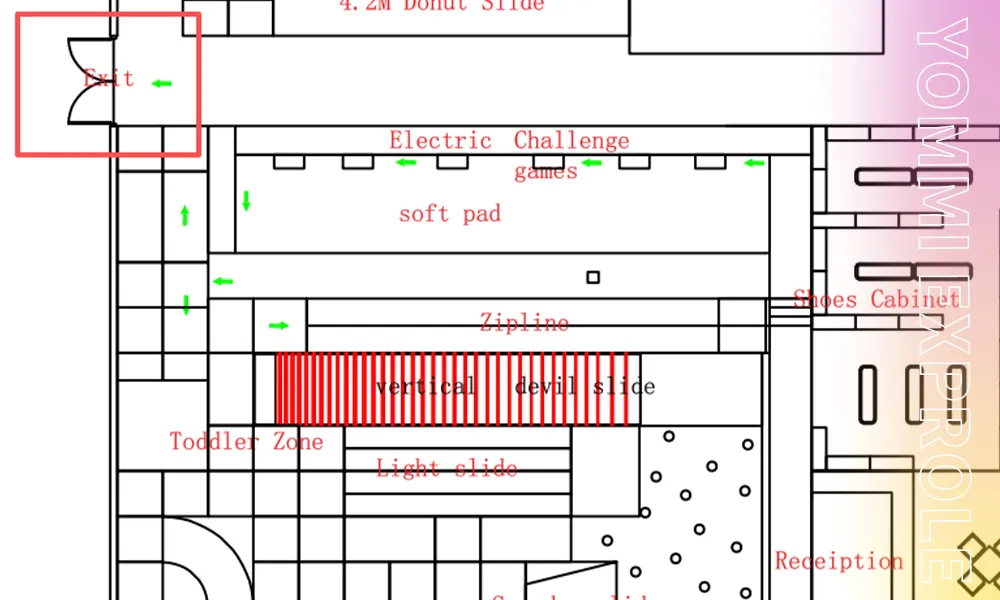
Fire inspectors do not care how beautiful your slide looks. They only care about crowd density and the physics of evacuation. When calculating your maximum legal occupancy capacity, the fire department takes into account your total floor area and specific functional zones. To pass the fire inspection, you must hit two non-negotiable metrics:
•Emergency Exits (Quantity): The number of exits must be sufficient to meet the maximum capacity requirements.
•Distance: There are strict limits regarding the actual distance a person must travel from the deepest part of the gaming area to the nearest fire exit.
If you make a calculation error in your design drawings, you have two options: either drastically reduce the size of the amusement ride to lower its capacity, or start demolishing concrete walls to construct new commercial emergency exits.
Equipment Compliance and the Insurance Guillotine
The government is responsible for inspecting buildings, while insurance companies are responsible for verifying the safety of materials. When applying for a business license and public liability insurance, you cannot simply submit an invoice from an unknown intermediary. Underwriters demand rigid, third-party technical documentation from your supplier. If you are importing high-end commercial indoor play area equipment, you must provide:
•ASTM Compliance Certificates: Specifically ASTM F1918 (for soft contained play) or F2970 (for trampoline parks). For European projects, EN 1176 is mandatory.
•Third-Party Lab Reports: Official testing documents from globally recognised labs like TÜV Rheinland or SGS.
If you purchase equipment that is non-compliant and lacks these specific documents, the following scenarios may arise: the insurance company may either outright reject your application, or reduce your coverage limits while increasing your premiums; in the worst-case scenario—should an accident occur—the insurer may completely deny your claim, leaving you personally liable for all compensation costs.
The Plumbing Math: The Hidden Restroom Code
Your legal maximum building capacity is directly chained to your plumbing code (such as the IBC in the United States). You must calculate the male-to-female toilet ratio based on your exact occupancy number. For example, if your legal capacity is 100 people, the building code might require 2 to 3 commercial toilets. If your capacity scales up to 300 people, you might suddenly need 6 to 10 toilets.
If you are renting an old warehouse equipped with only two rudimentary restrooms, your building permit application will be rejected immediately. You will need to hire a professional contractor to trench into the concrete foundation, install new heavy-duty drainage piping, and construct commercial-grade restrooms that fully comply with all applicable codes.
The Commercial Kitchen Nightmare
The true source of profit actually lies in secondary purchases. Every investor aims to generate earnings by selling high-margin food items. However, once you decide to sell hot food—such as fried chicken or baked pizza—you must comply with the commercial kitchen regulations set forth by the health department.
You must understand that a basic food handling permit is not sufficient; you are required to obtain a hot food service permit. You will need to install an underground grease trap and a commercial-grade exhaust hood system to prevent sewer blockages and facilitate ventilation through the roof. Finally, you must also install a fire suppression system above the kitchen area.
If you haven't allocated a budget for these commercial kitchen permits and infrastructure requirements, I suggest you put your food sales strategy on hold.
ADA and Strict Accessibility Laws
In many global markets, laws regarding accessibility for people with disabilities are strictly enforced. Your building permit will not be approved if your facility discriminates against individuals with disabilities.
Municipal engineering departments will conduct measurements of your facility. Your main corridors and wheelchair access routes must comply with strict width requirements. The gradient of entrance ramps must be calculated with precision. Your reception and checkout counters must feature lower sections designed to accommodate wheelchair heights. You are required to provide restrooms that fully comply with the standards set forth by the National Disability Acts. If you disregard these permitting requirements, you will fail the final municipal inspection, and your business will face the risk of malicious lawsuits stemming from accessibility issues.
Staff Clearances and Criminal Liability
Given that you operate an indoor children's playground, your legal obligations extend far beyond the physical structure of the building itself. To maintain your business license, you are legally required to subject all employees to rigorous background checks.
Before you can lawfully hire anyone to work at your facility, you must conduct comprehensive criminal background investigations, perform specific checks for records of child abuse, and—in many jurisdictions—also obtain official fingerprint records. This constitutes the absolute legal minimum requirement. If, in your haste to open for business, you bypass this critical step and an employee subsequently commits a crime on your premises, you will face consequences far more severe than mere civil litigation; you will be held directly and personally criminally liable for operational negligence.
The Source Factory Solution: Engineering Your Approvals
When the city council pushes back on your permit applications, a local middleman who just flips equipment cannot help you. They do not have the engineering data. This is why serious investors partner with top-tier indoor play manufacturers like us. We do not just sell steel and PVC. We sell an "Openable Solution." When the city demands technical proof, we immediately provide the lethal documentation you need to clear the bureaucracy:
•Precision 3D Layouts and Floor Plans: We provide engineered drawings that explicitly map out emergency escape distances, traffic flow paths, and mathematical capacity calculations to satisfy the Fire Marshal.
•Complete Material Compliance Dossiers: We hand you the TÜV/SGS test reports and fire-retardant certificates required to secure your public liability insurance instantly.
Comprehensive Operations Manuals: We supply the official installation and maintenance manuals that local inspectors demand to see before signing your final Certificate of Occupancy.
•Securing permits is a war of attrition against bureaucracy. Stop relying on luck and amateur advice. Partner with a source factory that arms you with the exact engineering data you need to legally open your doors and start generating revenue.
Hardcore B2B FAQ
Q: Can I skip the expensive "Change of Use" permit if I just quietly install the equipment inside an existing industrial warehouse?
No. Operating without a legal Change of Use permit will lead to immediate forced closure and potential financial ruin.
My Experience: I have personally witnessed clients of mine attempt to hide their indoor playground businesses inside cheap warehouses in an effort to bypass the approval process. However, this simply does not work. The moment you open your doors to the public, the fire marshal or municipal inspectors will show up for an inspection. When they discover a high-occupancy assembly venue situated within a light industrial zone, they will immediately padlock your doors. You will end up forfeiting your rent and equipment deposits, as the city authorities will not permit you to operate illegally.
Q: If I only have two small bathrooms in my rented building, can I still legally operate a 300-person capacity play centre?
No. Your maximum legal occupancy is strictly dictated by plumbing codes, and two bathrooms cannot legally support 300 people.
My Experience: Many investors frequently overlook plumbing codes. In the United States, the International Building Code strictly mandates restroom ratios based on occupancy capacity. For a facility accommodating 300 people, anywhere from 6 to 10 commercial-grade restrooms may be required. If a building permit application lists only two restrooms, there is a high probability that it will be summarily rejected.
Q: If I buy equipment without ASTM or EN certificates, can I just ask a local engineer to sign off on the safety for the insurance company?
No. A local engineer cannot magically certify the structural integrity and material flammability of undocumented equipment.
My Experience: Prior to providing a guarantee, local engineers will require the factory to furnish relevant certificates. If you purchase inexpensive, uncertified equipment, you will be unable to provide these documents. The engineers will terminate their cooperation, and the insurance company will outright refuse to process any claims; without insurance, you will be unable to operate legally. You must purchase equipment from factories capable of providing TÜV, SGS, and ASTM certification documents in advance.